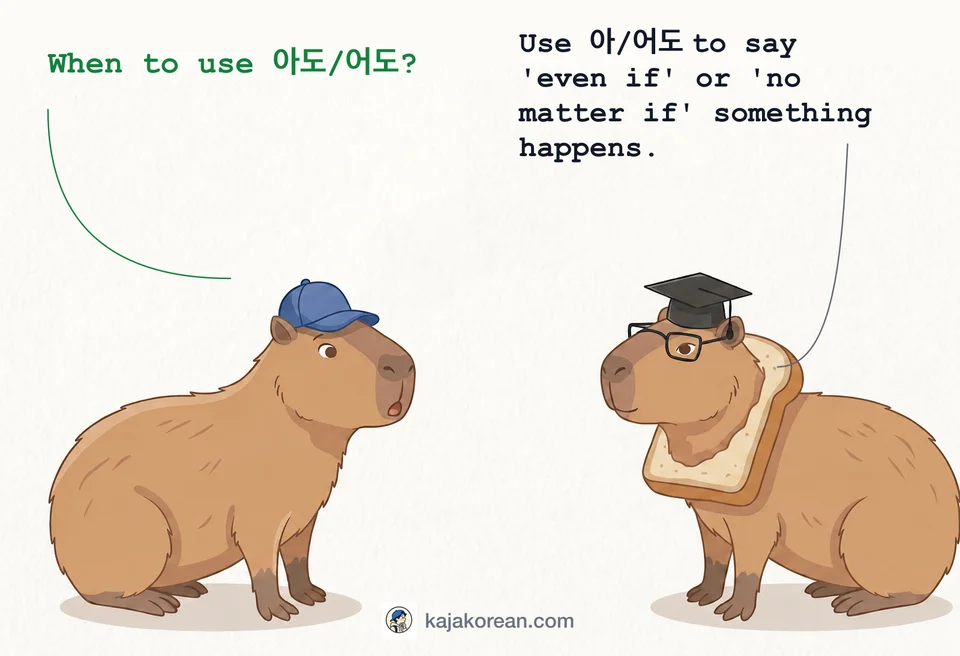
How to use 아도/어도 in Korean

Pattern: -(아/어)도

-(아/어)도 (-(a, (a, eo)do)

-(아/어)도 means 'even if ~' expressing concession or no change in result despite an action.

Korean grammar pattern 아/어도 meaning even if

Usage guide

When and how native speakers actually use it.

-(아/어)도(-(a, (a, eo)do)

‘~해도’ means that the result or state does not change even if a certain condition or action occurs.

When to use

Concession expression, Conditional statement, Emphasizing no change in result

The nuance

Attach ‘-아도’ or ‘-어도’ to the verb stem depending on vowel harmony: use ‘아도’ if the last vowel is ㅏ or ㅗ, otherwise ‘어도’. 하다 becomes ‘해도’. It expresses concession meaning ‘even if ~’ or ‘it’s okay even if ~.’

Real-world examples

  • 비가 와도 학교에 갑니다.

    bi-ga wa-do hak-gyo-e gap-ni-da., bi ga wa do hak gyo e gap ni da.

    The verb stem ‘와’ from ‘오다’ plus ‘-도’ forms ‘와도,’ correctly expressing ‘even if it rains.’

  • 밥을 먹아도 배가 고파요.

    bap-eul meok-a-do bae-ga go-pa-yo., bap eul meok a do bae ga go pa yo.

    The verb stem ‘먹’ plus ‘-어도’ forms ‘먹어도,’ a natural expression.

  • 공부해도 시험을 못 봐요.

    gong-bu-hae-do si-heom-eul mos bwa-yo., gong bu hae do si heom eul mos bwa yo.

    ‘하다’ changes to ‘해도,’ so ‘공부해도’ is correct.

  • 친구가 와도 나는 안 갈 거예요.

    chin-gu-ga wa-do na-neun an gal geo-ye-yo., chin gu ga wa do na neun an gal geo ye yo.

    ‘와도’ correctly formed from ‘오다’ stem plus ‘-도’.

  • 책을 읽아도 이해가 안 돼요.

    chaek-eul ik-a-do i-hae-ga an dwae-yo., chaek eul ik a do i hae ga an dwae yo.

    The correct form is ‘읽어도,’ not ‘읽아도.’

  • 운동해도 피곤하지 않아요.

    un-dong-hae-do pi-gon-ha-ji an-a-yo., un dong hae do pi gon ha ji an a yo.

    ‘하다’ becomes ‘해도,’ making it correct.

  • 노래를 불어도 잘 못해요.

    no-rae-reul bul-eo-do jal mos-hae-yo., no rae reul bul eo do jal mos hae yo.

    ‘노래하다’ conjugates as ‘노래해도,’ not ‘불어도.’

  • 늦게 자도 아침에 일찍 일어나요.

    neuj-ge ja-do a-chim-e il-jjik il-eo-na-yo., neuj ge ja do a chim e il jjik il eo na yo.

    ‘자도’ correctly formed from ‘자다’ stem plus ‘-도.’

Quick quiz

  1. Which sentence uses ‘-(아/어)도’ correctly?

    다음 중 ‘-(아/어)도’가 올바르게 사용된 문장은?(da-eumjung‘-(a, daeumjung‘(a, eo)do’gaol-ba-reu-gesa-yong-doenmun-jang-eun?, eo)do’gaolbareugesayongdoenmunjangeun?)
  2. What is the correct form of ‘-(아/어)도’ with the verb ‘하다’?

    ‘하다’ 동사에 ‘-(아/어)도’를 붙이면?(‘ha-da’dong-sa-e‘-(a, ‘hada’dongsae‘(a, eo)do’reulbut-i-myeon?, eo)do’reulbutimyeon?)
  3. Which sentence is incorrect?

    다음 중 틀린 문장은?(da-eumjungteul-rinmun-jang-eun?, daeumjungteulrinmunjangeun?)

More usage guides

View all usage guides →