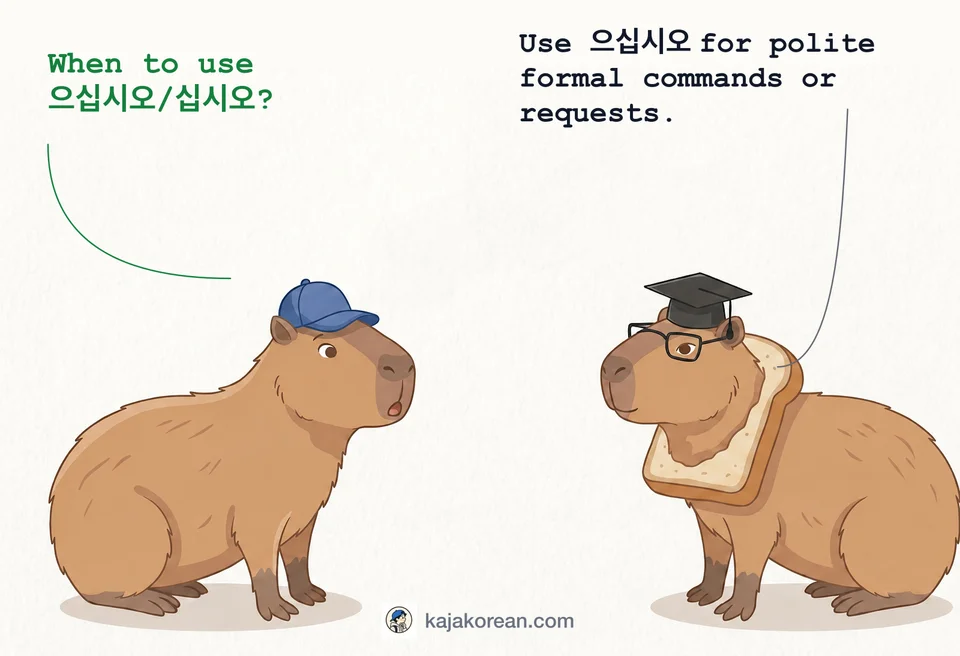
How to use 으십시오/십시오 in Korean

Pattern: -(으)십시오

-(으)십시오 (-(eu)sip-si-o, (eu)sipsio)

-(으)십시오 is a polite imperative ending used to give commands or requests respectfully.

Polite formal command ending 으십시오

Usage guide

When and how native speakers actually use it.

-(으)십시오(-(eu)sip-si-o, (eu)sipsio)

A polite sentence ending to express commands or requests

When to use

Formal occasions, Business situations, Giving commands to superiors

The nuance

Attach '-으십시오' if the verb stem ends with a consonant, '-십시오' if it ends with a vowel. Used in formal, polite commands or requests.

Real-world examples

  • 문을 닫으십시오.

    mun-eul dat-eu-sip-si-o., mun eul dat eu sip si o.

    The verb stem '닫-' ends with a consonant, so '-으십시오' is used for polite command.

  • 여기에 이름을 쓰십시오.

    yeo-gi-e i-reum-eul sseu-sip-si-o., yeo gi e i reum eul sseu sip si o.

    The verb stem '쓰-' ends with a vowel, so '-십시오' is used for polite command.

  • 조용히 하십시오.

    jo-yong-hi ha-sip-si-o., jo yong hi ha sip si o.

    The verb stem '하-' ends with a vowel, so '-십시오' is used for polite command.

  • 앉으십시오.

    an-eu-sip-si-o., an eu sip si o.

    The verb stem '앉-' ends with a consonant, so '-으십시오' is used for polite command.

  • 먹으십시오.

    meok-eu-sip-si-o., meok eu sip si o.

    The verb stem '먹-' ends with a consonant, so '-으십시오' is used for polite command.

  • 가십시오.

    ga-sip-si-o., ga sip si o.

    The verb stem '가-' ends with a vowel, so '-십시오' is used for polite command.

  • 달리십시오.

    dal-ri-sip-si-o., dal ri sip si o.

    The verb stem '달리-' ends with a vowel, so '-십시오' is used for polite command.

  • 읽으십시오.

    ik-eu-sip-si-o., ik eu sip si o.

    The verb stem '읽-' ends with a consonant, so '-으십시오' is used for polite command.

Quick quiz

  1. Which sentence correctly uses -(으)십시오?

    다음 중 '-(으)십시오'가 올바르게 사용된 문장은?(da-eumjung'-(eu)sip-si-o'gaol-ba-reu-gesa-yong-doenmun-jang-eun?, daeumjung'(eu)sipsio'gaolbareugesayongdoenmunjangeun?)
  2. If the verb stem ends with a vowel, which ending do you attach?

    동사 어간이 받침이 없으면 어떤 어미를 붙이나요?(dong-saeo-gan-ibat-chim-ieop-eu-myeoneo-tteoneo-mi-reulbut-i-na-yo?, dongsaeoganibatchimieopeumyeoneotteoneomireulbutinayo?)
  3. In which situation is it appropriate to use -(으)십시오?

    다음 중 '-(으)십시오'를 사용하기 적절한 상황은?(da-eumjung'-(eu)sip-si-o'reulsa-yong-ha-gijeok-jeol-hansang-hwang-eun?, daeumjung'(eu)sipsio'reulsayonghagijeokjeolhansanghwangeun?)

More usage guides

View all usage guides →