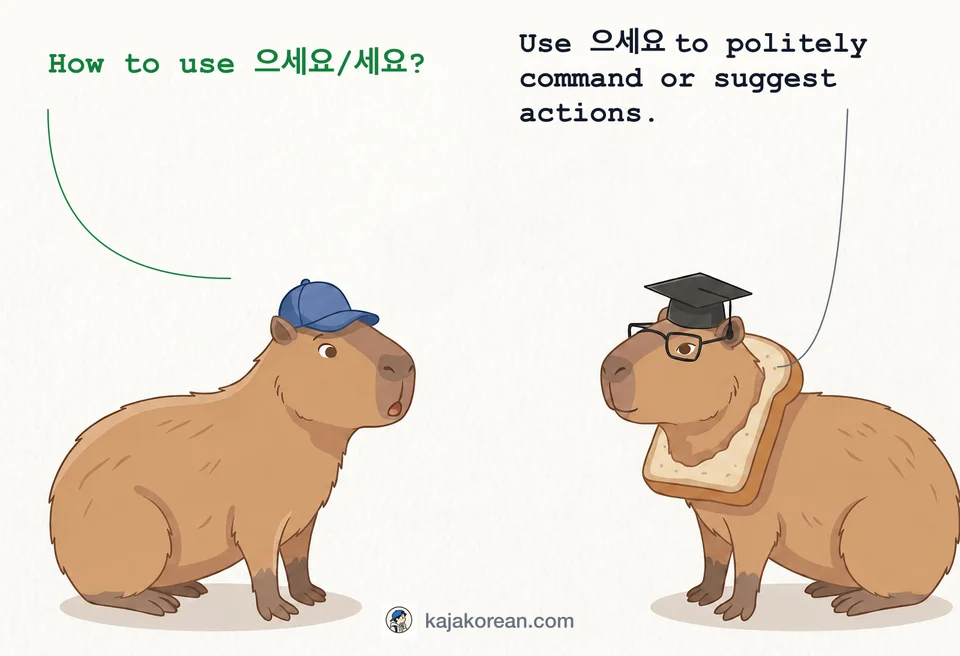
How to use 으세요/세요 in Korean

Pattern: -(으)세요

-(으)세요 (-(eu)se-yo, (eu)seyo)

-(으)세요 is used to make polite commands and suggestions in Korean.

Korean polite command and suggestion ending 으세요

Usage guide

When and how native speakers actually use it.

-(으)세요(-(eu)se-yo, (eu)seyo)

A polite verb ending used for commands and suggestions

When to use

Workplace commands, Inviting friends, Service situations, Family requests

The nuance

Attach '-으세요' if the verb stem ends with a consonant, '-세요' if it ends with a vowel. Used for polite commands and suggestions to make requests or invitations respectfully.

Real-world examples

  • 문을 닫으세요.

    mun-eul dat-eu-se-yo., mun eul dat eu se yo.

    The verb '닫다' ends with a consonant, so '-으세요' is attached to form a polite command.

  • 앉으세요.

    an-eu-se-yo., an eu se yo.

    '앉다' ends with a consonant, so '-으세요' is used for polite command.

  • 가세요.

    ga-se-yo., ga se yo.

    '가다' ends with a vowel, so '-세요' is attached for polite command.

  • 먹으세요.

    meok-eu-se-yo., meok eu se yo.

    '먹다' ends with a consonant, so '-으세요' is used for polite command or suggestion.

  • 공부하세요.

    gong-bu-ha-se-yo., gong bu ha se yo.

    '공부하다' ends with a vowel, so '-세요' is attached for polite command.

  • 읽으세요.

    ik-eu-se-yo., ik eu se yo.

    '읽다' ends with a consonant, so '-으세요' is used for polite command.

  • 일어나세요.

    il-eo-na-se-yo., il eo na se yo.

    '일어나다' ends with a vowel, so '-세요' is attached for polite command.

  • 공원에 가으세요.

    gong-won-e ga-eu-se-yo., gong won e ga eu se yo.

    '가으세요' is incorrect because '가다' ends with a vowel; only '-세요' should be attached.

Quick quiz

  1. Which is the correct command form?

    다음 중 올바른 명령형은?(da-eumjungol-ba-reunmyeong-ryeong-hyeong-eun?, daeumjungolbareunmyeongryeonghyeongeun?)
  2. What is the polite command form of '가다'?

    '가다'의 공손한 명령형은?('ga-da'uigong-son-hanmyeong-ryeong-hyeong-eun?, 'gada'uigongsonhanmyeongryeonghyeongeun?)
  3. Which sentence is incorrect?

    다음 중 틀린 문장은?(da-eumjungteul-rinmun-jang-eun?, daeumjungteulrinmunjangeun?)

More usage guides

View all usage guides →