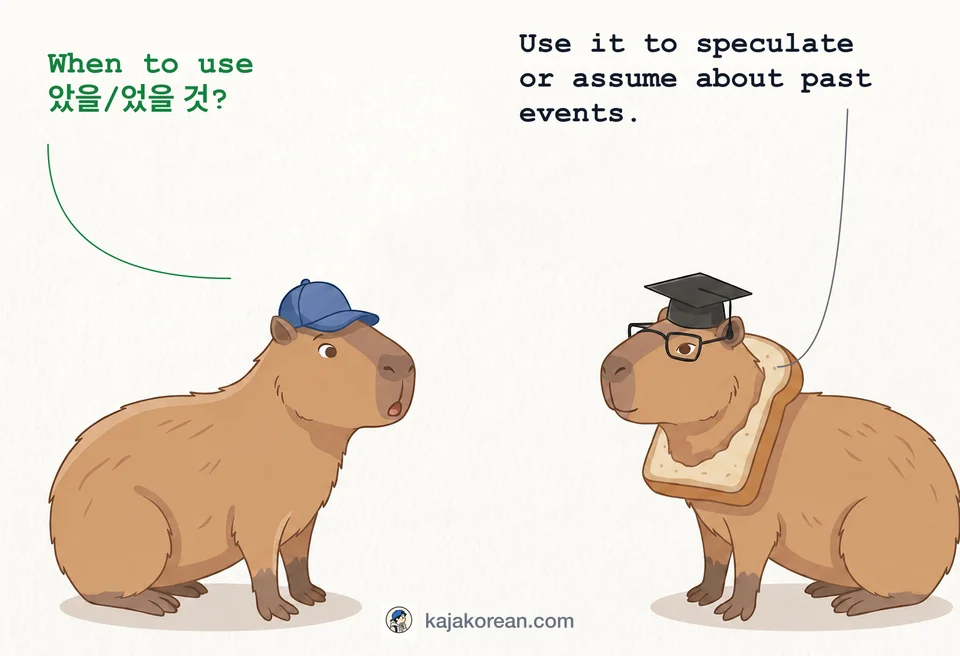
How to use 았을/었을 것 in Korean

Pattern: -(았/었)을 것

-(았/었)을 것 (-(ass, (ass, eoss)eulgeos)

-(았/었)을 것 expresses past speculation, assumption, or uncertainty about past facts.

Past speculation in Korean using -(았/었)을 것

Usage guide

When and how native speakers actually use it.

-(았/었)을 것(-(ass, (ass, eoss)eulgeos)

To speculate or assume that something happened in the past

When to use

Speculating about past events, Expressing uncertainty about past facts, Predicting past situations

The nuance

Attach -(았/었)을 것 to the past stem of verbs or adjectives to express speculation or assumption about past events. It means 'must have done' or 'probably did'. In conversation, '-았/었을 거예요' is common. It can also be used in negative sentences. For example, 갔을 것이다 = 갔었을 것, 가지 않았을 것이다 = 가지 않았었을 것.

Real-world examples

  • 그는 어제 집에 갔었을 것이다.

    geu-neun eo-je jip-e gass-eoss-eul geos-i-da., geu neun eo je jip e gass eoss eul geos i da.

    Attaches '-었을 것' to past stem '갔-' to express past speculation.

  • 비가 왔었을 것 같아요.

    bi-ga wass-eoss-eul geos gat-a-yo., bi ga wass eoss eul geos gat a yo.

    Uses past stem '왔-' plus '-었을 것' to indicate past speculation.

  • 그 사람은 지금 집에 있을 것이야.

    geu sa-ram-eun ji-geum jip-e iss-eul geos-i-ya., geu sa ram eun ji geum jip e iss eul geos i ya.

    -(았/었)을 것 is only for past speculation; current speculation uses '-(으)ㄹ 것'.

  • 어제 시험이 어려웠었을 것이다.

    eo-je si-heom-i eo-ryeo-woss-eoss-eul geos-i-da., eo je si heom i eo ryeo woss eoss eul geos i da.

    Attaches '-었을 것' to past stem '어려웠-' of adjective to express past speculation.

  • 나는 그 영화를 봤었을 것이다.

    na-neun geu yeong-hwa-reul bwass-eoss-eul geos-i-da., na neun geu yeong hwa reul bwass eoss eul geos i da.

    Uses past stem '봤-' plus '-었을 것' to indicate past speculation.

  • 그가 오지 않았었을 것이다.

    geu-ga o-ji an-ass-eoss-eul geos-i-da., geu ga o ji an ass eoss eul geos i da.

    Negative past speculation uses '-지 않았었을 것'.

Quick quiz

  1. Which sentence correctly expresses past speculation?

    다음 중 과거 추측 표현으로 맞는 문장은?(da-eumjunggwa-geochu-cheukpyo-hyeon-eu-romaj-neunmun-jang-eun?, daeumjunggwageochucheukpyohyeoneuromajneunmunjangeun?)
  2. What is the correct meaning of -(았/었)을 것?

    -(았/었)을 것의 의미로 알맞은 것은?(-(ass, (ass, eoss)eulgeos-uiui-mi-roal-maj-eungeos-eun?, eoss)eulgeosuiuimiroalmajeungeoseun?)
  3. Which sentence is incorrect?

    다음 문장 중 틀린 문장은?(da-eummun-jangjungteul-rinmun-jang-eun?, daeummunjangjungteulrinmunjangeun?)

More usage guides

View all usage guides →