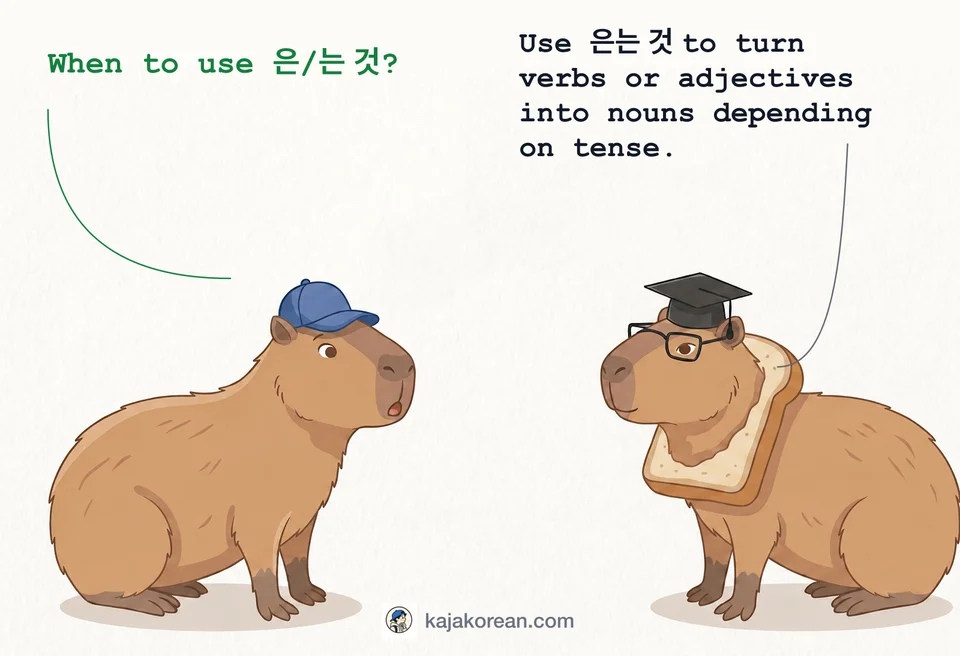
How to use 은/는 것 in Korean

Pattern: -(으)ㄴ/는 것

-(으)ㄴ/는 것 (-(eu)ㄴ, (eu)ㄴ, neungeos)

-(으)ㄴ/는 것 turns verbs or adjectives into nouns. It's common in daily conversation and writing.

Explanation of Korean grammar -(으)ㄴ/는 것

Usage guide

When and how native speakers actually use it.

-(으)ㄴ/는 것(-(eu)ㄴ, (eu)ㄴ, neungeos)

A grammatical form that nominalizes verbs or adjectives

When to use

Explaining, Expressing thoughts, Giving opinions

The nuance

Use -(으)ㄴ 것 after past tense verbs and adjectives to nominalize them. Use -는 것 for present tense or ongoing actions. For future or habitual actions, -는 것 is also used. The nominalized phrase can function as subject, object, or complement in a sentence.

Real-world examples

  • 내가 어제 만든 음식이 맛있었어.

    nae-ga eo-je man-deun eum-sik-i mas-iss-eoss-eo., nae ga eo je man deun eum sik i mas iss eoss eo.

    '만들다' is past tense verb, so -(으)ㄴ 것 ('만든') nominalizes it as subject.

  • 나는 지금 하는 일이 중요해.

    na-neun ji-geum ha-neun il-i jung-yo-hae., na neun ji geum ha neun il i jung yo hae.

    '하다' in present progressive takes -는 것 ('하는') to nominalize as subject.

  • 내일 갈 것에 대해 이야기하자.

    nae-il gal geos-e dae-hae i-ya-gi-ha-ja., nae il gal geos e dae hae i ya gi ha ja.

    Future verb '가다' uses -는 것 ('갈') to nominalize as object.

  • 그 사람이 친절한 것을 좋아해.

    geu sa-ram-i chin-jeol-han geos-eul joh-a-hae., geu sa ram i chin jeol han geos eul joh a hae.

    Adjective '친절하다' nominalized with -(으)ㄴ 것 ('친절한') as object.

  • 책 읽는 것을 좋아해요.

    chaek ik-neun geos-eul joh-a-hae-yo., chaek ik neun geos eul joh a hae yo.

    Present tense verb '읽다' nominalized with -는 것 ('읽는') as object.

  • 운동한 것이 건강에 좋아요.

    un-dong-han geos-i geon-gang-e joh-a-yo., un dong han geos i geon gang e joh a yo.

    Past verb '운동하다' nominalized with -(으)ㄴ 것 ('운동한') as subject.

  • 나는 공부하는 것을 멈추지 않을 거야.

    na-neun gong-bu-ha-neun geos-eul meom-chu-ji an-eul geo-ya., na neun gong bu ha neun geos eul meom chu ji an eul geo ya.

    Present progressive verb '공부하다' nominalized with -는 것 ('공부하는') as object.

  • 그가 만든 것은 정말 훌륭해.

    geu-ga man-deun geos-eun jeong-mal hul-ryung-hae., geu ga man deun geos eun jeong mal hul ryung hae.

    Past verb '만들다' nominalized with -(으)ㄴ 것 ('만든') as subject.

Quick quiz

  1. Which nominalizer fits a present progressive verb?

    다음 중 현재 진행형 동사에 맞는 명사형은?(da-eumjunghyeon-jaejin-haeng-hyeongdong-sa-emaj-neunmyeong-sa-hyeong-eun?, daeumjunghyeonjaejinhaenghyeongdongsaemajneunmyeongsahyeongeun?)
  2. What is the correct nominalized form of the adjective '예쁘다'?

    형용사 '예쁘다'를 명사화할 때 올바른 형태는?(hyeong-yong-sa'ye-ppeu-da'reulmyeong-sa-hwa-halttaeol-ba-reunhyeong-tae-neun?, hyeongyongsa'yeppeuda'reulmyeongsahwahalttaeolbareunhyeongtaeneun?)
  3. Correct nominalized form of past verb '먹다'?

    과거 동사 '먹다'를 명사화한 올바른 표현은?(gwa-geodong-sa'meok-da'reulmyeong-sa-hwa-hanol-ba-reunpyo-hyeon-eun?, gwageodongsa'meokda'reulmyeongsahwahanolbareunpyohyeoneun?)

More usage guides

View all usage guides →