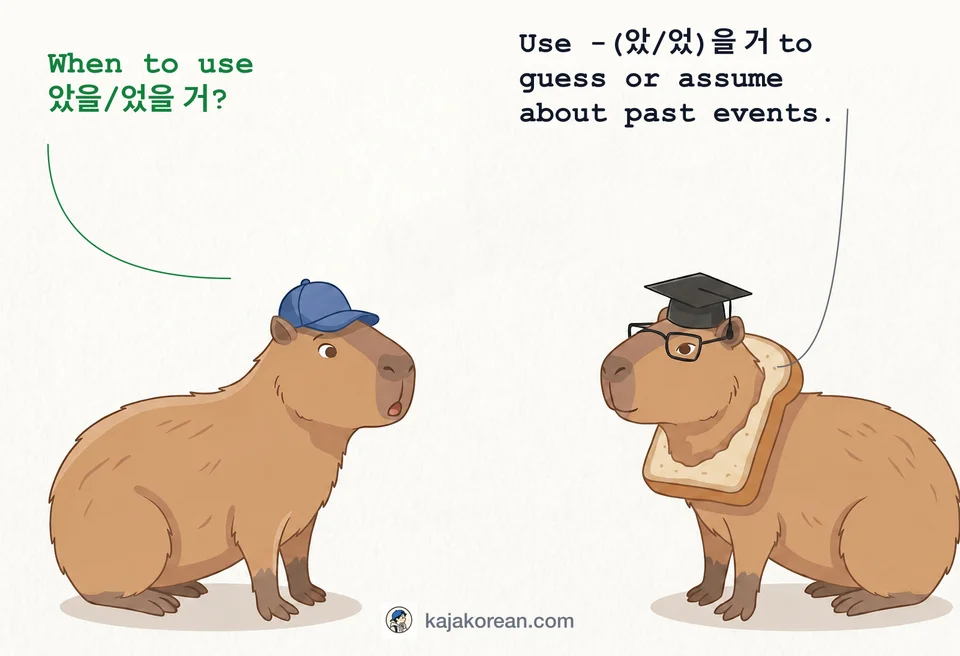
How to use 았을/었을 거 in Korean

Pattern: -(았/었)을 거

-(았/었)을 거 (-(ass, (ass, eoss)eulgeo)

-(았/었)을 거 expresses past assumptions or guesses in Korean.

Explanation of how to use -(았/었)을 거 in Korean

Usage guide

When and how native speakers actually use it.

-(았/었)을 거(-(ass, (ass, eoss)eulgeo)

Used to express assumptions or guesses about past events.

When to use

guessing past events, responding to others' statements, explaining past situations

The nuance

Attach -(았/었)을 거 to the past stem of verbs or adjectives to express assumptions about past events. It is mainly used when guessing that something probably happened based on context or someone’s statement.

Real-world examples

  • 어제 비가 많이 왔을 거예요.

    eo-je bi-ga man-i wass-eul geo-ye-yo., eo je bi ga man i wass eul geo ye yo.

    Correctly expresses a guess about heavy rain in the past.

  • 그 사람은 벌써 집에 갔을 거야.

    geu sa-ram-eun beol-sseo jip-e gass-eul geo-ya., geu sa ram eun beol sseo jip e gass eul geo ya.

    Naturally expresses assumption that the person went home in the past.

  • 나는 그 영화를 봤을 거야.

    na-neun geu yeong-hwa-reul bwass-eul geo-ya., na neun geu yeong hwa reul bwass eul geo ya.

    Appropriate for speaker’s own past assumption.

  • 어제 친구가 왔을 거 아니야?

    eo-je chin-gu-ga wass-eul geo a-ni-ya?, eo je chin gu ga wass eul geo a ni ya?

    Natural question form expressing past guess.

  • 나는 그 일을 할 거야.

    na-neun geu il-eul hal geo-ya., na neun geu il eul hal geo ya.

    -(았/었)을 거 cannot be used for future tense.

  • 그는 지금 집에 갔을 거예요.

    geu-neun ji-geum jip-e gass-eul geo-ye-yo., geu neun ji geum jip e gass eul geo ye yo.

    ‘Now’ conflicts with past assumption, making sentence unnatural.

Quick quiz

  1. Which sentence expresses a past assumption?

    다음 중 과거 추측을 표현한 문장은?(da-eumjunggwa-geochu-cheuk-eulpyo-hyeon-hanmun-jang-eun?, daeumjunggwageochucheukeulpyohyeonhanmunjangeun?)
  2. What is the correct use of -(았/었)을 거?

    "-(았/었)을 거"의 올바른 사용법은?("-(ass, "(ass, eoss)eulgeo"uiol-ba-reunsa-yong-beop-eun?, eoss)eulgeo"uiolbareunsayongbeopeun?)
  3. Which sentence is incorrect?

    다음 중 틀린 문장은?(da-eumjungteul-rinmun-jang-eun?, daeumjungteulrinmunjangeun?)

More usage guides

View all usage guides →