
topik upgrade · topik, verbs, daily
Everyday actions: TOPIK I → II in Korean
Want to sound more advanced in Korean? Upgrade your everyday verbs! 🔴 하다 [hada] - do
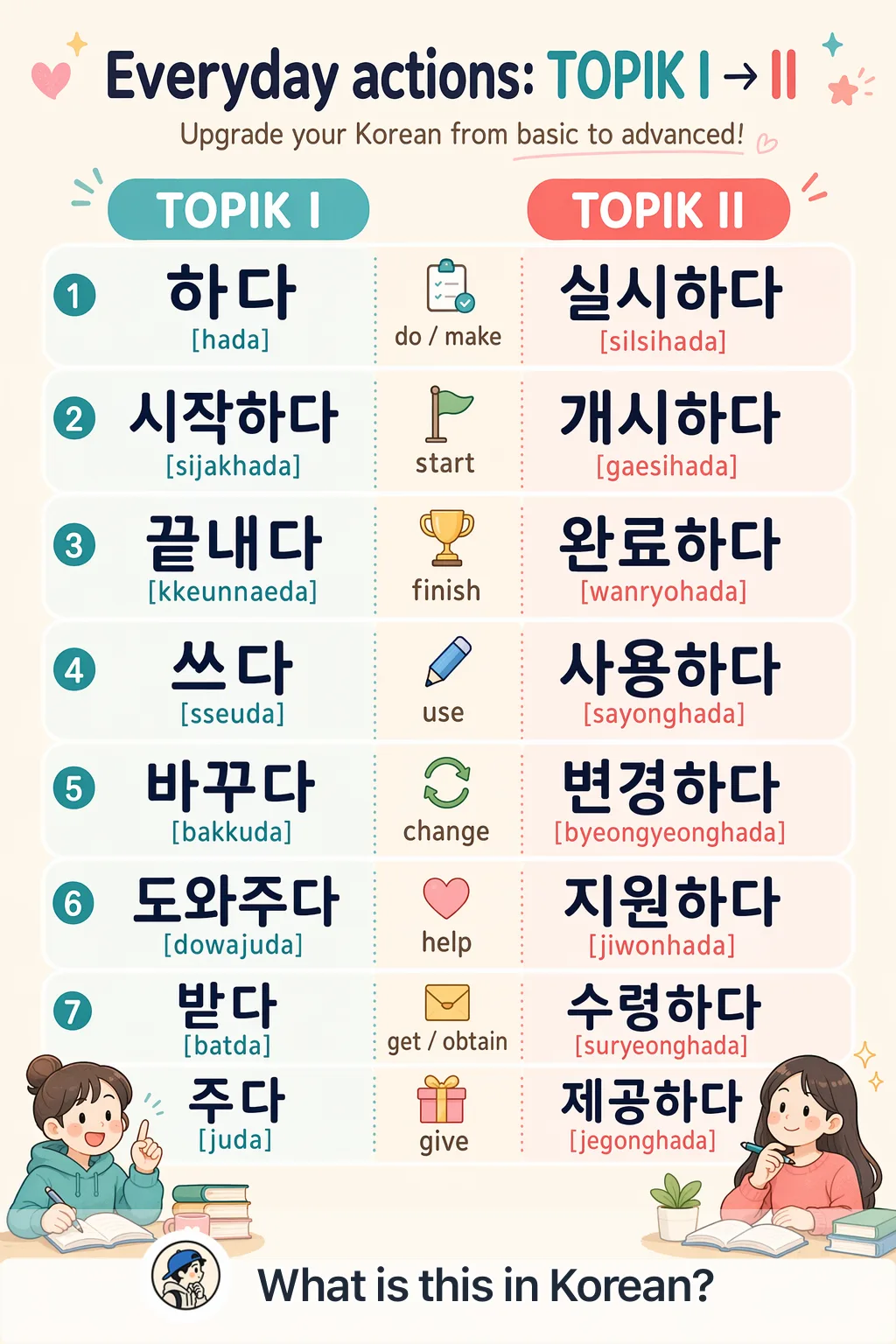
How these words work together
This chart shows pairs of Korean verbs used for everyday actions, comparing simpler TOPIK I words with more formal or advanced TOPIK II equivalents. Both verbs in each pair have similar meanings but differ in formality and usage context. Learning these pairs helps you upgrade your Korean vocabulary from basic to intermediate level.
Words in this chart
| Korean | Romanization | English |
|---|---|---|
| 하다 | hada | do / make (TOPIK I) |
| 실시하다 | silsihada | do / make (TOPIK II) |
| 시작하다 | sijakhada | start (TOPIK I) |
| 개시하다 | gaesihada | start (TOPIK II) |
| 끝내다 | kkeunnaeda | finish (TOPIK I) |
| 완료하다 | wanryohada | finish (TOPIK II) |
| 쓰다 | sseuda | use (TOPIK I) |
| 사용하다 | sayonghada | use (TOPIK II) |
| 바꾸다 | bakkuda | change (TOPIK I) |
| 변경하다 | byeongyeonghada | change (TOPIK II) |
| 도와주다 | dowajuda | help (TOPIK I) |
| 지원하다 | jiwonhada | help (TOPIK II) |
| 받다 | batda | get / obtain (TOPIK I) |
| 수령하다 | suryeonghada | get / obtain (TOPIK II) |
| 주다 | juda | give (TOPIK I) |
| 제공하다 | jegonghada | give (TOPIK II) |
Example sentences
오늘 회의를 시작하다.
Start the meeting today.
저는 도움을 지원하고 싶어요.
I want to provide help.
새 프로그램을 사용하다.
Use the new program.
Practice these words in context? Open the vocab quiz · Browse how-to-say word guides.