
재미있다(jae-mi-iss-da, jaemiissda)
Indicates a state of being fun and interesting.
When to use
interesting activity, enjoyable experience, fun story
The nuance
Use when an activity or situation is enjoyable and engaging.
재미있다 (jae-mi-iss-da, jaemiissda) · 지루하다 (ji-ru-ha-da, jiruhada)
재미있다 expresses a state of being fun and interesting, while 지루하다 describes a state of boredom and lack of interest.
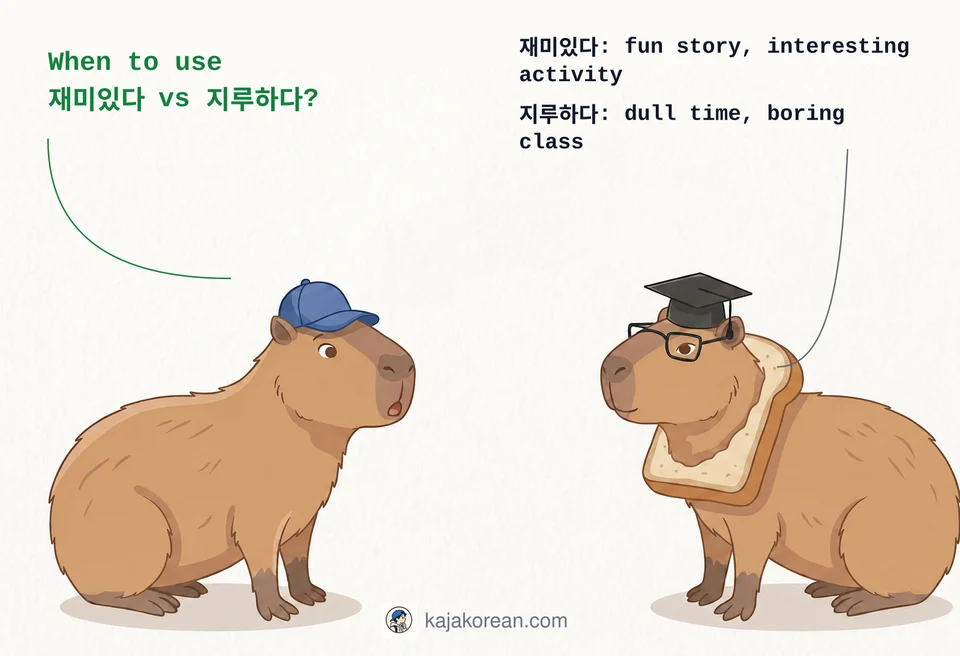
One lane per word — no nested boxes, just the gist.
Indicates a state of being fun and interesting.
When to use
interesting activity, enjoyable experience, fun story
The nuance
Use when an activity or situation is enjoyable and engaging.
Indicates a state of being boring or uninteresting.
When to use
boring class, uninteresting conversation, dull time
The nuance
Use when an activity or situation is dull and fails to engage interest.
이 영화는 정말 재미있다.
i yeong-hwa-neun jeong-mal jae-mi-iss-da., i yeong hwa neun jeong mal jae mi iss da.
This sentence naturally means the movie is interesting and enjoyable.
이 영화는 정말 지루하다.
i yeong-hwa-neun jeong-mal ji-ru-ha-da., i yeong hwa neun jeong mal ji ru ha da.
Correct expression meaning the movie is boring and dull.
이 수업은 재미있다.
i su-eop-eun jae-mi-iss-da., i su eop eun jae mi iss da.
Natural expression when the class is interesting and enjoyable.
이 수업은 지루하다.
i su-eop-eun ji-ru-ha-da., i su eop eun ji ru ha da.
Appropriate expression when the class is dull and uninteresting.
지루한 영화는 재미있다.
ji-ru-han yeong-hwa-neun jae-mi-iss-da., ji ru han yeong hwa neun jae mi iss da.
'Boring' and 'fun' are opposite meanings, so using them together is awkward.
재미있는 수업은 지루하다.
jae-mi-iss-neun su-eop-eun ji-ru-ha-da., jae mi iss neun su eop eun ji ru ha da.
'Fun' and 'boring' contradict each other, making the sentence illogical.
심심한 시간은 지루하다.
sim-sim-han si-gan-eun ji-ru-ha-da., sim sim han si gan eun ji ru ha da.
'Boring time' and '지루하다' have similar meanings, so this is natural.
즐거운 경험은 지루하다.
jeul-geo-un gyeong-heom-eun ji-ru-ha-da., jeul geo un gyeong heom eun ji ru ha da.
'Enjoyable experience' and 'boring' are opposite meanings.
Which sentence is correct?
When to use '지루하다'?
Which word is the opposite of '재미있다'?
What does it mean?