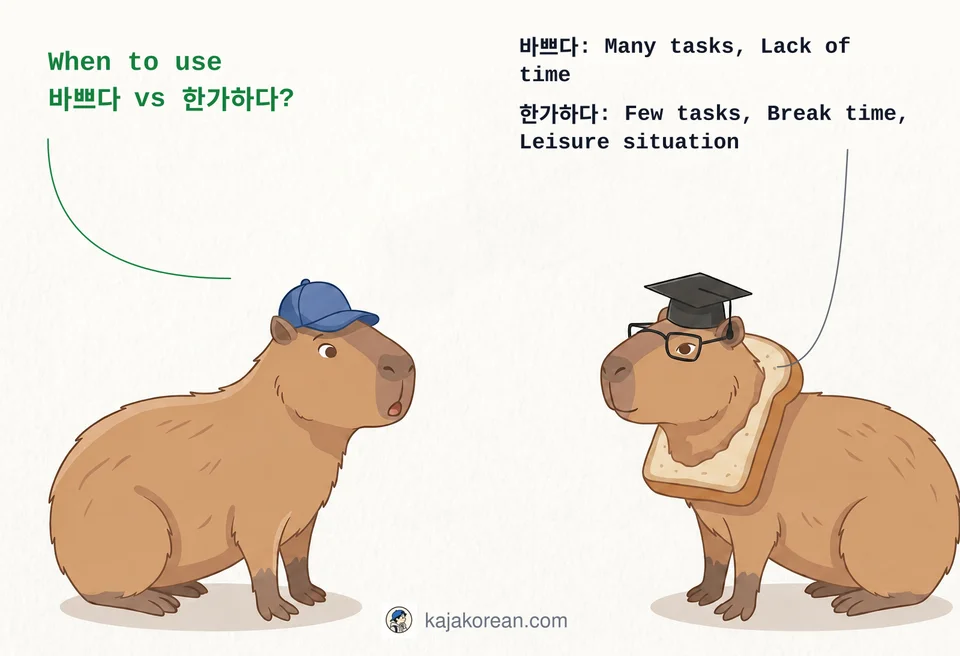
바쁘다 vs 한가하다: Difference in Time Availability

바쁘다 (ba-ppeu-da, bappeuda) · 한가하다 (han-ga-ha-da, hangahada)

'바쁘다' is used when someone has little time and many tasks, while '한가하다' describes having plenty of free time and leisure.

Comparison of Korean words 바쁘다 and 한가하다 about being busy or free

Word-by-word breakdown

One lane per word — no nested boxes, just the gist.

바쁘다(ba-ppeu-da, bappeuda)

Having many tasks and little time

When to use

Many tasks, Overlapping appointments, Lack of time

The nuance

Use '바쁘다' when someone has many tasks and limited time. It generally has no negative connotation but often implies fatigue or stress.

한가하다(han-ga-ha-da, hangahada)

Having plenty of free time and few tasks

When to use

Break time, Few tasks, Leisure situation

The nuance

Use '한가하다' when someone has few or no tasks and plenty of free time. It usually conveys a positive and relaxed state.

Real-world examples

  • 오늘은 너무 바빠서 점심도 못 먹었어요.

    o-neul-eun neo-mu ba-ppa-seo jeom-sim-do mos meok-eoss-eo-yo., o neul eun neo mu ba ppa seo jeom sim do mos meok eoss eo yo.

    Appropriate use for a situation with many tasks and no time.

  • 내일은 한가하니까 같이 영화 보러 가자.

    nae-il-eun han-ga-ha-ni-kka gat-i yeong-hwa bo-reo ga-ja., nae il eun han ga ha ni kka gat i yeong hwa bo reo ga ja.

    Natural sentence suggesting plans due to free time.

  • 바쁠 때는 쉬는 시간이 많아요.

    ba-ppeul ttae-neun swi-neun si-gan-i man-a-yo., ba ppeul ttae neun swi neun si gan i man a yo.

    Incorrect because being busy means less rest time; use '한가할 때' instead.

  • 한가할 때도 일이 많아서 힘들어요.

    han-ga-hal ttae-do il-i man-a-seo him-deul-eo-yo., han ga hal ttae do il i man a seo him deul eo yo.

    Incorrect because '한가하다' implies few tasks, contradicting '일이 많다'.

  • 회의가 많아서 이번 주는 정말 바빠요.

    hoe-ui-ga man-a-seo i-beon ju-neun jeong-mal ba-ppa-yo., hoe ui ga man a seo i beon ju neun jeong mal ba ppa yo.

    Correct for a situation with many meetings and little time.

  • 한가해서 매일 야근해요.

    han-ga-hae-seo mae-il ya-geun-hae-yo., han ga hae seo mae il ya geun hae yo.

    Incorrect because '한가하다' (free) contradicts '야근' (overtime work).

  • 바쁠 때는 커피를 많이 마셔요.

    ba-ppeul ttae-neun keo-pi-reul man-i ma-syeo-yo., ba ppeul ttae neun keo pi reul man i ma syeo yo.

    Natural to drink coffee to relieve fatigue when busy.

  • 한가한 날에는 책을 많이 읽어요.

    han-ga-han nal-e-neun chaek-eul man-i ik-eo-yo., han ga han nal e neun chaek eul man i ik eo yo.

    Appropriate for leisurely reading on free days.

Quick quiz

  1. Which sentence correctly uses '바쁘다'?

    다음 중 '바쁘다'를 올바르게 사용한 문장은?(da-eumjung'ba-ppeu-da'reulol-ba-reu-gesa-yong-hanmun-jang-eun?, daeumjung'bappeuda'reulolbareugesayonghanmunjangeun?)
  2. Which sentence cannot use '한가하다'?

    '한가하다'를 사용할 수 없는 문장은?('han-ga-ha-da'reulsa-yong-halsueop-neunmun-jang-eun?, 'hangahada'reulsayonghalsueopneunmunjangeun?)
  3. Which situation is least associated with '한가하다'?

    '한가하다'와 가장 거리가 먼 상황은?('han-ga-ha-da'waga-janggeo-ri-gameonsang-hwang-eun?, 'hangahada'wagajanggeorigameonsanghwangeun?)

What does it mean?

More comparisons to explore

View all word comparisons →