Expresses a joyful and satisfied emotional state
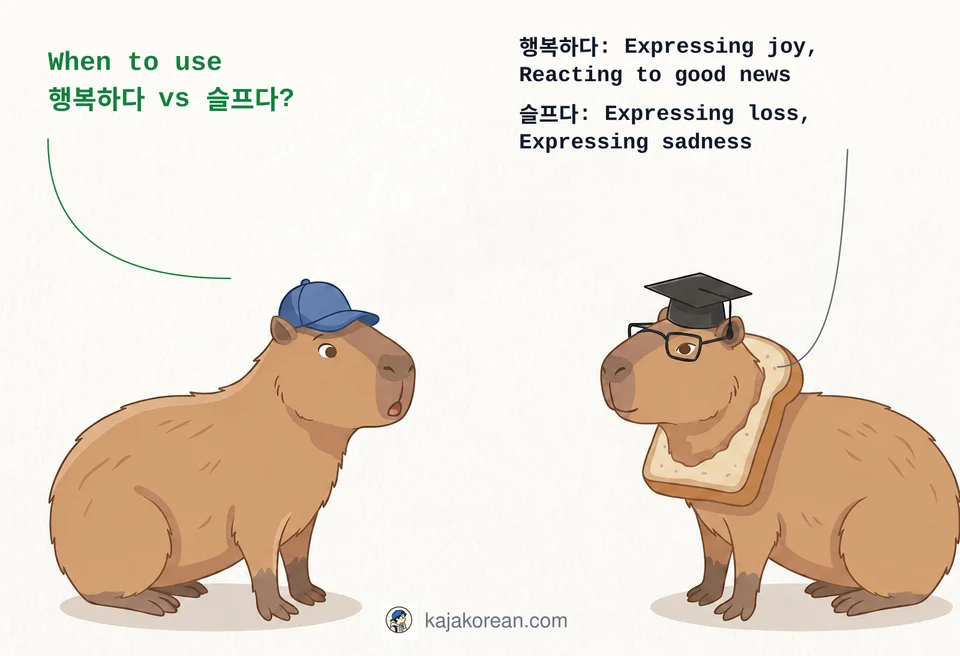
When to use
Expressing joy, Expressing satisfaction, Reacting to good news
The nuance
행복하다 is used to express positive emotions, such as when something good happens or when feeling content.
행복하다 (haeng-bok-ha-da, haengbokhada) · 슬프다 (seul-peu-da, seulpeuda)
행복하다 expresses positive joy, while 슬프다 conveys negative sadness, both describing emotional states.

One lane per word — no nested boxes, just the gist.
Expresses a joyful and satisfied emotional state
When to use
Expressing joy, Expressing satisfaction, Reacting to good news
The nuance
행복하다 is used to express positive emotions, such as when something good happens or when feeling content.
Expresses a painful and gloomy emotional state
When to use
Expressing sadness, Expressing loss, Reacting to bad news
The nuance
슬프다 is used to express negative emotions, such as when something bad happens or when feeling a sense of loss.
오늘 정말 행복하다!
o-neul jeong-mal haeng-bok-ha-da!, o neul jeong mal haeng bok ha da!
A natural sentence expressing positive emotion.
오늘 정말 슬프다!
o-neul jeong-mal seul-peu-da!, o neul jeong mal seul peu da!
A proper sentence expressing negative emotion.
그 소식을 듣고 행복했어요.
geu so-sik-eul deut-go haeng-bok-haess-eo-yo., geu so sik eul deut go haeng bok haess eo yo.
Appropriate positive reaction to good news.
그 소식을 듣고 슬펐어요.
geu so-sik-eul deut-go seul-peoss-eo-yo., geu so sik eul deut go seul peoss eo yo.
Appropriate negative reaction to bad news.
슬프다, 오늘 너무 기뻐!
seul-peu-da, o-neul neo-mu gi-ppeo!, seul peu da, o neul neo mu gi ppeo!
Using 슬프다 and 기쁘다 together is contradictory and unnatural.
행복하다, 친구가 떠나서.
haeng-bok-ha-da, chin-gu-ga tteo-na-seo., haeng bok ha da, chin gu ga tteo na seo.
Saying 행복하다 in the context of a friend leaving is contextually inappropriate.
그 영화는 슬프지만 아름답다.
geu yeong-hwa-neun seul-peu-ji-man a-reum-dap-da., geu yeong hwa neun seul peu ji man a reum dap da.
A natural sentence expressing both sadness and beauty.
나는 슬프다, 오늘 좋은 일이 있었어.
na-neun seul-peu-da, o-neul joh-eun il-i iss-eoss-eo., na neun seul peu da, o neul joh eun il i iss eoss eo.
It is awkward to say 슬프다 when something good happened.
Which sentence correctly uses '행복하다'?
When is it appropriate to use '슬프다'?
Which sentence is incorrect?
What does it mean?