
맞다(maj-da, majda)
Indicates that something is correct or right.
When to use
correct answer, right judgment, accurate information
The nuance
Use when a fact or answer is accurate or correct.
맞다 (maj-da, majda) · 틀리다 (teul-ri-da, teulrida)
맞다 indicates correctness or being right, while 틀리다 indicates incorrectness or being wrong.
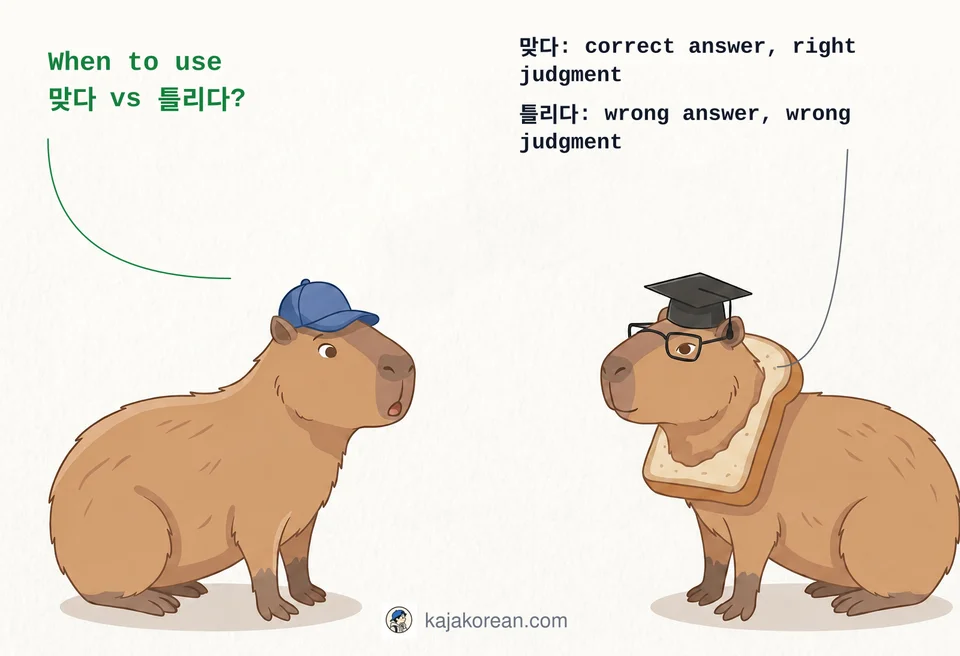
One lane per word — no nested boxes, just the gist.
Indicates that something is correct or right.
When to use
correct answer, right judgment, accurate information
The nuance
Use when a fact or answer is accurate or correct.
Indicates that something is incorrect or wrong.
When to use
wrong answer, wrong judgment, incorrect information
The nuance
Use when a fact or answer is wrong or incorrect.
이 문제의 답이 맞아요.
i mun-je-ui dap-i maj-a-yo., i mun je ui dap i maj a yo.
Use 맞다 to express a correct answer.
이 문제의 답이 틀려요.
i mun-je-ui dap-i teul-ryeo-yo., i mun je ui dap i teul ryeo yo.
Use 틀리다 to express a wrong answer.
그의 의견이 맞지 않아요.
geu-ui ui-gyeon-i maj-ji an-a-yo., geu ui ui gyeon i maj ji an a yo.
Use 맞지 않다 to negate correctness of an opinion.
이 정보가 틀려요.
i jeong-bo-ga teul-ryeo-yo., i jeong bo ga teul ryeo yo.
Use 틀리다 to express incorrect information.
이 정보가 맞아요.
i jeong-bo-ga maj-a-yo., i jeong bo ga maj a yo.
Use 맞다 to express accurate information.
틀려서 맞아요.
teul-ryeo-seo maj-a-yo., teul ryeo seo maj a yo.
Contradictory phrase; can't use 틀리다 and 맞다 together like this.
맞아서 틀려요.
maj-a-seo teul-ryeo-yo., maj a seo teul ryeo yo.
Contradictory meaning; unnatural sentence.
Which word do you use when an answer is correct?
Which word is appropriate to express a wrong answer?
Which word do you use to talk about accurate facts?
Which word fits to express a wrong judgment?