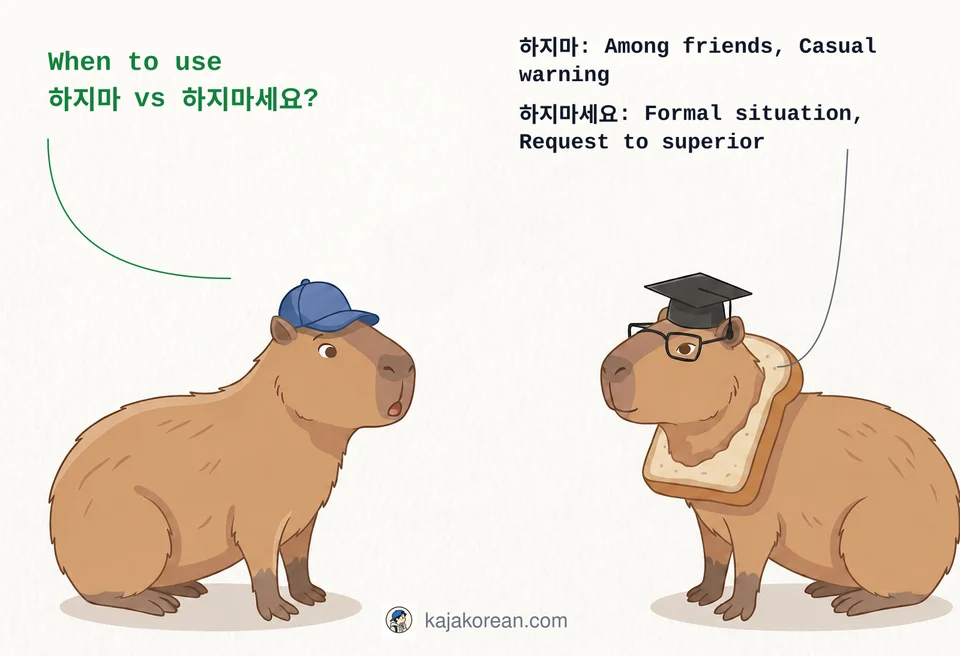
하지마 vs 하지마세요: Casual vs Polite Negative Imperatives

하지마 (ha-ji-ma, hajima) · 하지마세요 (ha-ji-ma-se-yo, hajimaseyo)

하지마 is casual and used among close friends, while 하지마세요 is polite and used for respectful requests or warnings.

Comparison of 하지마 and 하지마세요 usage in Korean

Word-by-word breakdown

One lane per word — no nested boxes, just the gist.

하지마(ha-ji-ma, hajima)

Casual negative imperative form meaning 'Don't do it,' used among close friends or informal situations.

When to use

Among friends, Command to younger sibling, Casual warning

The nuance

Used when giving a negative command without honorifics to close friends or younger people, expressing familiarity or lowering the listener.

하지마세요(ha-ji-ma-se-yo, hajimaseyo)

Polite negative imperative form used to politely request or warn someone not to do something.

When to use

Request to superior, Formal situation, Warning to stranger

The nuance

Used to politely command or request in formal situations, to strangers, or to superiors.

Real-world examples

  • 하지마! 그거 위험해.

    ha-ji-ma! geu-geo wi-heom-hae., ha ji ma! geu geo wi heom hae.

    Appropriate casual warning to a close friend or younger person.

  • 하지마세요! 그거 위험해요.

    ha-ji-ma-se-yo! geu-geo wi-heom-hae-yo., ha ji ma se yo! geu geo wi heom hae yo.

    Polite warning suitable for superiors or strangers.

  • 할머니, 하지마세요! 다치실 수 있어요.

    hal-meo-ni, ha-ji-ma-se-yo! da-chi-sil su iss-eo-yo., hal meo ni, ha ji ma se yo! da chi sil su iss eo yo.

    Polite warning using honorifics to an elder.

  • 친구한테 하지마세요라고 말했어요.

    chin-gu-han-te ha-ji-ma-se-yo-ra-go mal-haess-eo-yo., chin gu han te ha ji ma se yo ra go mal haess eo yo.

    Saying 하지마세요 to a friend is overly formal; 하지마 is natural.

  • 동생에게 하지마세요라고 했어요.

    dong-saeng-e-ge ha-ji-ma-se-yo-ra-go haess-eo-yo., dong saeng e ge ha ji ma se yo ra go haess eo yo.

    Using 하지마세요 with a younger sibling sounds unnatural; 하지마 is correct.

  • 회사에서 하지마라고 말했어요.

    hoe-sa-e-seo ha-ji-ma-ra-go mal-haess-eo-yo., hoe sa e seo ha ji ma ra go mal haess eo yo.

    In the workplace, 하지마세요 is appropriate; 하지마 is too casual.

  • 하지마세요! 너무 시끄러워요.

    ha-ji-ma-se-yo! neo-mu si-kkeu-reo-wo-yo., ha ji ma se yo! neo mu si kkeu reo wo yo.

    Polite command, appropriate usage.

  • 하지마! 너무 시끄러워.

    ha-ji-ma! neo-mu si-kkeu-reo-wo., ha ji ma! neo mu si kkeu reo wo.

    Natural casual command to friend or younger person.

Quick quiz

  1. Which expression is natural to say to a friend: 하지마 or 하지마세요?

    친구에게 '하지마'와 '하지마세요' 중 어떤 표현이 자연스러운가요?(chin-gu-e-ge'ha-ji-ma'wa'ha-ji-ma-se-yo'jungeo-tteonpyo-hyeon-ija-yeon-seu-reo-un-ga-yo?, chinguege'hajima'wa'hajimaseyo'jungeotteonpyohyeonijayeonseureoungayo?)
  2. Which expression is appropriate to politely tell a superior 'Don't do it'?

    윗사람에게 부드럽게 '하지 말라'고 말할 때 적절한 표현은?(wis-sa-ram-e-gebu-deu-reop-ge'ha-jimal-ra'gomal-halttaejeok-jeol-hanpyo-hyeon-eun?, wissaramegebudeureopge'hajimalra'gomalhalttaejeokjeolhanpyohyeoneun?)
  3. Which expression is appropriate when warning a stranger?

    모르는 사람에게 경고할 때 적절한 표현은?(mo-reu-neunsa-ram-e-gegyeong-go-halttaejeok-jeol-hanpyo-hyeon-eun?, moreuneunsaramegegyeonggohalttaejeokjeolhanpyohyeoneun?)

More comparisons to explore

View all word comparisons →