Choban vs Jungban vs Huban: How to Distinguish Time Phases

초반 (cho-ban, choban) · 중반 (jung-ban, jungban) · 후반 (hu-ban, huban)

Choban, Jungban, and Huban indicate the beginning, middle, and end phases of an event or period, each with distinct positions and usage.

Comparison of Korean words 초반, 중반, 후반 showing beginning, middle, and end phases

Word-by-word breakdown

One lane per word — no nested boxes, just the gist.

초반(cho-ban, choban)

The beginning phase of an event or period

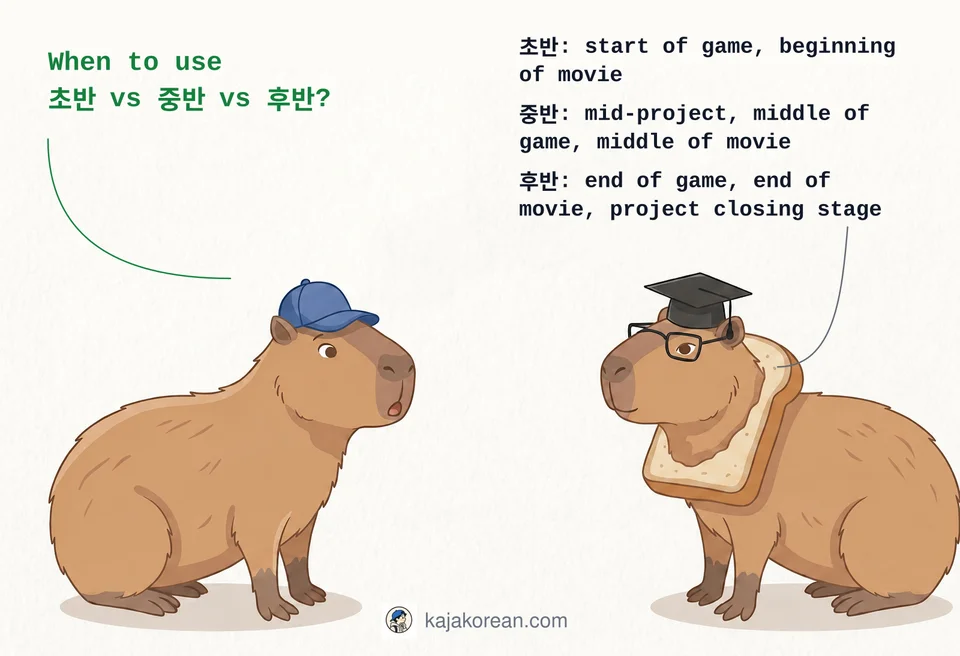
When to use

start of game, early project stage, beginning of movie

The nuance

Use 초반 when referring to the very start phase of an event or period, typically covering the first 0–30% of the total duration.

중반(jung-ban, jungban)

The middle phase of an event or period

When to use

middle of game, mid-project, middle of movie

The nuance

Use 중반 to indicate the middle phase, roughly 30–70% of the total duration, when the event or process is actively ongoing.

후반(hu-ban, huban)

The ending phase of an event or period

When to use

end of game, project closing stage, end of movie

The nuance

Use 후반 to refer to the final phase, approximately 70–100% of the total duration, when the event is nearing completion.

Real-world examples

  • 축구 경기 초반에 골이 나왔다.

    chuk-gu gyeong-gi cho-ban-e gol-i na-wass-da., chuk gu gyeong gi cho ban e gol i na wass da.

    Appropriate to use 초반 because it refers to the start phase of the game.

  • 축구 경기 중반에 골이 나왔다.

    chuk-gu gyeong-gi jung-ban-e gol-i na-wass-da., chuk gu gyeong gi jung ban e gol i na wass da.

    Correct to use 중반 as it indicates the middle phase of the game.

  • 축구 경기 후반에 골이 나왔다.

    chuk-gu gyeong-gi hu-ban-e gol-i na-wass-da., chuk gu gyeong gi hu ban e gol i na wass da.

    Using 후반 is correct because it refers to the end phase of the game.

  • 영화 초반에 결말이 나왔다.

    yeong-hwa cho-ban-e gyeol-mal-i na-wass-da., yeong hwa cho ban e gyeol mal i na wass da.

    Ending cannot be at the beginning; 후반 should be used instead of 초반.

  • 프로젝트 중반에 계획을 세웠다.

    peu-ro-jek-teu jung-ban-e gye-hoek-eul se-woss-da., peu ro jek teu jung ban e gye hoek eul se woss da.

    Planning usually happens early, so 초반 is more appropriate than 중반.

  • 프로젝트 후반에 기획을 시작했다.

    peu-ro-jek-teu hu-ban-e gi-hoek-eul si-jak-haess-da., peu ro jek teu hu ban e gi hoek eul si jak haess da.

    Planning is done at the start, so 후반 is incorrect here.

  • 영화 중반부에 긴장감이 최고조에 달했다.

    yeong-hwa jung-ban-bu-e gin-jang-gam-i choe-go-jo-e dal-haess-da., yeong hwa jung ban bu e gin jang gam i choe go jo e dal haess da.

    Using 중반 is appropriate for tension peaking in the middle part.

  • 영화 후반부에 주인공이 소개되었다.

    yeong-hwa hu-ban-bu-e ju-in-gong-i so-gae-doe-eoss-da., yeong hwa hu ban bu e ju in gong i so gae doe eoss da.

    Introducing the main character usually happens early, so 후반 is wrong here.

Quick quiz

  1. In a soccer game, when does '초반' refer to?

    축구 경기에서 '초반'은 언제를 의미하나요?(chuk-gugyeong-gi-e-seo'cho-ban'euneon-je-reului-mi-ha-na-yo?, chukgugyeonggieseo'choban'euneonjereuluimihanayo?)
  2. Which situation is incorrect for using '후반'?

    '후반'을 사용할 수 없는 상황은?('hu-ban'eulsa-yong-halsueop-neunsang-hwang-eun?, 'huban'eulsayonghalsueopneunsanghwangeun?)
  3. Which sentence best fits using '중반'?

    '중반'에 가장 적절한 문장은?('jung-ban'ega-jangjeok-jeol-hanmun-jang-eun?, 'jungban'egajangjeokjeolhanmunjangeun?)

More comparisons to explore

View all word comparisons →