
위(wi)
Indicates the 'above' position of something.
When to use
On top of desk, Above ceiling, Above person's head
The nuance
Use 위 to refer to the position directly above or on top of something, indicating vertical upper part.
위 (wi) · 아래 (a-rae, arae) · 옆 (yeop)
위 (wi), 아래 (arae), and 옆 (yeop) indicate position: above, below, and beside respectively, each used for distinct spatial relations.
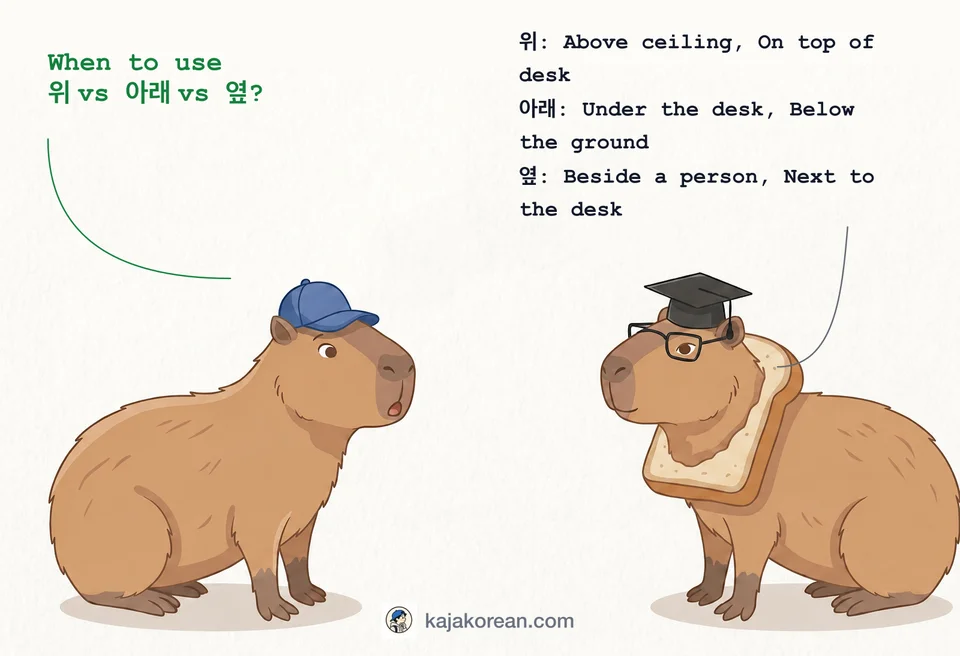
One lane per word — no nested boxes, just the gist.
Indicates the 'above' position of something.
When to use
On top of desk, Above ceiling, Above person's head
The nuance
Use 위 to refer to the position directly above or on top of something, indicating vertical upper part.
Indicates the 'below' position of something.
When to use
Under the desk, Below the ground, Under person's feet
The nuance
Use 아래 to refer to the position directly below or beneath something, indicating vertical lower part.
Indicates the 'beside' or 'side' position of something.
When to use
Next to the desk, Beside a person, Next to the door
The nuance
Use 옆 to refer to the position directly beside something horizontally, including both left and right sides.
책상 위에 책이 있어요.
chaek-sang wi-e chaek-i iss-eo-yo., chaek sang wi e chaek i iss eo yo.
위 indicates the correct position on top of the desk.
책상 아래에 책이 있어요.
chaek-sang a-rae-e chaek-i iss-eo-yo., chaek sang a rae e chaek i iss eo yo.
아래 correctly indicates below the desk.
책상 옆에 책이 있어요.
chaek-sang yeop-e chaek-i iss-eo-yo., chaek sang yeop e chaek i iss eo yo.
옆 correctly indicates beside the desk horizontally.
책상 위에 사람이 있어요.
chaek-sang wi-e sa-ram-i iss-eo-yo., chaek sang wi e sa ram i iss eo yo.
위 correctly indicates the person is physically on top of the desk.
책상 아래에 사람이 있어요.
chaek-sang a-rae-e sa-ram-i iss-eo-yo., chaek sang a rae e sa ram i iss eo yo.
아래 correctly indicates the person is beneath the desk.
책상 옆에 사람이 있어요.
chaek-sang yeop-e sa-ram-i iss-eo-yo., chaek sang yeop e sa ram i iss eo yo.
옆 correctly indicates the person is next to the desk.
사람 위에 책이 있어요.
sa-ram wi-e chaek-i iss-eo-yo., sa ram wi e chaek i iss eo yo.
위 correctly indicates the book is on top of the person.
사람 아래에 책이 있어요.
sa-ram a-rae-e chaek-i iss-eo-yo., sa ram a rae e chaek i iss eo yo.
아래 correctly indicates the book is under the person.
The pencil is ___ the desk.
The bag is ___ the chair.
My friend is sitting ___ me.
What does it mean?