듣기 vs 따라하기 vs 반복하기: Comparing Learning Actions

듣기 (deut-gi, deutgi) · 따라하기 (tta-ra-ha-gi, ttarahagi) · 반복하기 (ban-bok-ha-gi, banbokhagi)

듣기 means receiving information, 따라하기 means imitating actions, and 반복하기 means doing the same action multiple times.

Comparison of 듣기, 따라하기, and 반복하기 usage in Korean learning contexts

Word-by-word breakdown

One lane per word — no nested boxes, just the gist.

듣기(deut-gi, deutgi)

The act of receiving sounds or speech through the ear

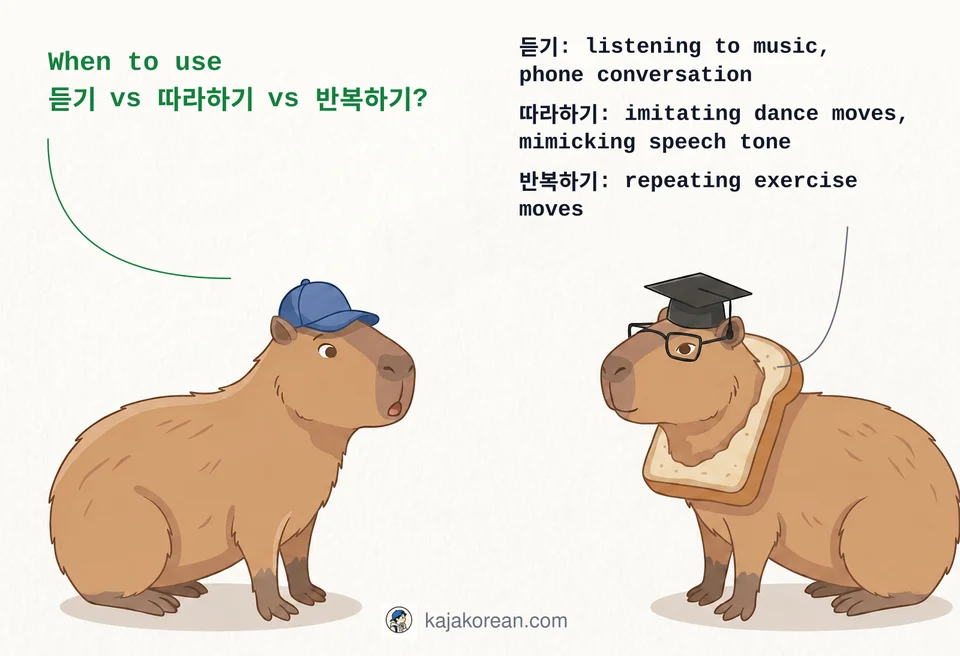
When to use

understanding lectures, listening to music, phone conversation

The nuance

듣기 is mainly used when receiving or understanding information, focusing on perceiving sounds.

따라하기(tta-ra-ha-gi, ttarahagi)

The act of imitating someone else's actions or speech

When to use

pronunciation practice, imitating dance moves, mimicking speech tone

The nuance

따라하기 is used when copying someone’s actions or speech exactly, often seen in learning or practice.

반복하기(ban-bok-ha-gi, banbokhagi)

The act of repeating the same action or process multiple times

When to use

reading sentences multiple times, repeating exercise moves, solving practice problems

The nuance

반복하기 is used when repeating the same action multiple times to improve learning or training effectiveness.

Real-world examples

  • 나는 영어 듣기를 매일 한다.

    na-neun yeong-eo deut-gi-reul mae-il han-da., na neun yeong eo deut gi reul mae il han da.

    듣기 fits naturally as it refers to the act of listening and understanding sounds.

  • 나는 영어 따라하기를 매일 한다.

    na-neun yeong-eo tta-ra-ha-gi-reul mae-il han-da., na neun yeong eo tta ra ha gi reul mae il han da.

    따라하기 is appropriate as it means imitating speech or actions for practice.

  • 나는 영어 반복하기를 매일 한다.

    na-neun yeong-eo ban-bok-ha-gi-reul mae-il han-da., na neun yeong eo ban bok ha gi reul mae il han da.

    반복하기 suits repeating the same action multiple times for learning.

  • 나는 음악을 따라하기.

    na-neun eum-ak-eul tta-ra-ha-gi., na neun eum ak eul tta ra ha gi.

    Music is sound, so 듣기 fits better; 따라하기 is for imitating actions.

  • 나는 강의를 반복하기.

    na-neun gang-ui-reul ban-bok-ha-gi., na neun gang ui reul ban bok ha gi.

    Repeating a lecture is unnatural here; 듣기 or 다시 듣기 is better.

  • 나는 발음을 듣기.

    na-neun bal-eum-eul deut-gi., na neun bal eum eul deut gi.

    Pronunciation is practiced by 따라하기; 듣기 focuses on listening only.

  • 나는 춤을 반복하기.

    na-neun chum-eul ban-bok-ha-gi., na neun chum eul ban bok ha gi.

    Dance moves are first imitated by 따라하기; 반복하기 is for repeating moves after learning.

  • 나는 전화 통화를 따라하기.

    na-neun jeon-hwa tong-hwa-reul tta-ra-ha-gi., na neun jeon hwa tong hwa reul tta ra ha gi.

    Phone calls involve listening and speaking; 따라하기 is for imitation only.

Quick quiz

  1. Which sentence best describes '따라하기'?

    다음 중 '따라하기'를 가장 잘 설명하는 문장은?(da-eumjung'tta-ra-ha-gi'reulga-jangjalseol-myeong-ha-neunmun-jang-eun?, daeumjung'ttarahagi'reulgajangjalseolmyeonghaneunmunjangeun?)
  2. When is '반복하기' appropriate?

    '반복하기'가 적절한 상황은?('ban-bok-ha-gi'gajeok-jeol-hansang-hwang-eun?, 'banbokhagi'gajeokjeolhansanghwangeun?)
  3. Which sentence does NOT fit '듣기'?

    '듣기'가 어울리지 않는 문장은?('deut-gi'gaeo-ul-ri-jian-neunmun-jang-eun?, 'deutgi'gaeoulrijianneunmunjangeun?)

More comparisons to explore

View all word comparisons →