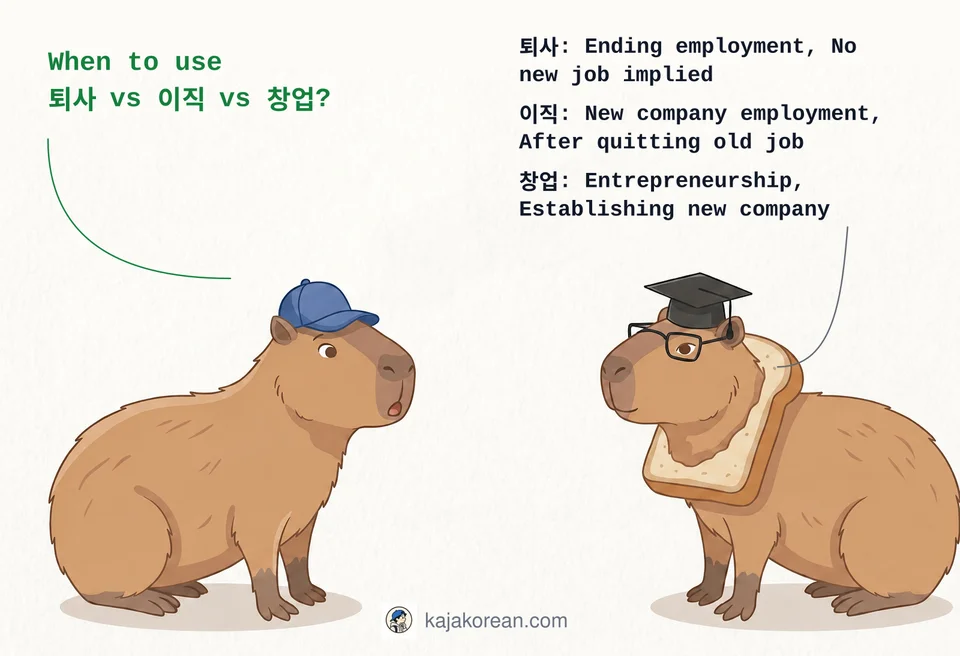
Leaving the current company you work for
When to use
Leaving current company, Ending employment, No new job implied
The nuance
퇴사 means simply quitting your current job and does not necessarily include getting a new job or starting a business.
퇴사 (toe-sa, toesa) · 이직 (i-jik, ijik) · 창업 (chang-eop, changeop)
Understand the difference between 퇴사 (leaving a company), 이직 (moving to another company), and 창업 (starting your own business).

One lane per word — no nested boxes, just the gist.
Leaving the current company you work for
When to use
Leaving current company, Ending employment, No new job implied
The nuance
퇴사 means simply quitting your current job and does not necessarily include getting a new job or starting a business.
Changing jobs by moving to a different company
When to use
New company employment, Maintaining job continuity, After quitting old job
The nuance
이직 means quitting one job and getting employed at another company, maintaining employment continuity.
Starting a new company or business by oneself
When to use
Establishing new company, Starting self-employment, Entrepreneurship
The nuance
창업 is used only when someone starts their own business, not when joining an existing company.
저는 이번 달에 퇴사했어요.
jeo-neun i-beon dal-e toe-sa-haess-eo-yo., jeo neun i beon dal e toe sa haess eo yo.
This sentence correctly expresses quitting the current company.
저는 이번 달에 이직했어요.
jeo-neun i-beon dal-e i-jik-haess-eo-yo., jeo neun i beon dal e i jik haess eo yo.
Appropriate when someone moved to a different company.
저는 이번 달에 창업했어요.
jeo-neun i-beon dal-e chang-eop-haess-eo-yo., jeo neun i beon dal e chang eop haess eo yo.
Correct for starting a new business oneself.
퇴사하고 바로 창업했어요.
toe-sa-ha-go ba-ro chang-eop-haess-eo-yo., toe sa ha go ba ro chang eop haess eo yo.
Natural to quit and then start a business.
이직하고 회사를 그만뒀어요.
i-jik-ha-go hoe-sa-reul geu-man-dwoss-eo-yo., i jik ha go hoe sa reul geu man dwoss eo yo.
You cannot quit a company after changing jobs; it contradicts the meaning of 이직.
창업 후에 다른 회사에 취직했어요.
chang-eop hu-e da-reun hoe-sa-e chwi-jik-haess-eo-yo., chang eop hu e da reun hoe sa e chwi jik haess eo yo.
Starting a business and then getting employed contradicts 창업's meaning.
퇴사했는데 아직 새 직장이 없어요.
toe-sa-haess-neun-de a-jik sae jik-jang-i eop-eo-yo., toe sa haess neun de a jik sae jik jang i eop eo yo.
퇴사 does not imply having a new job yet.
이직했는데 아직 회사에 다니지 않아요.
i-jik-haess-neun-de a-jik hoe-sa-e da-ni-ji an-a-yo., i jik haess neun de a jik hoe sa e da ni ji an a yo.
You cannot 이직 without working at the new company.
Which word means 'starting a new company by yourself'?
Which word means 'changing jobs by moving to another company'?
Which word best expresses 'leaving the current company you work for'?