
존댓말(jon-daes-mal, jondaesmal)
Formal speech style showing respect to the listener
When to use
Meeting strangers, Talking to boss, Formal occasions
The nuance
Used with older people, higher status, or strangers, and in formal contexts.
존댓말 (jon-daes-mal, jondaesmal) · 반말 (ban-mal, banmal) · 하오체 (ha-o-che, haoche)
존댓말, 반말, and 하오체 represent respect, familiarity, and classical formality in Korean speech styles respectively.
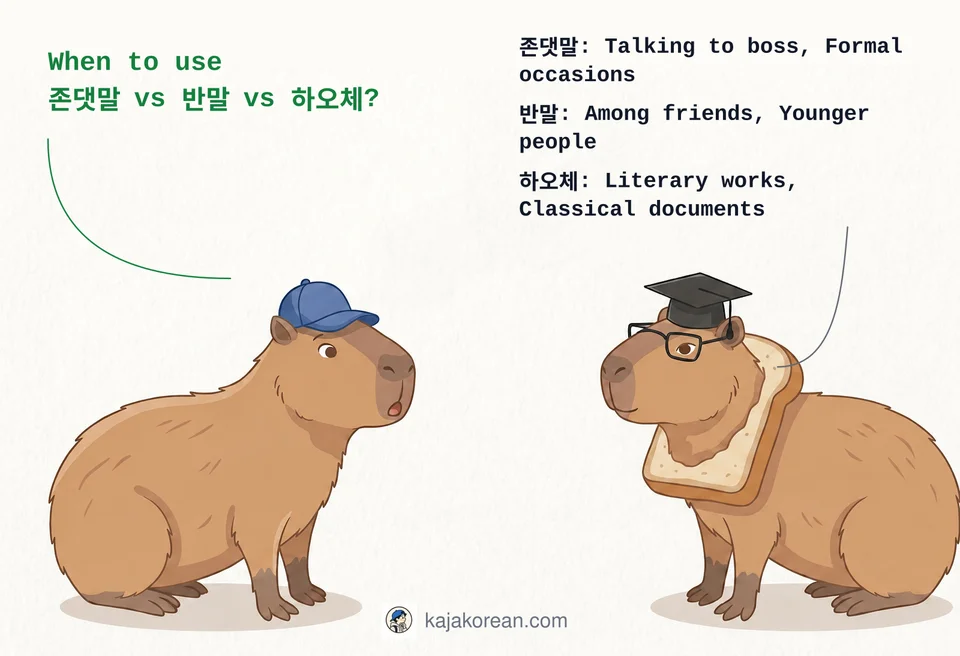
One lane per word — no nested boxes, just the gist.
Formal speech style showing respect to the listener
When to use
Meeting strangers, Talking to boss, Formal occasions
The nuance
Used with older people, higher status, or strangers, and in formal contexts.
Informal speech used among close or younger people
When to use
Among friends, Younger people, Family conversations
The nuance
Used with friends, peers, or younger people without formality.
Classical formal speech style used historically
When to use
Classical documents, Historical speeches, Literary works
The nuance
Used historically in written or formal speeches, rarely used in modern daily speech.
안녕하세요. 처음 뵙겠습니다.
an-nyeong-ha-se-yo. cheo-eum boep-gess-seup-ni-da., an nyeong ha se yo. cheo eum boep gess seup ni da.
Appropriate 존댓말 greeting for meeting someone for the first time.
야, 밥 먹었어?
ya, bap meok-eoss-eo?, ya, bap meok eoss eo?
Natural 반말 used among close friends.
저는 오늘 학교에 갔소.
jeo-neun o-neul hak-gyo-e gass-so., jeo neun o neul hak gyo e gass so.
Appropriate 하오체 expression for classical literature or speech.
안녕, 선생님. 오늘 수업 어땠어?
an-nyeong, seon-saeng-nim. o-neul su-eop eo-ttaess-eo?, an nyeong, seon saeng nim. o neul su eop eo ttaess eo?
Using 반말 with a teacher is rude; 존댓말 is required.
할아버지, 밥 먹었소?
hal-a-beo-ji, bap meok-eoss-so?, hal a beo ji, bap meok eoss so?
Using 하오체 with grandfather is unnatural; 존댓말 or 반말 is appropriate.
상사에게 '야, 이거 해.'라고 말하면 안 됩니다.
sang-sa-e-ge 'ya, i-geo hae.'ra-go mal-ha-myeon an doep-ni-da., sang sa e ge 'ya, i geo hae.'ra go mal ha myeon an doep ni da.
Using 반말 to a boss is rude; 존댓말 must be used.
회의 중에 '저는 그 의견에 찬성이오.'라고 말하는 것은 하오체입니다.
hoe-ui jung-e 'jeo-neun geu ui-gyeon-e chan-seong-i-o.'ra-go mal-ha-neun geos-eun ha-o-che-ip-ni-da., hoe ui jung e 'jeo neun geu ui gyeon e chan seong i o.'ra go mal ha neun geos eun ha o che ip ni da.
하오체 is classical and formal, appropriate in certain formal meetings.
친구에게 '안녕하세요'라고 하면 어색합니다.
chin-gu-e-ge 'an-nyeong-ha-se-yo'ra-go ha-myeon eo-saek-hap-ni-da., chin gu e ge 'an nyeong ha se yo'ra go ha myeon eo saek hap ni da.
Among friends, 반말 is natural; 존댓말 greetings feel awkward.
Appropriate speech style for a friend?
Most appropriate speech style for meeting someone first time?
Speech style mainly used in classical literature?
What if you use 반말 to your boss?