
단어(dan-eo, daneo)
The smallest independent unit of meaning in language
When to use
dictionary lookup, independent meaning, spacing unit
The nuance
단어 is a spacing unit that can stand alone with complete meaning or be found in a dictionary.
단어 (dan-eo, daneo) · 구 (gu) · 문장 (mun-jang, munjang)
단어 (word), 구 (phrase), and 문장 (sentence) are basic units in Korean language structure, each differing in meaning units and structural roles.
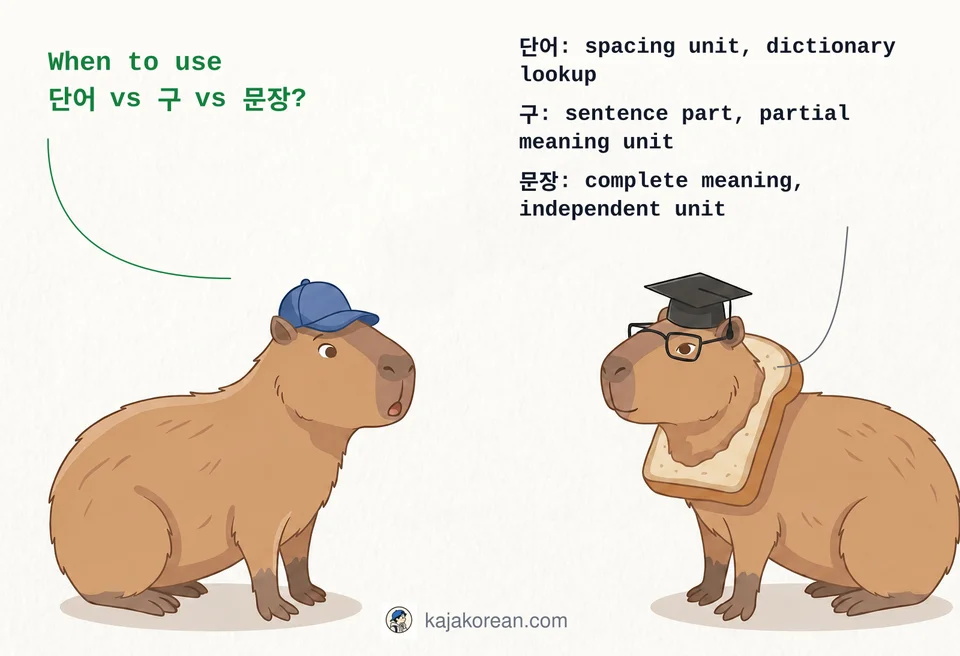
One lane per word — no nested boxes, just the gist.
The smallest independent unit of meaning in language
When to use
dictionary lookup, independent meaning, spacing unit
The nuance
단어 is a spacing unit that can stand alone with complete meaning or be found in a dictionary.
A group of two or more words forming a meaningful unit but not a complete sentence
When to use
partial meaning unit, sentence part, incomplete subject-predicate
The nuance
A 구 consists of words performing a grammatical function but lacks a subject-predicate structure to be a full sentence.
A unit of speech with subject and predicate conveying a complete meaning
When to use
complete meaning, subject and predicate included, independent unit
The nuance
문장 includes subject and predicate and can independently convey complete meaning.
사과는 빨갛다.
sa-gwa-neun ppal-gah-da., sa gwa neun ppal gah da.
It is a complete sentence with subject (사과) and predicate (빨갛다).
빨간 사과
ppal-gan sa-gwa, ppal gan sa gwa
A phrase formed by two words creating a meaningful unit, but not a full sentence.
사과
sa-gwa, sa gwa
A single word with independent meaning, found in dictionaries.
빨갛다 사과
ppal-gah-da sa-gwa, ppal gah da sa gwa
The word order is incorrect, so it is neither a natural phrase nor sentence.
나는 학교에 간다.
na-neun hak-gyo-e gan-da., na neun hak gyo e gan da.
It has subject (나) and predicate (간다), making it a complete sentence.
학교에 간다
hak-gyo-e gan-da, hak gyo e gan da
A sentence with omitted subject, still natural and complete.
간다 학교에
gan-da hak-gyo-e, gan da hak gyo e
Word order is unnatural, so it is neither a natural sentence nor phrase.
맛있는
mas-iss-neun, mas iss neun
A word functioning as an adjective with independent meaning.
Which of the following is a complete sentence?
What does ‘빨간 사과’ represent?
What unit is ‘사과’?
What unit is ‘학교에 간다’?