Positive vs Negative vs Interrogative Sentences: Mastering Sentence Types

긍정문 (geung-jeong-mun, geungjeongmun) · 부정문 (bu-jeong-mun, bujeongmun) · 의문문 (ui-mun-mun, uimunmun)

Positive, negative, and interrogative sentences clearly express affirmation, negation, and questioning intentions respectively.

Comparison of positive, negative, and interrogative Korean sentences

Word-by-word breakdown

One lane per word — no nested boxes, just the gist.

긍정문(geung-jeong-mun, geungjeongmun)

A sentence that affirms a fact or state positively

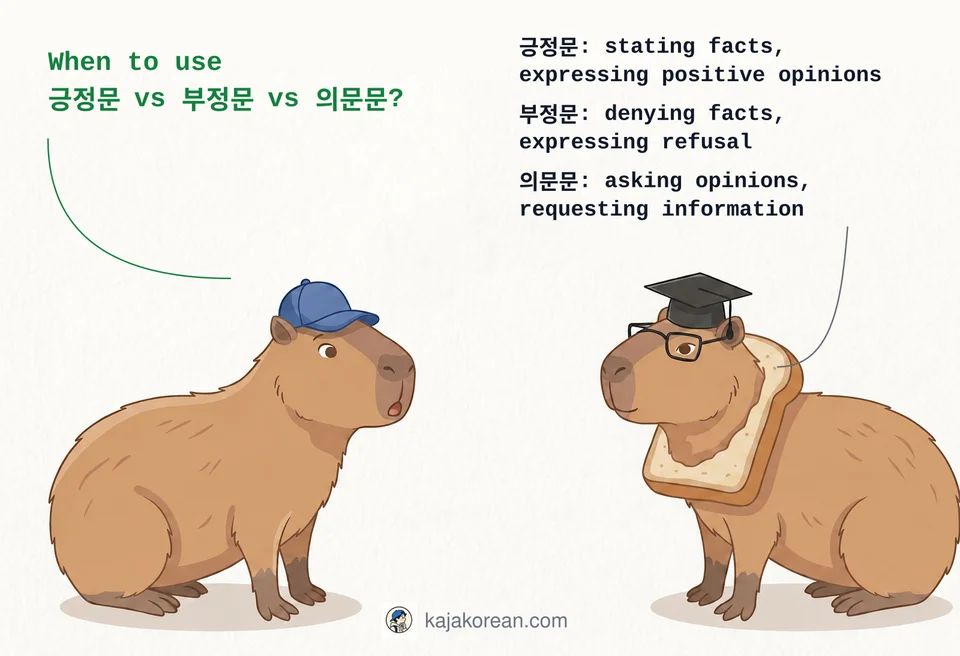
When to use

stating facts, expressing positive opinions, conveying confirmed information

The nuance

Used when the subject’s action or state is actually happening or acknowledged as true.

부정문(bu-jeong-mun, bujeongmun)

A sentence that negates a fact or state

When to use

denying facts, expressing refusal, rejecting requests

The nuance

Used when the subject’s action or state does not exist or is denied.

의문문(ui-mun-mun, uimunmun)

A sentence that asks a question or seeks information

When to use

requesting information, confirmation questions, asking opinions

The nuance

Used to express a question expecting an answer, often ending with ‘-까?’, ‘-니?’, ‘-나요?’ etc.

Real-world examples

  • 오늘 날씨가 좋다.

    o-neul nal-ssi-ga joh-da., o neul nal ssi ga joh da.

    Correct positive sentence stating a fact affirmatively.

  • 오늘 날씨가 좋지 않다.

    o-neul nal-ssi-ga joh-ji an-da., o neul nal ssi ga joh ji an da.

    Correct negative sentence negating the weather being good.

  • 오늘 날씨가 좋니?

    o-neul nal-ssi-ga joh-ni?, o neul nal ssi ga joh ni?

    Correct interrogative sentence asking about the weather.

  • 나는 학교에 안 간다.

    na-neun hak-gyo-e an gan-da., na neun hak gyo e an gan da.

    Correct negative sentence denying going to school.

  • 나는 학교에 간다?

    na-neun hak-gyo-e gan-da?, na neun hak gyo e gan da?

    Incorrect as a question; lacks interrogative ending despite question intonation.

  • 지금 몇 시야.

    ji-geum myeoch si-ya., ji geum myeoch si ya.

    Incorrect interrogative sentence; missing question ending makes it sound like statement or command.

  • 그 사람은 선생님이다.

    geu sa-ram-eun seon-saeng-nim-i-da., geu sa ram eun seon saeng nim i da.

    Correct positive sentence affirming the person's role.

  • 그 사람은 선생님이 아니다.

    geu sa-ram-eun seon-saeng-nim-i a-ni-da., geu sa ram eun seon saeng nim i a ni da.

    Correct negative sentence negating the person's role.

Quick quiz

  1. Which of the following is NOT a positive sentence?

    다음 중 긍정문이 아닌 문장은?(da-eumjunggeung-jeong-mun-ia-ninmun-jang-eun?, daeumjunggeungjeongmunianinmunjangeun?)
  2. What type of sentence is ‘오늘 몇 시에 출발하니?’

    ‘오늘 몇 시에 출발하니?’는 어떤 문장인가?(‘o-neulmyeochsi-echul-bal-ha-ni?’neuneo-tteonmun-jang-in-ga?, ‘oneulmyeochsiechulbalhani?’neuneotteonmunjanginga?)
  3. What type of sentence is ‘나는 숙제를 했다.’?

    ‘나는 숙제를 했다.’ 문장의 유형은?(‘na-neunsuk-je-reulhaess-da.’mun-jang-uiyu-hyeong-eun?, ‘naneunsukjereulhaessda.’munjanguiyuhyeongeun?)

More comparisons to explore

View all word comparisons →