
때(ttae)
A specific moment or point in time
When to use
Exact moment, Single event, Specific point in time
The nuance
때 is used to indicate a clear or specific moment, usually focusing on a single event or situation.
때 (ttae) · 무렵 (mu-ryeop, muryeop) · 즈음 (jeu-eum, jeueum)
때 indicates a specific moment, 무렵 refers to an approximate period, and 즈음 denotes a near point in time, each used in distinct contexts.
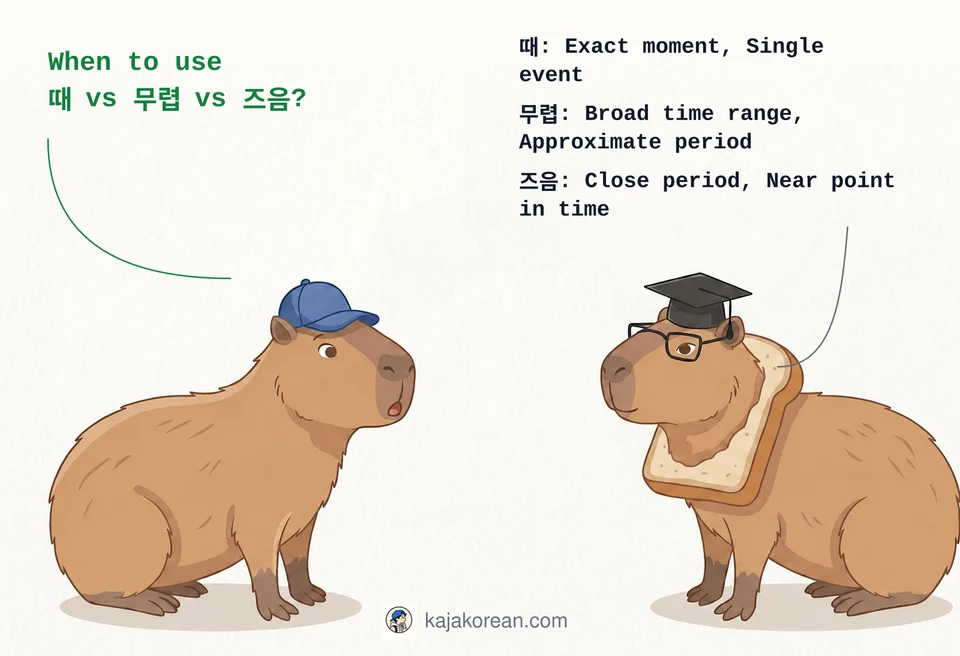
One lane per word — no nested boxes, just the gist.
A specific moment or point in time
When to use
Exact moment, Single event, Specific point in time
The nuance
때 is used to indicate a clear or specific moment, usually focusing on a single event or situation.
An approximate period or time frame
When to use
Approximate period, Broad time range, Past or future time
The nuance
무렵 is used to indicate a broad time range around a certain point, often referring to an approximate past or future period.
A time near or around a certain point
When to use
Near point in time, Close period, Intermediate range between 때 and 무렵
The nuance
즈음 refers to a time near a certain point, less specific than 때 but narrower than 무렵.
학교에 갈 때 비가 왔어요.
hak-gyo-e gal ttae bi-ga wass-eo-yo., hak gyo e gal ttae bi ga wass eo yo.
'때' correctly indicates the specific moment of 'going to school.'
학교에 갈 무렵 비가 왔어요.
hak-gyo-e gal mu-ryeop bi-ga wass-eo-yo., hak gyo e gal mu ryeop bi ga wass eo yo.
'무렵' is inappropriate because 'going to school' is a specific moment, not an approximate period.
여름 무렵에 여행을 갔어요.
yeo-reum mu-ryeop-e yeo-haeng-eul gass-eo-yo., yeo reum mu ryeop e yeo haeng eul gass eo yo.
'무렵' naturally expresses the approximate period of summer.
여름 즈음에 여행을 갔어요.
yeo-reum jeu-eum-e yeo-haeng-eul gass-eo-yo., yeo reum jeu eum e yeo haeng eul gass eo yo.
'즈음' also appropriately indicates a time near summer.
여름 때에 여행을 갔어요.
yeo-reum ttae-e yeo-haeng-eul gass-eo-yo., yeo reum ttae e yeo haeng eul gass eo yo.
'때' is unsuitable here because it denotes a specific moment, not an entire season.
시험 즈음에 공부를 많이 했어요.
si-heom jeu-eum-e gong-bu-reul man-i haess-eo-yo., si heom jeu eum e gong bu reul man i haess eo yo.
'즈음' properly indicates the period near the exam.
시험 때에 공부를 많이 했어요.
si-heom ttae-e gong-bu-reul man-i haess-eo-yo., si heom ttae e gong bu reul man i haess eo yo.
'때' fits because it focuses on the specific time of the exam.
시험 무렵에 공부를 많이 했어요.
si-heom mu-ryeop-e gong-bu-reul man-i haess-eo-yo., si heom mu ryeop e gong bu reul man i haess eo yo.
'무렵' is natural as it refers to the approximate time around the exam.
Which word indicates a specific moment?
Which word is closest in meaning to ‘여름 무렵’?
Why is ‘즈음’ appropriate in ‘시험 즈음에 공부했다’?