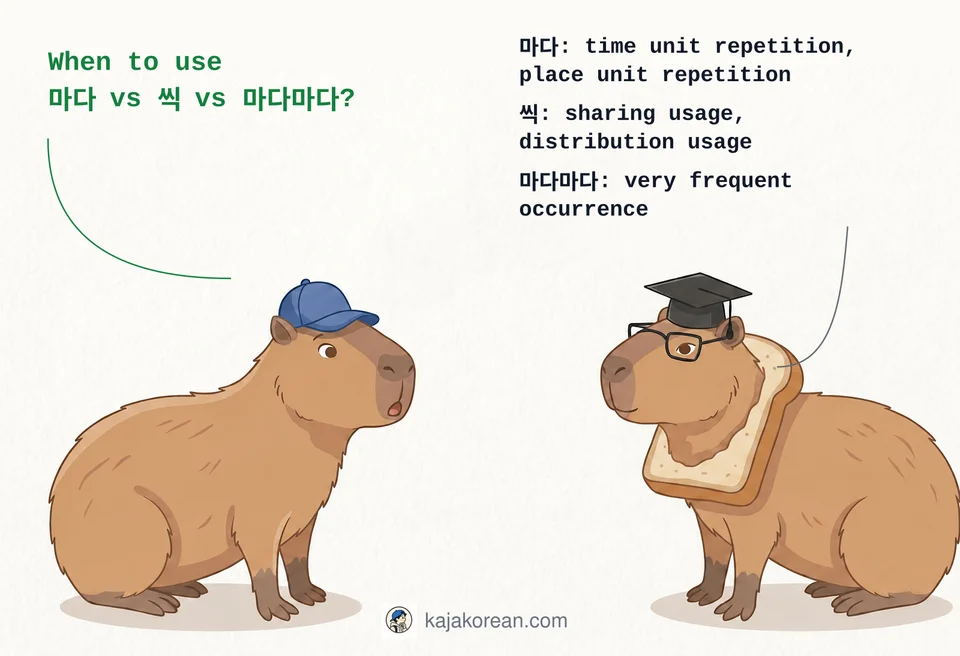
Indicates each individual target, time, or place; ‘마다’ means ‘each’ or ‘every’
When to use
time unit repetition, place unit repetition, subject unit repetition
The nuance
Attach after a noun to indicate each unit or repeated time/place.
마다 (ma-da, mada) · 씩 (ssik) · 마다마다 (ma-da-ma-da, madamada)
마다 indicates each repeated unit, 씩 expresses a fixed amount or quantity per unit, and 마다마다 is an emphatic form of 마다 highlighting strong repetition.

One lane per word — no nested boxes, just the gist.
Indicates each individual target, time, or place; ‘마다’ means ‘each’ or ‘every’
When to use
time unit repetition, place unit repetition, subject unit repetition
The nuance
Attach after a noun to indicate each unit or repeated time/place.
Expresses quantity or amount per unit, meaning ‘per each unit’
When to use
quantity unit expression, distribution usage, sharing usage
The nuance
Attach after a quantity noun to express a fixed amount or number per unit.
An emphatic form of ‘마다’ used to stress frequent repetition or occurrence
When to use
strong repetition emphasis, very frequent occurrence, annoyed repetition expression
The nuance
Attach ‘마다’ again after ‘마다’ to emphasize strong repetition or frequency.
나는 매일 아침마다 운동을 한다.
na-neun mae-il a-chim-ma-da un-dong-eul han-da., na neun mae il a chim ma da un dong eul han da.
‘마다’ indicates repetition per time unit, so ‘매일 아침마다’ is natural.
나는 사과마다 2개를 샀다.
na-neun sa-gwa-ma-da 2gae-reul sass-da., na neun sa gwa ma da 2gae reul sass da.
‘마다’ is for each unit but to express quantity per unit, use ‘씩’.
나는 사과를 2개씩 샀다.
na-neun sa-gwa-reul 2gae-ssik sass-da., na neun sa gwa reul 2gae ssik sass da.
‘씩’ expresses fixed quantity, so ‘2개씩’ is correct.
우리는 한 시간마다마다 쉬었다.
u-ri-neun han si-gan-ma-da-ma-da swi-eoss-da., u ri neun han si gan ma da ma da swi eoss da.
‘마다마다’ is emphatic but ‘한 시간마다마다’ is redundant and unnatural.
그는 일주일마다마다 편지를 보낸다.
geu-neun il-ju-il-ma-da-ma-da pyeon-ji-reul bo-naen-da., geu neun il ju il ma da ma da pyeon ji reul bo naen da.
‘마다마다’ can be used to emphasize strong repetition.
사람마다 의견이 다르다.
sa-ram-ma-da ui-gyeon-i da-reu-da., sa ram ma da ui gyeon i da reu da.
‘마다’ fits subject unit repetition.
친구들마다 선물을 받았다.
chin-gu-deul-ma-da seon-mul-eul bat-ass-da., chin gu deul ma da seon mul eul bat ass da.
‘마다’ usually pairs with singular nouns; ‘친구마다’ is correct.
학생들에게 책을 한 권씩 나누어 주었다.
hak-saeng-deul-e-ge chaek-eul han gwon-ssik na-nu-eo ju-eoss-da., hak saeng deul e ge chaek eul han gwon ssik na nu eo ju eoss da.
‘씩’ is appropriate for distribution.
Which sentence correctly uses ‘마다’?
Which sentence requires ‘씩’?
Which sentence naturally uses ‘마다마다’?