자주 vs 드물게: Subtle Differences in Frequency

자주 (ja-ju, jaju) · 드물게 (deu-mul-ge, deumulge)

자주 indicates frequent occurrence, while 드물게 denotes rarity; they are opposite frequency expressions.

Comparison of Korean adverbs 자주 and 드물게 indicating frequency

Word-by-word breakdown

One lane per word — no nested boxes, just the gist.

자주(ja-ju, jaju)

An adverb indicating that something happens frequently

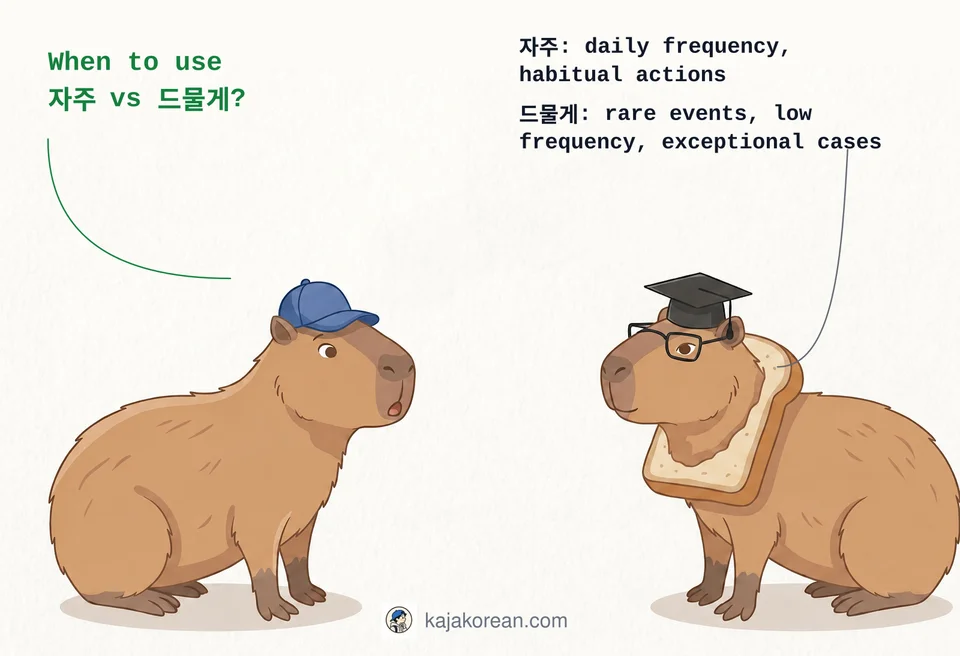
When to use

daily frequency, habitual actions, repetitive events

The nuance

Use 자주 when an action or event occurs at a relatively high frequency, commonly experienced or observed in daily life.

드물게(deu-mul-ge, deumulge)

An adverb indicating that something happens very infrequently or rarely

When to use

rare events, exceptional cases, low frequency

The nuance

Use 드물게 when something happens very rarely or almost never; suitable for uncommon or exceptional situations.

Real-world examples

  • 나는 드물게 카페에 간다.

    na-neun deu-mul-ge ka-pe-e gan-da., na neun deu mul ge ka pe e gan da.

    Saying 'I rarely go to cafes' accurately indicates a very low frequency of cafe visits.

  • 나는 자주 병에 걸린다.

    na-neun ja-ju byeong-e geol-rin-da., na neun ja ju byeong e geol rin da.

    Getting sick frequently is unlikely; '자주' is inappropriate here. Use '드물게' instead.

  • 나는 드물게 운동한다.

    na-neun deu-mul-ge un-dong-han-da., na neun deu mul ge un dong han da.

    '드물게' is appropriate to mean exercising infrequently.

  • 나는 드물게 친구를 만난다.

    na-neun deu-mul-ge chin-gu-reul man-nan-da., na neun deu mul ge chin gu reul man nan da.

    Use '드물게' when meeting friends is not frequent.

  • 그는 드물게 늦게 온다.

    geu-neun deu-mul-ge neuj-ge on-da., geu neun deu mul ge neuj ge on da.

    '드물게' fits to mean he rarely arrives late.

  • 그는 자주 늦게 온다.

    geu-neun ja-ju neuj-ge on-da., geu neun ja ju neuj ge on da.

    Use '자주' when being late happens frequently.

Quick quiz

  1. Which sentence should use '자주'?

    다음 중 '자주'를 써야 하는 문장은?(da-eumjung'ja-ju'reulsseo-yaha-neunmun-jang-eun?, daeumjung'jaju'reulsseoyahaneunmunjangeun?)
  2. When is '드물게' appropriate?

    '드물게'가 적절한 경우는?('deu-mul-ge'gajeok-jeol-hangyeong-u-neun?, 'deumulge'gajeokjeolhangyeonguneun?)
  3. Which word fits: '나는 ___ 카페에 간다.'?

    '나는 ___ 카페에 간다.'에 알맞은 단어는?('na-neun___ka-pe-egan-da.'eal-maj-eundan-eo-neun?, 'naneun___kapeeganda.'ealmajeundaneoneun?)

What does it mean?

More comparisons to explore

View all word comparisons →