항상 vs 맨날 vs 자주: Mastering Frequency Expressions

항상 (hang-sang, hangsang) · 맨날 (maen-nal, maennal) · 자주 (ja-ju, jaju)

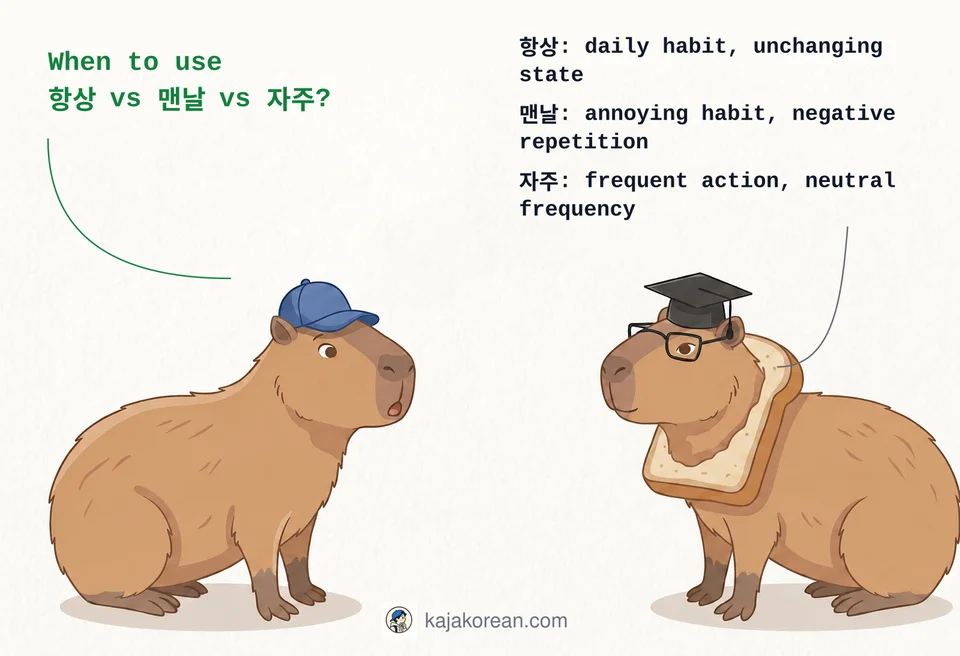
항상, 맨날, and 자주 all express frequency, but 항상 indicates an unchanging habit or state, 맨날 carries a negative nuance of repetitive action, and 자주 naturally expresses relatively high frequency without negativity.

Comparison of Korean frequency adverbs 항상, 맨날, 자주 with usage examples

Word-by-word breakdown

One lane per word — no nested boxes, just the gist.

항상(hang-sang, hangsang)

Indicates an unchanging, always consistent state or action

When to use

daily habit, unchanging state, positive repetition

The nuance

항상 is used when an action or state continues without exception. Suitable for positive or neutral contexts.

맨날(maen-nal, maennal)

Used to emphasize repetitive actions or situations with a negative nuance

When to use

negative repetition, annoying habit, complaint expression

The nuance

맨날 is mainly used with negative feelings to express repeated actions. It does not fit positive contexts.

자주(ja-ju, jaju)

Indicates relatively high frequency without negative connotation

When to use

frequent action, neutral frequency, positive frequency

The nuance

자주 is naturally used for frequent actions or situations, fitting both positive and neutral contexts.

Real-world examples

  • 나는 항상 아침에 커피를 마신다.

    na-neun hang-sang a-chim-e keo-pi-reul ma-sin-da., na neun hang sang a chim e keo pi reul ma sin da.

    항상 properly indicates an unchanging habit.

  • 나는 맨날 아침에 커피를 마신다.

    na-neun maen-nal a-chim-e keo-pi-reul ma-sin-da., na neun maen nal a chim e keo pi reul ma sin da.

    맨날 carries negative nuance, so it’s inappropriate for positive habits.

  • 나는 자주 아침에 커피를 마신다.

    na-neun ja-ju a-chim-e keo-pi-reul ma-sin-da., na neun ja ju a chim e keo pi reul ma sin da.

    자주 naturally expresses high frequency, so it fits well.

  • 그는 항상 지각한다.

    geu-neun hang-sang ji-gak-han-da., geu neun hang sang ji gak han da.

    항상 indicates an unchanging state, so it’s correct.

  • 그는 맨날 지각한다.

    geu-neun maen-nal ji-gak-han-da., geu neun maen nal ji gak han da.

    맨날 fits negative repetition, so it’s correct.

  • 그는 자주 지각한다.

    geu-neun ja-ju ji-gak-han-da., geu neun ja ju ji gak han da.

    자주 appropriately expresses frequent actions neutrally.

  • 나는 맨날 친구들에게 고마움을 느낀다.

    na-neun maen-nal chin-gu-deul-e-ge go-ma-um-eul neu-kkin-da., na neun maen nal chin gu deul e ge go ma um eul neu kkin da.

    맨날’s negative nuance makes it unsuitable for positive feelings.

  • 나는 자주 친구들에게 고마움을 느낀다.

    na-neun ja-ju chin-gu-deul-e-ge go-ma-um-eul neu-kkin-da., na neun ja ju chin gu deul e ge go ma um eul neu kkin da.

    자주 fits positive frequency expressions well.

Quick quiz

  1. Which word best emphasizes negative repetition?

    다음 중 부정적인 반복을 강조할 때 가장 적절한 단어는?(da-eumjungbu-jeong-jeok-inban-bok-eulgang-jo-halttaega-jangjeok-jeol-handan-eo-neun?, daeumjungbujeongjeokinbanbokeulgangjohalttaegajangjeokjeolhandaneoneun?)
  2. Which word is suitable for expressing an unchanging habit?

    변함없는 습관을 표현할 때 적합한 단어는?(byeon-ham-eop-neunseup-gwan-eulpyo-hyeon-halttaejeok-hap-handan-eo-neun?, byeonhameopneunseupgwaneulpyohyeonhalttaejeokhaphandaneoneun?)
  3. Which word best expresses a positive and natural high frequency?

    긍정적이고 자연스러운 높은 빈도를 나타낼 때 가장 알맞은 단어는?(geung-jeong-jeok-i-goja-yeon-seu-reo-unnop-eunbin-do-reulna-ta-naelttaega-jangal-maj-eundan-eo-neun?, geungjeongjeokigojayeonseureounnopeunbindoreulnatanaelttaegajangalmajeundaneoneun?)

What does it mean?

More comparisons to explore

View all word comparisons →