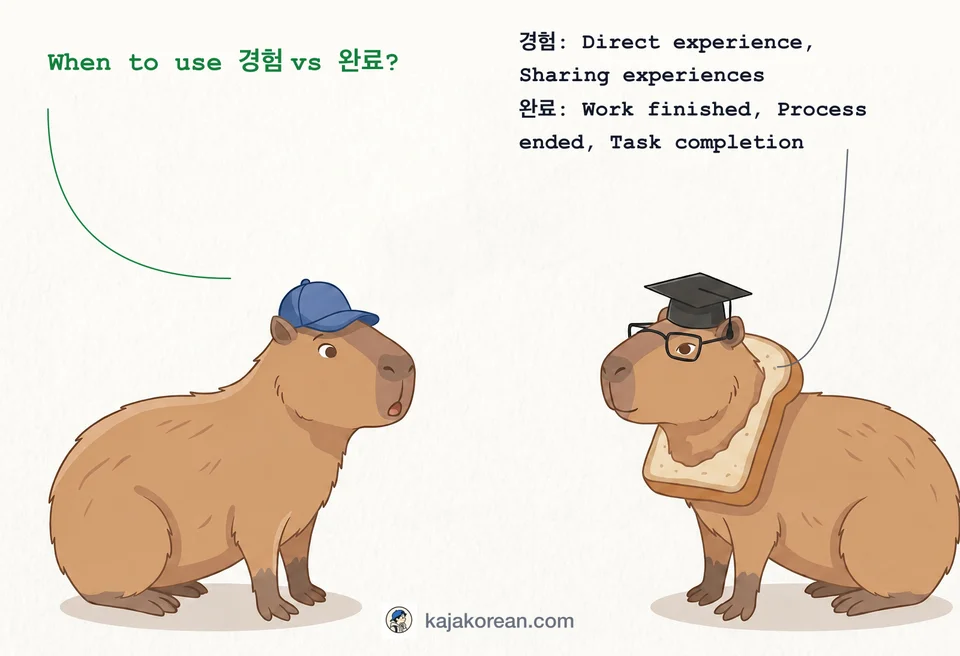
경험 (Gyeongheom) vs 완료 (Wanryo): Difference Between Experience and Completion

경험 (gyeong-heom, gyeongheom) · 완료 (wan-ryo, wanryo)

경험 (gyeongheom) means to have experienced something, while 완료 (wanryo) means to have completed or finished something.

Comparison of Korean words 경험 (experience) and 완료 (completion)

Word-by-word breakdown

One lane per word — no nested boxes, just the gist.

경험(gyeong-heom, gyeongheom)

To have directly experienced or undergone something

When to use

Direct experience, Sharing experiences, Referring to past events or incidents

The nuance

Use 경험 when referring to having gone through or undergone an event, activity, or situation. Unlike 완료, it focuses on 'experiencing' rather than 'finishing'.

완료(wan-ryo, wanryo)

Indicates the state of having finished or completed something

When to use

Task completion, Work finished, Process ended

The nuance

Use 완료 to emphasize that an action or task has been finished. Unlike 경험, it focuses on ‘completion’ rather than ‘experiencing’.

Real-world examples

  • 나는 해외 여행을 경험했어요.

    na-neun hae-oe yeo-haeng-eul gyeong-heom-haess-eo-yo., na neun hae oe yeo haeng eul gyeong heom haess eo yo.

    ‘경험’ is appropriate because it describes having directly experienced something.

  • 나는 해외 여행을 완료했어요.

    na-neun hae-oe yeo-haeng-eul wan-ryo-haess-eo-yo., na neun hae oe yeo haeng eul wan ryo haess eo yo.

    ‘완료’ means completion of a task, so it’s inappropriate for describing travel experience.

  • 프로젝트를 완료했습니다.

    peu-ro-jek-teu-reul wan-ryo-haess-seup-ni-da., peu ro jek teu reul wan ryo haess seup ni da.

    ‘완료’ fits because it indicates finishing a project or task.

  • 프로젝트를 경험했습니다.

    peu-ro-jek-teu-reul gyeong-heom-haess-seup-ni-da., peu ro jek teu reul gyeong heom haess seup ni da.

    ‘경험’ means to have experienced something, but it’s incorrect for saying you finished a project.

  • 그는 다양한 직업 경험이 많다.

    geu-neun da-yang-han jik-eop gyeong-heom-i man-da., geu neun da yang han jik eop gyeong heom i man da.

    ‘경험’ is suitable for expressing actual experiences.

  • 그는 다양한 직업 완료가 많다.

    geu-neun da-yang-han jik-eop wan-ryo-ga man-da., geu neun da yang han jik eop wan ryo ga man da.

    ‘완료’ does not collocate with ‘많다’ and is wrong for describing experience.

  • 수업을 완료한 후 증명서를 받았다.

    su-eop-eul wan-ryo-han hu jeung-myeong-seo-reul bat-ass-da., su eop eul wan ryo han hu jeung myeong seo reul bat ass da.

    ‘완료’ is appropriate because it indicates finishing a course.

  • 수업을 경험한 후 증명서를 받았다.

    su-eop-eul gyeong-heom-han hu jeung-myeong-seo-reul bat-ass-da., su eop eul gyeong heom han hu jeung myeong seo reul bat ass da.

    ‘경험’ means to have experienced, but it’s wrong to connect with receiving a certificate.

Quick quiz

  1. Which word is appropriate to indicate ‘directly experienced something’?

    어떤 단어가 ‘직접 겪은 일’을 나타낼 때 적합한가요?(eo-tteondan-eo-ga‘jik-jeopgyeokk-eunil’eulna-ta-naelttaejeok-hap-han-ga-yo?, eotteondaneoga‘jikjeopgyeokkeunil’eulnatanaelttaejeokhaphangayo?)
  2. Which word correctly expresses ‘finished a project’?

    ‘프로젝트를 끝냈다’를 표현할 때 올바른 단어는?(‘peu-ro-jek-teu-reulkkeut-naess-da’reulpyo-hyeon-halttaeol-ba-reundan-eo-neun?, ‘peurojekteureulkkeutnaessda’reulpyohyeonhalttaeolbareundaneoneun?)
  3. Which word fits in ‘He has a lot of diverse job ___’?

    ‘다양한 직업 ___이 많다’ 문장에 들어갈 단어는?(‘da-yang-hanjik-eop___iman-da’mun-jang-edeul-eo-galdan-eo-neun?, ‘dayanghanjikeop___imanda’munjangedeuleogaldaneoneun?)

More comparisons to explore

View all word comparisons →