
인용(in-yong, inyong)
Using someone else's exact words by quoting them
When to use
academic writing, interview quoting, legal evidence, exact wording
The nuance
Use 인용 when quoting original speech or text exactly without changing tone or content.
인용 (in-yong, inyong) · 전달 (jeon-dal, jeondal)
Inyong (인용) means quoting someone's exact words, while Jeondal (전달) means delivering information to others.
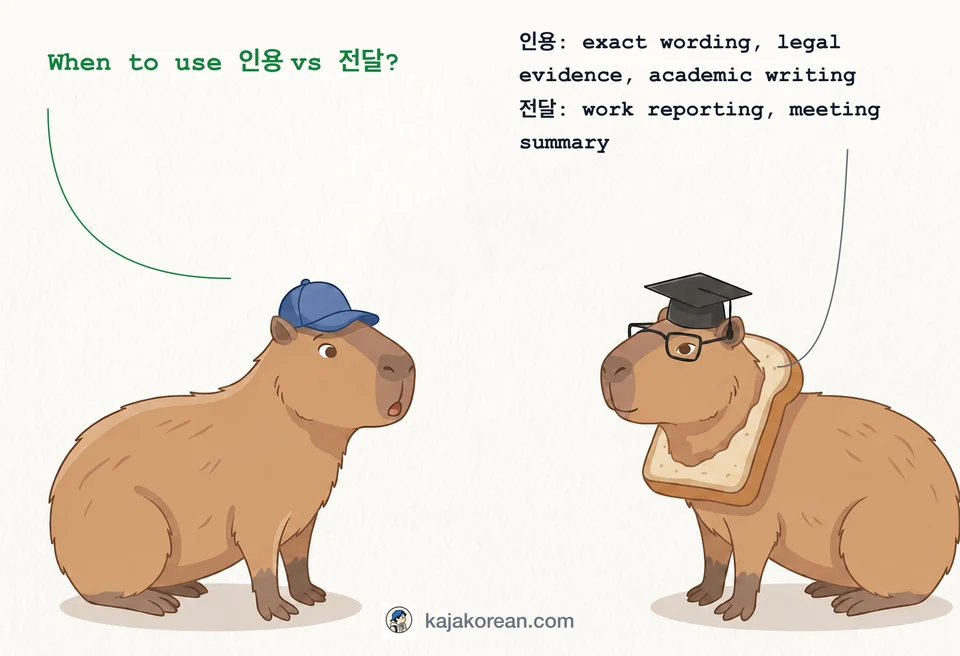
One lane per word — no nested boxes, just the gist.
Using someone else's exact words by quoting them
When to use
academic writing, interview quoting, legal evidence, exact wording
The nuance
Use 인용 when quoting original speech or text exactly without changing tone or content.
Informing or conveying information or content to others
When to use
work reporting, meeting summary, informing a friend, message delivery
The nuance
Use 전달 when conveying key information to others; exact wording is not necessary.
그 논문에서 유명 학자의 말을 인용했다.
geu non-mun-e-seo yu-myeong hak-ja-ui mal-eul in-yong-haess-da., geu non mun e seo yu myeong hak ja ui mal eul in yong haess da.
In academic writing, quoting exact words is appropriate for 인용.
그는 회의 내용을 인용해서 설명했다.
geu-neun hoe-ui nae-yong-eul in-yong-hae-seo seol-myeong-haess-da., geu neun hoe ui nae yong eul in yong hae seo seol myeong haess da.
Meeting content is usually summarized and conveyed, so 전달 is correct, not 인용.
친구에게 선생님 말씀을 전달했다.
chin-gu-e-ge seon-saeng-nim mal-sseum-eul jeon-dal-haess-da., chin gu e ge seon saeng nim mal sseum eul jeon dal haess da.
Since it's not exact wording but conveying content, 전달 is appropriate.
법정에서 증인의 말을 전달했다.
beop-jeong-e-seo jeung-in-ui mal-eul jeon-dal-haess-da., beop jeong e seo jeung in ui mal eul jeon dal haess da.
In court, exact words must be quoted, so 인용 is correct.
신문 기사에 대통령의 연설을 인용했다.
sin-mun gi-sa-e dae-tong-ryeong-ui yeon-seol-eul in-yong-haess-da., sin mun gi sa e dae tong ryeong ui yeon seol eul in yong haess da.
Media uses 인용 when quoting precise statements.
회의 결과를 팀원들에게 인용했다.
hoe-ui gyeol-gwa-reul tim-won-deul-e-ge in-yong-haess-da., hoe ui gyeol gwa reul tim won deul e ge in yong haess da.
Results are summarized and conveyed, so 전달 should be used instead of 인용.
상사가 지시사항을 전달했다.
sang-sa-ga ji-si-sa-hang-eul jeon-dal-haess-da., sang sa ga ji si sa hang eul jeon dal haess da.
Instructions involve conveying key points, so 전달 is correct.
책에서 명언을 전달했다.
chaek-e-seo myeong-eon-eul jeon-dal-haess-da., chaek e seo myeong eon eul jeon dal haess da.
Famous quotes require exact wording, so 인용 is appropriate.
Which word fits when quoting exact words?
Which is appropriate when summarizing meeting content?
Which word is used for quoting witness words exactly in court?
Which word fits when briefly informing a friend of what a teacher said?