합격하다 vs 합격되다: Subtle Difference Between Active and Passive

합격하다 (hap-gyeok-ha-da, hapgyeokhada) · 합격되다 (hap-gyeok-doe-da, hapgyeokdoeda)

'합격하다' expresses actively passing an exam, while '합격되다' emphasizes the passive receipt of the exam result.

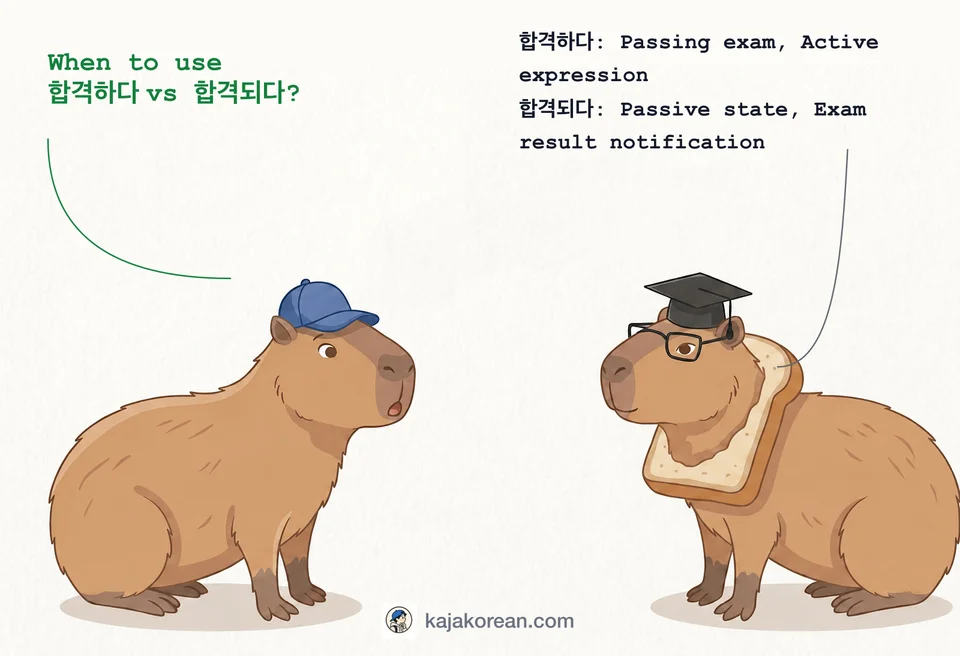
Comparison of Korean verbs 합격하다 and 합격되다 with usage examples

Word-by-word breakdown

One lane per word — no nested boxes, just the gist.

합격하다(hap-gyeok-ha-da, hapgyeokhada)

To actively pass an exam or screening.

When to use

Passing exam, Self-driven action, Active expression

The nuance

Used when the subject actively passes the exam. Strong active meaning, usually with a person as the subject.

합격되다(hap-gyeok-doe-da, hapgyeokdoeda)

To be passively given the result of passing or to become in a passed state.

When to use

Exam result notification, Passive state, Result-focused expression

The nuance

Used to express the subject being passively passed. Nuance of the result being given by the exam authority or external factors.

Real-world examples

  • 나는 이번 시험에 합격했다.

    na-neun i-beon si-heom-e hap-gyeok-haess-da., na neun i beon si heom e hap gyeok haess da.

    Naturally expresses the subject actively passing the exam.

  • 나는 이번 시험에 합격되었다.

    na-neun i-beon si-heom-e hap-gyeok-doe-eoss-da., na neun i beon si heom e hap gyeok doe eoss da.

    Using passive form here is unnatural for active passing; use '합격했다' instead.

  • 그는 드디어 합격했다.

    geu-neun deu-di-eo hap-gyeok-haess-da., geu neun deu di eo hap gyeok haess da.

    Appropriate for active, subject-driven passing.

  • 그는 드디어 합격되었다.

    geu-neun deu-di-eo hap-gyeok-doe-eoss-da., geu neun deu di eo hap gyeok doe eoss da.

    Passive form is awkward when subject is a person; active form recommended.

  • 합격되었다는 소식을 들었다.

    hap-gyeok-doe-eoss-da-neun so-sik-eul deul-eoss-da., hap gyeok doe eoss da neun so sik eul deul eoss da.

    Passive form is natural when the exam result is notified externally.

  • 합격했다는 소식을 들었다.

    hap-gyeok-haess-da-neun so-sik-eul deul-eoss-da., hap gyeok haess da neun so sik eul deul eoss da.

    Active form can also convey the passing news.

  • 시험에 합격되었다고 자랑하지 마라.

    si-heom-e hap-gyeok-doe-eoss-da-go ja-rang-ha-ji ma-ra., si heom e hap gyeok doe eoss da go ja rang ha ji ma ra.

    Passive form is unnatural with a person subject; use '합격했다'.

  • 시험에 합격했다고 자랑하지 마라.

    si-heom-e hap-gyeok-haess-da-go ja-rang-ha-ji ma-ra., si heom e hap gyeok haess da go ja rang ha ji ma ra.

    Active and natural expression.

Quick quiz

  1. Which word is appropriate to express the subject actively passing the exam?

    시험에 직접 합격한 주체를 표현할 때 적절한 단어는?(si-heom-ejik-jeophap-gyeok-hanju-che-reulpyo-hyeon-halttaejeok-jeol-handan-eo-neun?, siheomejikjeophapgyeokhanjuchereulpyohyeonhalttaejeokjeolhandaneoneun?)
  2. Which expression fits when the exam result is notified externally?

    시험 결과가 외부로부터 통보되는 상황에 어울리는 표현은?(si-heomgyeol-gwa-gaoe-bu-ro-bu-teotong-bo-doe-neunsang-hwang-eeo-ul-ri-neunpyo-hyeon-eun?, siheomgyeolgwagaoeburobuteotongbodoeneunsanghwangeeoulrineunpyohyeoneun?)
  3. Which expression is natural when the subject is a person?

    사람이 주어일 때 자연스러운 표현은?(sa-ram-iju-eo-ilttaeja-yeon-seu-reo-unpyo-hyeon-eun?, saramijueoilttaejayeonseureounpyohyeoneun?)

More comparisons to explore

View all word comparisons →