
여행하다(yeo-haeng-ha-da, yeohaenghada)
Actively planning and undertaking travel oneself
When to use
active travel, voluntary action, subjective planning
The nuance
Use when the subject actively performs the travel. It is an active verb.
여행하다 (yeo-haeng-ha-da, yeohaenghada) · 여행되다 (yeo-haeng-doe-da, yeohaengdoeda)
여행하다 (yeohaenghada) expresses active travel done by oneself, while 여행되다 (yeohaengdoeda) indicates passive or resulting travel by someone or circumstances.
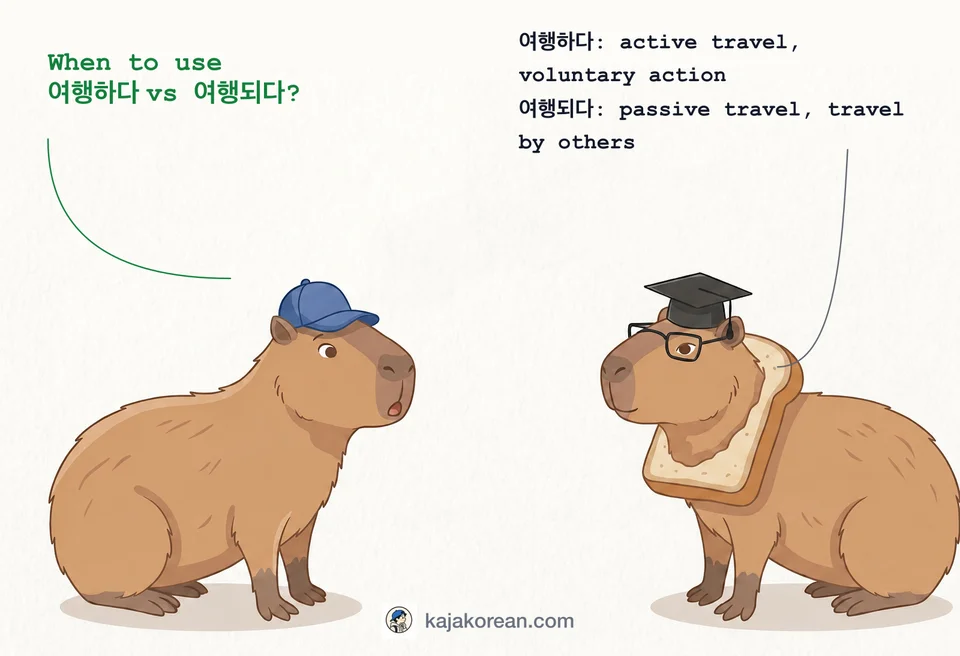
One lane per word — no nested boxes, just the gist.
Actively planning and undertaking travel oneself
When to use
active travel, voluntary action, subjective planning
The nuance
Use when the subject actively performs the travel. It is an active verb.
Travel happens due to external factors or by others; passive or resulting travel
When to use
passive travel, travel by others, situational result
The nuance
Used when the subject undergoes travel or when travel results from circumstances; has a passive meaning.
나는 다음 달에 일본으로 여행한다.
na-neun da-eum dal-e il-bon-eu-ro yeo-haeng-han-da., na neun da eum dal e il bon eu ro yeo haeng han da.
The subject actively travels, so 여행한다 is correct.
다음 달에 일본으로 여행된다.
da-eum dal-e il-bon-eu-ro yeo-haeng-doen-da., da eum dal e il bon eu ro yeo haeng doen da.
여행되다 is passive and unsuitable here; use active 여행한다.
그 회사 직원들은 해외로 자주 여행한다.
geu hoe-sa jik-won-deul-eun hae-oe-ro ja-ju yeo-haeng-han-da., geu hoe sa jik won deul eun hae oe ro ja ju yeo haeng han da.
Employees actively travel, so 여행한다 fits.
그 회사 직원들은 해외로 자주 여행된다.
geu hoe-sa jik-won-deul-eun hae-oe-ro ja-ju yeo-haeng-doen-da., geu hoe sa jik won deul eun hae oe ro ja ju yeo haeng doen da.
Implies employees are passively traveled, which is odd; use active form.
그는 갑작스러운 출장으로 여행되었다.
geu-neun gap-jak-seu-reo-un chul-jang-eu-ro yeo-haeng-doe-eoss-da., geu neun gap jak seu reo un chul jang eu ro yeo haeng doe eoss da.
Subject travels due to external factors, fitting passive 여행되다.
그는 갑작스러운 출장으로 여행했다.
geu-neun gap-jak-seu-reo-un chul-jang-eu-ro yeo-haeng-haess-da., geu neun gap jak seu reo un chul jang eu ro yeo haeng haess da.
Subject actively traveled, so 여행하다 fits too.
우리 가족은 계획 없이 여행되었다.
u-ri ga-jok-eun gye-hoek eop-i yeo-haeng-doe-eoss-da., u ri ga jok eun gye hoek eop i yeo haeng doe eoss da.
Travel happened passively due to circumstances, so 여행되다 fits.
우리 가족은 계획 없이 여행했다.
u-ri ga-jok-eun gye-hoek eop-i yeo-haeng-haess-da., u ri ga jok eun gye hoek eop i yeo haeng haess da.
Family actively traveled, even without planning, so 여행하다 fits.
Which word expresses the subject actively traveling?
Which word fits travel caused by external circumstances?
Which word to use if an employee voluntarily goes abroad on business?