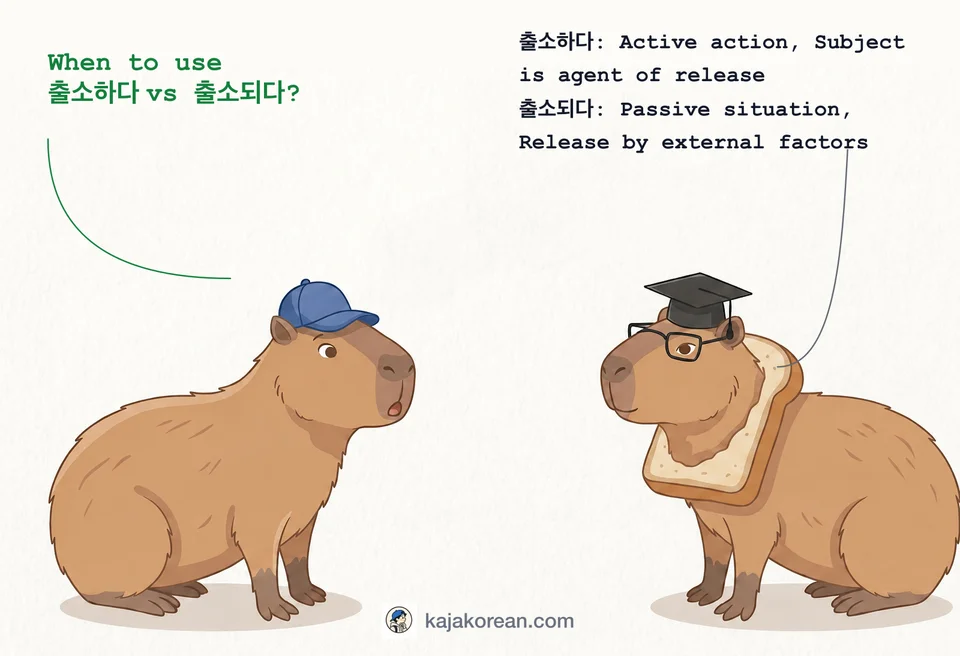
출소하다 vs 출소되다: Active vs Passive Nuance

출소하다 (chul-so-ha-da, chulsohada) · 출소되다 (chul-so-doe-da, chulsodoeda)

'출소하다' (chulsohada) expresses the active act of someone leaving prison themselves, while '출소되다' (chulso doeda) conveys the passive state of being released due to external factors.

Comparison of 출소하다 and 출소되다 usage in Korean

Word-by-word breakdown

One lane per word — no nested boxes, just the gist.

출소하다(chul-so-ha-da, chulsohada)

Active action of someone leaving prison themselves

When to use

Subject leaves prison themselves, Active action, Subject is agent of release

The nuance

Use when the subject actively leaves prison themselves; the subject is the agent of release.

출소되다(chul-so-doe-da, chulsodoeda)

Passive state of being released from prison by external factors

When to use

Release decided by authorities, Passive situation, Release by external factors

The nuance

Use when the subject is passively released due to external forces; release is decided by others.

Real-world examples

  • 그는 오늘 출소했다.

    geu-neun o-neul chul-so-haess-da., geu neun o neul chul so haess da.

    The subject actively leaves prison, so '출소하다' is correct.

  • 그는 오늘 출소되었다.

    geu-neun o-neul chul-so-doe-eoss-da., geu neun o neul chul so doe eoss da.

    Emphasizes passive release by external decision, so '출소되다' is acceptable.

  • 그녀는 출소되었다고 말했어요.

    geu-nyeo-neun chul-so-doe-eoss-da-go mal-haess-eo-yo., geu nyeo neun chul so doe eoss da go mal haess eo yo.

    Appropriate for expressing passive release situation.

  • 그녀는 출소했다라고 말했다.

    geu-nyeo-neun chul-so-haess-da-ra-go mal-haess-da., geu nyeo neun chul so haess da ra go mal haess da.

    Natural when expressing active release.

  • 나는 출소되었다.

    na-neun chul-so-doe-eoss-da., na neun chul so doe eoss da.

    Since the subject actively leaves, use '출소하다' instead.

  • 나는 출소했다.

    na-neun chul-so-haess-da., na neun chul so haess da.

    Correct for active action of self-release.

  • 그는 출소되었다고 자랑했다.

    geu-neun chul-so-doe-eoss-da-go ja-rang-haess-da., geu neun chul so doe eoss da go ja rang haess da.

    Natural sentence expressing passive release.

  • 그는 출소했다고 자랑했다.

    geu-neun chul-so-haess-da-go ja-rang-haess-da., geu neun chul so haess da go ja rang haess da.

    Appropriate for expressing active release.

Quick quiz

  1. Which sentence expresses active release from prison?

    다음 중 능동적 출소를 표현한 문장은?(da-eumjungneung-dong-jeokchul-so-reulpyo-hyeon-hanmun-jang-eun?, daeumjungneungdongjeokchulsoreulpyohyeonhanmunjangeun?)
  2. Which is appropriate for a passive release situation?

    수동적 출소 상황에 적합한 표현은?(su-dong-jeokchul-sosang-hwang-ejeok-hap-hanpyo-hyeon-eun?, sudongjeokchulsosanghwangejeokhaphanpyohyeoneun?)
  3. Which word fits in '나는 ___'?

    '나는 ___'에 들어갈 알맞은 단어는?('na-neun___'edeul-eo-galal-maj-eundan-eo-neun?, 'naneun___'edeuleogalalmajeundaneoneun?)

More comparisons to explore

View all word comparisons →