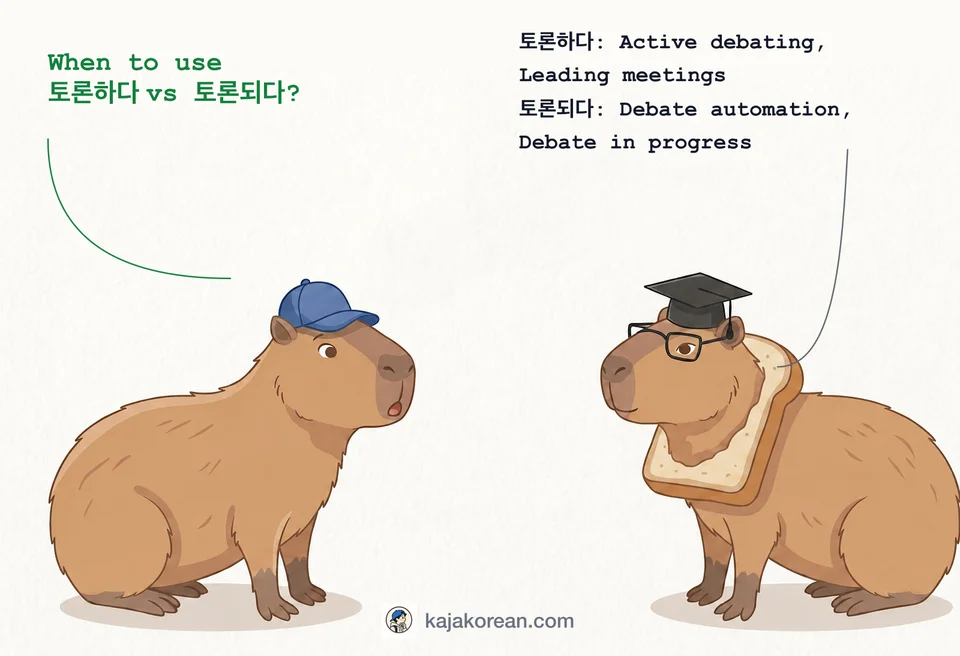
토론하다 vs 토론되다: Active vs Passive Usage

토론하다 (to-ron-ha-da, toronhada) · 토론되다 (to-ron-doe-da, torondoeda)

토론하다 (toronhada) describes actively debating or discussing, while 토론되다 (torondoeda) expresses that a debate happens or is conducted passively or automatically.

Comparison of Korean verbs 토론하다 and 토론되다 showing active vs passive usage

Word-by-word breakdown

One lane per word — no nested boxes, just the gist.

토론하다(to-ron-ha-da, toronhada)

An active act of exchanging opinions and debating directly

When to use

Active debating, Leading meetings, Q&A after presentations

The nuance

Use when the subject actively engages in debating or discussing. It is an active verb.

토론되다(to-ron-doe-da, torondoeda)

Indicates that a debate is happening or being conducted passively or automatically

When to use

Debate in progress, Meeting outcome reporting, Debate automation

The nuance

Use to express that a debate is taking place or is conducted passively. It is a passive verb.

Real-world examples

  • 우리는 내일 중요한 주제에 대해 토론한다.

    u-ri-neun nae-il jung-yo-han ju-je-e dae-hae to-ron-han-da., u ri neun nae il jung yo han ju je e dae hae to ron han da.

    The subject actively debates, so 토론하다 is correct.

  • 회의에서 여러 의견이 토론되었다.

    hoe-ui-e-seo yeo-reo ui-gyeon-i to-ron-doe-eoss-da., hoe ui e seo yeo reo ui gyeon i to ron doe eoss da.

    Indicates debate happened passively, so 토론되다 is correct.

  • 학생들이 토론되었다.

    hak-saeng-deul-i to-ron-doe-eoss-da., hak saeng deul i to ron doe eoss da.

    Students cannot be 'debated' passively; they actively debate, so 토론하다 is correct.

  • 그 문제를 토론되었다.

    geu mun-je-reul to-ron-doe-eoss-da., geu mun je reul to ron doe eoss da.

    It is unnatural for a problem to be 'debated' passively; use 토론하다 for active discussion.

  • 우리는 토론을 통해 해결책을 찾았다.

    u-ri-neun to-ron-eul tong-hae hae-gyeol-chaek-eul chaj-ass-da., u ri neun to ron eul tong hae hae gyeol chaek eul chaj ass da.

    Active discussion is happening, so use 토론하다.

  • 회의에서 토론되었던 내용이 보고서에 포함되었다.

    hoe-ui-e-seo to-ron-doe-eoss-deon nae-yong-i bo-go-seo-e po-ham-doe-eoss-da., hoe ui e seo to ron doe eoss deon nae yong i bo go seo e po ham doe eoss da.

    Describes debate occurring passively, so 토론되다 is correct.

  • 우리는 토론되었다.

    u-ri-neun to-ron-doe-eoss-da., u ri neun to ron doe eoss da.

    People cannot be passively debated; use active 토론하다.

  • 그 주제는 토론되었다.

    geu ju-je-neun to-ron-doe-eoss-da., geu ju je neun to ron doe eoss da.

    The topic was passively debated, so 토론되다 is correct.

Quick quiz

  1. Which sentence expresses actively exchanging opinions?

    다음 중 능동적으로 의견을 나누는 행위를 표현한 문장은?(da-eumjungneung-dong-jeok-eu-roui-gyeon-eulna-nu-neunhaeng-wi-reulpyo-hyeon-hanmun-jang-eun?, daeumjungneungdongjeokeurouigyeoneulnanuneunhaengwireulpyohyeonhanmunjangeun?)
  2. Which word fits when opinions are passively discussed in a meeting?

    회의에서 의견이 자동으로 논의된 상태를 표현할 때 적절한 단어는?(hoe-ui-e-seoui-gyeon-ija-dong-eu-ronon-ui-doensang-tae-reulpyo-hyeon-halttaejeok-jeol-handan-eo-neun?, hoeuieseouigyeonijadongeurononuidoensangtaereulpyohyeonhalttaejeokjeolhandaneoneun?)
  3. Fill in the blank: ‘학생들이 토론____.’

    ‘학생들이 토론____.’ 빈칸에 들어갈 말은?(‘hak-saeng-deul-ito-ron____.’bin-kan-edeul-eo-galmal-eun?, ‘haksaengdeulitoron____.’binkanedeuleogalmaleun?)

More comparisons to explore

View all word comparisons →