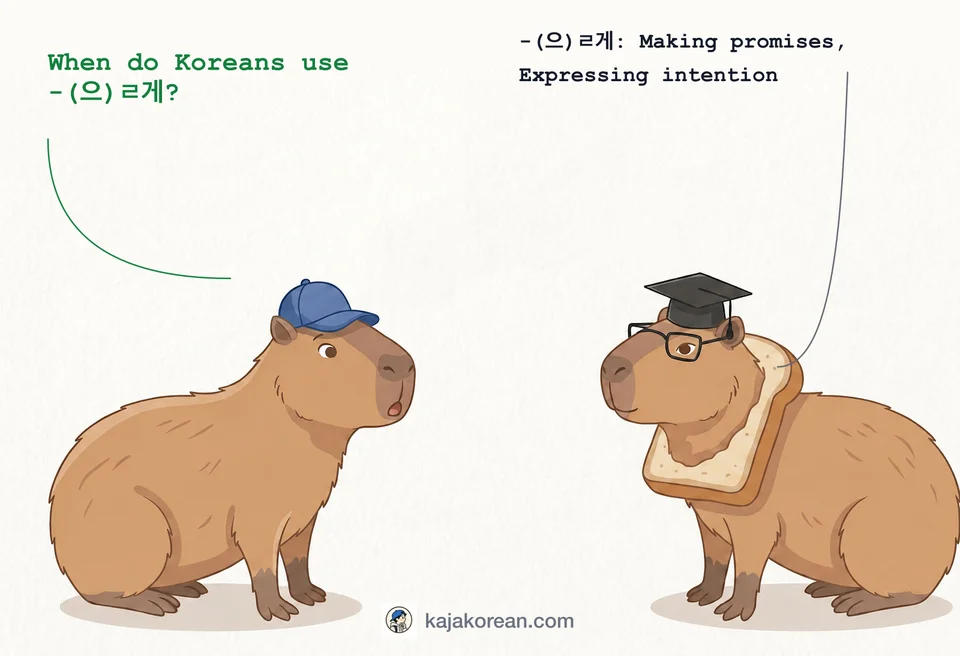
How to use 을/ㄹ게 in Korean

Pattern: -(으)ㄹ게

-(으)ㄹ게 (-(eu)ㄹge, (eu)ㄹge)

-(으)ㄹ게 is a sentence ending used to gently express your intention or promise to someone.

Korean grammar -(으)ㄹ게 usage explanation

Usage guide

When and how native speakers actually use it.

-(으)ㄹ게(-(eu)ㄹge, (eu)ㄹge)

A sentence ending that the speaker uses to inform the listener of their intention or promise.

When to use

Making promises, Expressing intention, Consideration for listener

The nuance

Attach '-을게' to verb stems ending in a consonant, and '-ㄹ게' after vowels. This ending is mainly used by first-person subjects (나, 저) to express intention, promise, or willingness toward the listener. It implies acting according to the listener’s response or situation. It is used in declarative sentences, giving a friendly and soft tone in conversation.

Real-world examples

  • 내일 일찍 올게.

    nae-il il-jjik ol-ge., nae il il jjik ol ge.

    Natural expression where first-person promises the listener.

  • 너 기다릴게.

    neo gi-da-ril-ge., neo gi da ril ge.

    Correct sentence expressing intention with consideration for listener.

  • 내가 할게.

    nae-ga hal-ge., nae ga hal ge.

    Typical example of gently expressing one’s intention.

  • 내일 비가 올게.

    nae-il bi-ga ol-ge., nae il bi ga ol ge.

    Subject is third-person; -(으)ㄹ게 is only for first-person subjects.

  • 나는 먹을게.

    na-neun meok-eul-ge., na neun meok eul ge.

    Appropriate sentence expressing intention with first-person subject.

  • 우리 집에 갈게.

    u-ri jip-e gal-ge., u ri jip e gal ge.

    Natural sentence informing listener of speaker’s intention.

  • 너는 할게.

    neo-neun hal-ge., neo neun hal ge.

    -(으)ㄹ게 is only used with first-person subjects, not second-person.

Quick quiz

  1. Which sentence correctly uses -(으)ㄹ게?

    다음 중 -(으)ㄹ게를 올바르게 쓴 문장은?(da-eumjung-(eu)ㄹge-reulol-ba-reu-gesseunmun-jang-eun?, daeumjung(eu)ㄹgereulolbareugesseunmunjangeun?)
  2. What is the main use of -(으)ㄹ게?

    -(으)ㄹ게의 주된 용도는?(-(eu)ㄹge-uiju-doenyong-do-neun?, (eu)ㄹgeuijudoenyongdoneun?)
  3. Which sentence is incorrect?

    다음 중 틀린 문장은?(da-eumjungteul-rinmun-jang-eun?, daeumjungteulrinmunjangeun?)

More usage guides

View all usage guides →