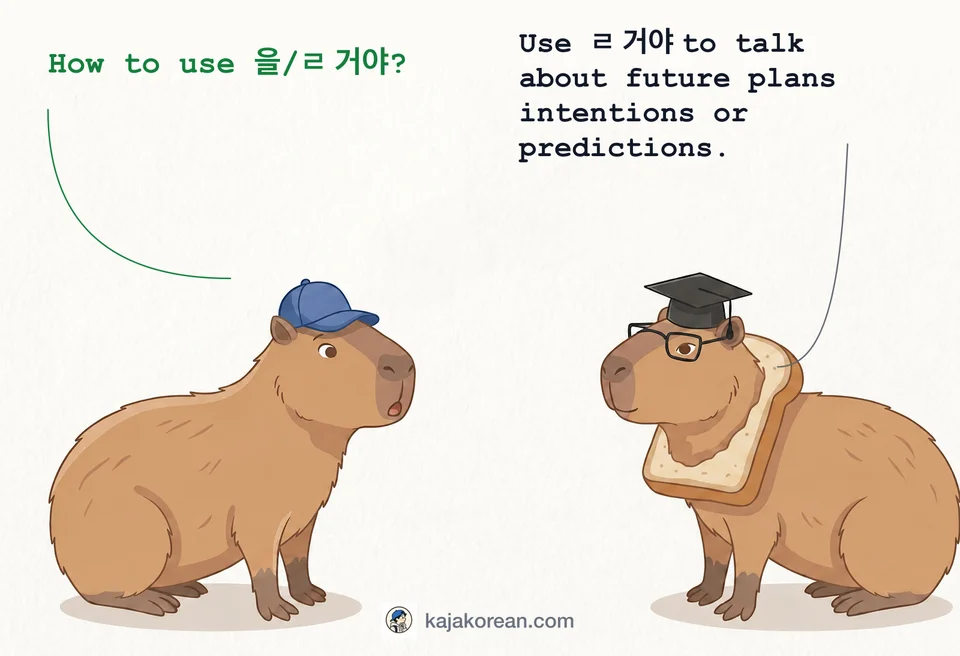
How to use 을/ㄹ 거야 in Korean

Pattern: -(으)ㄹ 거야

-(으)ㄹ 거야 (-(eu)ㄹgeo-ya, (eu)ㄹgeoya)

-(으)ㄹ 거야 expresses future intentions or predictions in Korean.

Korean future tense grammar -(으)ㄹ 거야 explained

Usage guide

When and how native speakers actually use it.

-(으)ㄹ 거야(-(eu)ㄹgeo-ya, (eu)ㄹgeoya)

Indicates future events or intentions

When to use

Talking about future plans, Expressing predictions or guesses, Showing intention

The nuance

Attach -(으)ㄹ 거야 to the verb or adjective stem to form the future tense. Use -을 거야 if the stem ends with a consonant, and -ㄹ 거야 if it ends with a vowel. It is mainly used in spoken Korean to express intention, plan, or prediction.

Real-world examples

  • 내일 친구를 만날 거야.

    nae-il chin-gu-reul man-nal geo-ya., nae il chin gu reul man nal geo ya.

    Naturally expresses a future event.

  • 비가 올 거야.

    bi-ga ol geo-ya., bi ga ol geo ya.

    Correctly indicates a future weather prediction.

  • 나는 지금 먹을 거야.

    na-neun ji-geum meok-eul geo-ya., na neun ji geum meok eul geo ya.

    Expresses intention to eat soon.

  • 내일 도서관에 갈 거야.

    nae-il do-seo-gwan-e gal geo-ya., nae il do seo gwan e gal geo ya.

    Naturally expresses a future plan.

  • 내일 도서관에 가을 거야.

    nae-il do-seo-gwan-e ga-eul geo-ya., nae il do seo gwan e ga eul geo ya.

    '가을' is a noun, incorrect conjugation here.

  • 나는 공부할 거야.

    na-neun gong-bu-hal geo-ya., na neun gong bu hal geo ya.

    Proper form expressing future intention.

  • 그 사람은 올 거야?

    geu sa-ram-eun ol geo-ya?, geu sa ram eun ol geo ya?

    Appropriate expression for a future question.

  • 나는 먹을 거야 지금.

    na-neun meok-eul geo-ya ji-geum., na neun meok eul geo ya ji geum.

    Adverb placement is unnatural.

Quick quiz

  1. Which sentence expresses a future plan?

    다음 중 미래 계획을 표현한 문장은?(da-eumjungmi-raegye-hoek-eulpyo-hyeon-hanmun-jang-eun?, daeumjungmiraegyehoekeulpyohyeonhanmunjangeun?)
  2. What does '비가 올 거야' mean?

    ‘비가 올 거야’ 문장의 의미는?(‘bi-gaolgeo-ya’mun-jang-uiui-mi-neun?, ‘bigaolgeoya’munjanguiuimineun?)
  3. What is the role of -(으)ㄹ 거야 in ‘내일 친구를 만날 거야’?

    ‘내일 친구를 만날 거야’ 문장에서 -(으)ㄹ 거야의 역할은?(‘nae-ilchin-gu-reulman-nalgeo-ya’mun-jang-e-seo-(eu)ㄹgeo-ya-uiyeok-hal-eun?, ‘naeilchingureulmannalgeoya’munjangeseo(eu)ㄹgeoyauiyeokhaleun?)

More usage guides

View all usage guides →