How to use 을/ㄹ 때 in Korean

Pattern: -(으)ㄹ 때

-(으)ㄹ 때 (-(eu)ㄹttae, (eu)ㄹttae)

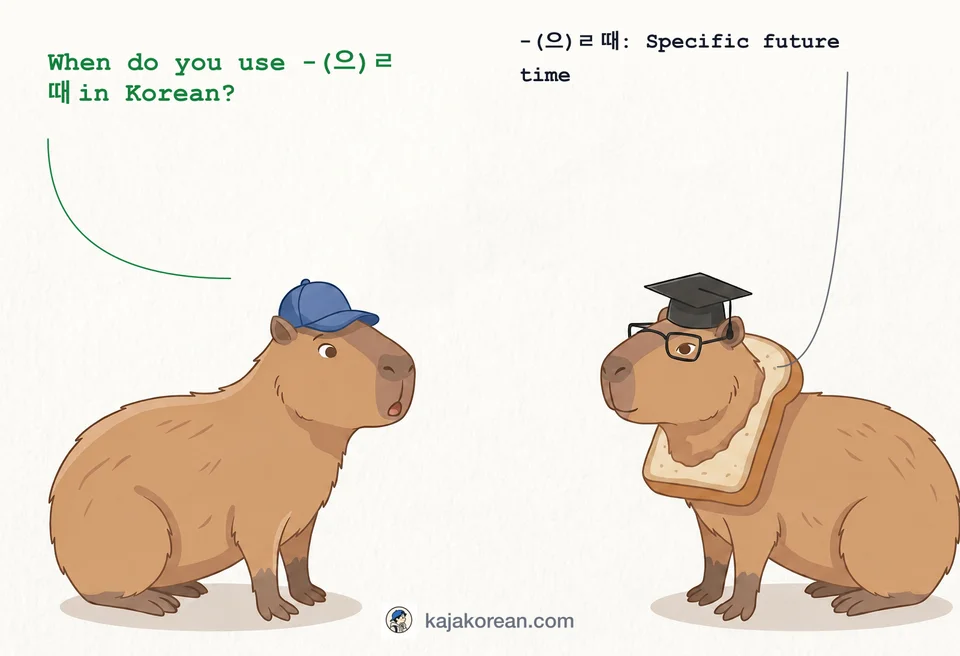
-(으)ㄹ 때 indicates a specific future time or situation. It naturally expresses 'when' something happens.

Korean grammar -(으)ㄹ 때 usage illustration

Usage guide

When and how native speakers actually use it.

-(으)ㄹ 때(-(eu)ㄹttae, (eu)ㄹttae)

Indicates the time or situation when something happens.

When to use

Specific future time, Moment when an action happens, General situation description

The nuance

Attach -(으)ㄹ 때 to the verb or adjective stem to indicate a future or general time. Use -을 때 if the stem ends with a consonant, -ㄹ 때 if it ends with a vowel. Examples: 먹다 → 먹을 때, 가다 → 갈 때.

Real-world examples

  • 학교에 갈 때 비가 왔어요.

    hak-gyo-e gal ttae bi-ga wass-eo-yo., hak gyo e gal ttae bi ga wass eo yo.

    '갈 때' correctly attaches '-ㄹ 때' to the stem of '가다' indicating the time of going.

  • 밥을 먹을 때 손을 씻으세요.

    bap-eul meok-eul ttae son-eul ssis-eu-se-yo., bap eul meok eul ttae son eul ssis eu se yo.

    Since '먹다' has a final consonant, '-을 때' is correctly attached as '먹을 때'.

  • 노래를 부를 때 즐거워요.

    no-rae-reul bu-reul ttae jeul-geo-wo-yo., no rae reul bu reul ttae jeul geo wo yo.

    '부르다' ends with a vowel, so '-ㄹ 때' is correctly attached as '부를 때'.

  • 책을 읽을 때 조용히 하세요.

    chaek-eul ik-eul ttae jo-yong-hi ha-se-yo., chaek eul ik eul ttae jo yong hi ha se yo.

    '읽다' has a final consonant, so '-을 때' is correctly attached as '읽을 때'.

  • 운동할 때 음악을 들어요.

    un-dong-hal ttae eum-ak-eul deul-eo-yo., un dong hal ttae eum ak eul deul eo yo.

    '운동하다' ends with a vowel, so '-ㄹ 때' is correctly attached as '운동할 때'.

  • 학교에 갈때 비가 왔어요.

    hak-gyo-e gal-ttae bi-ga wass-eo-yo., hak gyo e gal ttae bi ga wass eo yo.

    '갈 때' must be written separately; writing together is incorrect.

  • 먹을때 손을 씻으세요.

    meok-eul-ttae son-eul ssis-eu-se-yo., meok eul ttae son eul ssis eu se yo.

    '먹을 때' must be written separately; writing together is incorrect.

Quick quiz

  1. Which sentence uses '-(으)ㄹ 때' correctly?

    다음 중 '-(으)ㄹ 때'를 올바르게 쓴 문장은?(da-eumjung'-(eu)ㄹttae'reulol-ba-reu-gesseunmun-jang-eun?, daeumjung'(eu)ㄹttae'reulolbareugesseunmunjangeun?)
  2. What is the correct meaning of '-(으)ㄹ 때'?

    '(으)ㄹ 때'의 의미로 옳은 것은?('(eu)ㄹttae'uiui-mi-rool-eungeos-eun?, '(eu)ㄹttae'uiuimirooleungeoseun?)
  3. How do you attach '-(으)ㄹ 때' to '가다'?

    '가다'에 '-(으)ㄹ 때'를 붙이면?('ga-da'e'-(eu)ㄹttae'reulbut-i-myeon?, 'gada'e'(eu)ㄹttae'reulbutimyeon?)

More usage guides

View all usage guides →