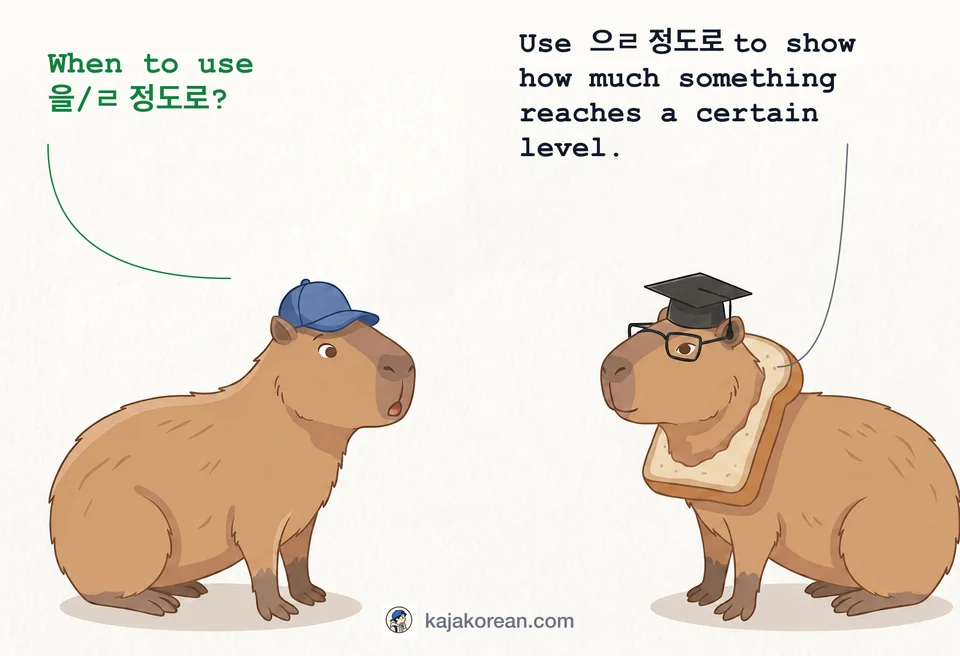
How to use 을/ㄹ 정도로 in Korean

Pattern: -(으)ㄹ 정도로

-(으)ㄹ 정도로 (-(eu)ㄹjeong-do-ro, (eu)ㄹjeongdoro)

-(으)ㄹ 정도로 expresses that a situation or state has reached a certain level or degree.

Korean grammar 으ㄹ 정도로 usage explanation

Usage guide

When and how native speakers actually use it.

-(으)ㄹ 정도로(-(eu)ㄹjeong-do-ro, (eu)ㄹjeongdoro)

Indicates that a state or degree is very high or intense.

When to use

expressing emotions, describing states, emphasizing intensity

The nuance

Attach -(으)ㄹ 정도로 to verb or adjective stems to indicate the degree or level. Use -(으)ㄹ 정도로 for present or future, and -(으)ㄴ 정도로 for past. Usually followed by a positive or negative result or state.

Real-world examples

  • 너무 배고파서 쓰러질 정도로 아팠어.

    neo-mu bae-go-pa-seo sseu-reo-jil jeong-do-ro a-pass-eo., neo mu bae go pa seo sseu reo jil jeong do ro a pass eo.

    '쓰러질 정도로' naturally expresses the intensity of 'being hungry'.

  • 그 영화가 재미없을 정도로 지루했어.

    geu yeong-hwa-ga jae-mi-eop-eul jeong-do-ro ji-ru-haess-eo., geu yeong hwa ga jae mi eop eul jeong do ro ji ru haess eo.

    '재미없을 정도로' appropriately indicates a negative degree.

  • 비가 올 정도로 구름이 많았어요.

    bi-ga ol jeong-do-ro gu-reum-i man-ass-eo-yo., bi ga ol jeong do ro gu reum i man ass eo yo.

    '올 정도로' suits present or future situations.

  • 너무 피곤해서 잠을 잘 정도로 졸렸어.

    neo-mu pi-gon-hae-seo jam-eul jal jeong-do-ro jol-ryeoss-eo., neo mu pi gon hae seo jam eul jal jeong do ro jol ryeoss eo.

    '잘 정도로' well expresses the intensity of a state.

  • 그는 노래를 부를 정도로 춤을 잘 춰요.

    geu-neun no-rae-reul bu-reul jeong-do-ro chum-eul jal chwo-yo., geu neun no rae reul bu reul jeong do ro chum eul jal chwo yo.

    '노래를 부를 정도로' is awkward because singing and dancing are unrelated here.

  • 너무 빨라서 따라올 정도로 힘들었어.

    neo-mu ppal-ra-seo tta-ra-ol jeong-do-ro him-deul-eoss-eo., neo mu ppal ra seo tta ra ol jeong do ro him deul eoss eo.

    '따라올 정도로' does not fit well with a negative meaning here.

Quick quiz

  1. Which sentence correctly uses -(으)ㄹ 정도로?

    다음 중 '-(으)ㄹ 정도로'를 올바르게 사용한 문장은?(da-eumjung'-(eu)ㄹjeong-do-ro'reulol-ba-reu-gesa-yong-hanmun-jang-eun?, daeumjung'(eu)ㄹjeongdoro'reulolbareugesayonghanmunjangeun?)
  2. What does -(으)ㄹ 정도로 mean in '너무 피곤해서 잠을 잘 정도로 졸렸어.'?

    '너무 피곤해서 잠을 잘 정도로 졸렸어.' 문장에서 '-(으)ㄹ 정도로'의 의미는?('neo-mupi-gon-hae-seojam-euljaljeong-do-rojol-ryeoss-eo.'mun-jang-e-seo'-(eu)ㄹjeong-do-ro'uiui-mi-neun?, 'neomupigonhaeseojameuljaljeongdorojolryeosseo.'munjangeseo'(eu)ㄹjeongdoro'uiuimineun?)
  3. Which form is used instead of -(으)ㄹ 정도로 for past situations?

    과거 상황을 표현할 때 '-(으)ㄹ 정도로' 대신 사용할 표현은?(gwa-geosang-hwang-eulpyo-hyeon-halttae'-(eu)ㄹjeong-do-ro'dae-sinsa-yong-halpyo-hyeon-eun?, gwageosanghwangeulpyohyeonhalttae'(eu)ㄹjeongdoro'daesinsayonghalpyohyeoneun?)

More usage guides

View all usage guides →