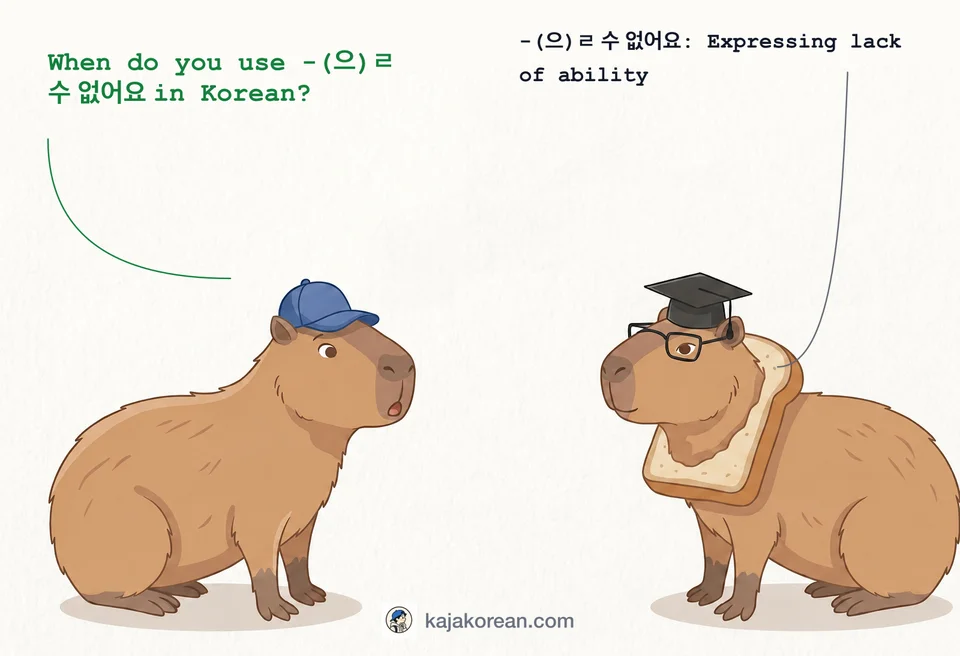
How to use 을/ㄹ 수 없어요 in Korean

Pattern: -(으)ㄹ 수 없어요

-(으)ㄹ 수 없어요 (-(eu)ㄹsueop-eo-yo, (eu)ㄹsueopeoyo)

-(으)ㄹ 수 없어요 is used to express impossibility of an action or situation in Korean.

Korean grammar -(으)ㄹ 수 없어요 usage guide

Usage guide

When and how native speakers actually use it.

-(으)ㄹ 수 없어요(-(eu)ㄹsueop-eo-yo, (eu)ㄹsueopeoyo)

Expression indicating that an action or situation is impossible

When to use

Describing impossible situations, Expressing lack of ability, Denying permission or possibility

The nuance

Attach -(으)ㄹ 수 없어요 to the verb stem to mean 'cannot do ~' or 'it is impossible to ~'. Use -을 수 없어요 if the stem ends with a consonant, and -ㄹ 수 없어요 if it ends with a vowel. Example: 가다 → 갈 수 없어요, 먹다 → 먹을 수 없어요.

Real-world examples

  • 내일 회의에 참석할 수 없어요.

    nae-il hoe-ui-e cham-seok-hal su eop-eo-yo., nae il hoe ui e cham seok hal su eop eo yo.

    The verb stem '참석하' has no final consonant, so '-ㄹ 수 없어요' is used.

  • 이 문제를 해결할 수 없어요.

    i mun-je-reul hae-gyeol-hal su eop-eo-yo., i mun je reul hae gyeol hal su eop eo yo.

    The verb stem '해결하' has no final consonant, so '-ㄹ 수 없어요' is used.

  • 그는 노래할 수 없어요.

    geu-neun no-rae-hal su eop-eo-yo., geu neun no rae hal su eop eo yo.

    The verb stem '노래하' has no final consonant, so '-ㄹ 수 없어요' is used.

  • 나는 그 일을 할 수 없어요.

    na-neun geu il-eul hal su eop-eo-yo., na neun geu il eul hal su eop eo yo.

    The verb stem '하' has no final consonant, so '-ㄹ 수 없어요' is used.

  • 저는 수영할 수 없어요.

    jeo-neun su-yeong-hal su eop-eo-yo., jeo neun su yeong hal su eop eo yo.

    The verb stem '수영하' has no final consonant, so '-ㄹ 수 없어요' is used.

Quick quiz

  1. What does '-(으)ㄹ 수 없어요' mean?

    ‘-(으)ㄹ 수 없어요’는 어떤 의미인가요?(‘-(eu)ㄹsueop-eo-yo’neuneo-tteonui-mi-in-ga-yo?, ‘(eu)ㄹsueopeoyo’neuneotteonuimiingayo?)
  2. Which is the correct '-(으)ㄹ 수 없어요' form for '가다'?

    ‘가다’ 동사에 맞는 ‘-(으)ㄹ 수 없어요’ 형태는?(‘ga-da’dong-sa-emaj-neun‘-(eu)ㄹsueop-eo-yo’hyeong-tae-neun?, ‘gada’dongsaemajneun‘(eu)ㄹsueopeoyo’hyeongtaeneun?)
  3. Which sentence is correct?

    다음 문장 중 올바른 문장은?(da-eummun-jangjungol-ba-reunmun-jang-eun?, daeummunjangjungolbareunmunjangeun?)

More usage guides

View all usage guides →