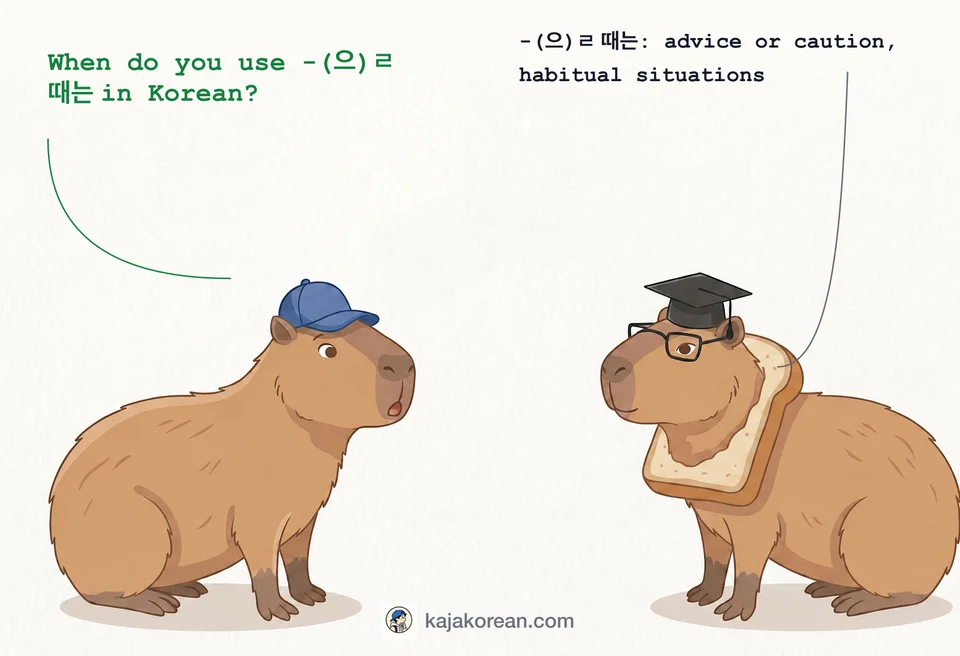
How to use 을/ㄹ 때는 in Korean

Pattern: -(으)ㄹ 때는

-(으)ㄹ 때는 (-(eu)ㄹttae-neun, (eu)ㄹttaeneun)

-(으)ㄹ 때는 indicates the time when an action or situation occurs, mainly for future or habitual contexts.

Korean grammar pattern -(으)ㄹ 때는 usage

Usage guide

When and how native speakers actually use it.

-(으)ㄹ 때는(-(eu)ㄹttae-neun, (eu)ㄹttaeneun)

Indicates the time or situation when something happens.

When to use

future action timing, habitual situations, advice or caution, conditional situations

The nuance

Attach -(으)ㄹ 때는 to the verb or adjective stem. Use '-을 때는' if the stem ends with a consonant, '-ㄹ 때는' if it ends with a vowel. It mainly expresses the time of a future action or habitual situation.

Real-world examples

  • 학교에 갈 때는 꼭 마스크를 써야 해요.

    hak-gyo-e gal ttae-neun kkok ma-seu-keu-reul sseo-ya hae-yo., hak gyo e gal ttae neun kkok ma seu keu reul sseo ya hae yo.

    ‘가다’ has no final consonant, so ‘-ㄹ 때는’ is correct; it indicates future action timing.

  • 운전할 때는 항상 조심하세요.

    un-jeon-hal ttae-neun hang-sang jo-sim-ha-se-yo., un jeon hal ttae neun hang sang jo sim ha se yo.

    ‘운전하다’ has no final consonant, so ‘-ㄹ 때는’ is correct; it expresses advice.

  • 밥을 먹을 때는 손을 씻으세요.

    bap-eul meok-eul ttae-neun son-eul ssis-eu-se-yo., bap eul meok eul ttae neun son eul ssis eu se yo.

    ‘먹다’ has a final consonant, so ‘-을 때는’ is correct; it indicates habitual situation.

  • 비가 올 때는 우산을 가져가세요.

    bi-ga ol ttae-neun u-san-eul ga-jyeo-ga-se-yo., bi ga ol ttae neun u san eul ga jyeo ga se yo.

    ‘오다’ has no final consonant, so ‘-ㄹ 때는’ is correct; it expresses conditional situation.

  • 운동할 때는 물을 많이 마셔요.

    un-dong-hal ttae-neun mul-eul man-i ma-syeo-yo., un dong hal ttae neun mul eul man i ma syeo yo.

    ‘운동하다’ has no final consonant, so ‘-ㄹ 때는’ is correct; it indicates habitual situation.

  • 책을 읽을 때는 조용히 해야 해요.

    chaek-eul ik-eul ttae-neun jo-yong-hi hae-ya hae-yo., chaek eul ik eul ttae neun jo yong hi hae ya hae yo.

    ‘읽다’ has a final consonant, so ‘-을 때는’ is correct; it indicates habitual action.

  • 학교에 갈 때는 꼭 마스크를 안 써야 해요.

    hak-gyo-e gal ttae-neun kkok ma-seu-keu-reul an sseo-ya hae-yo., hak gyo e gal ttae neun kkok ma seu keu reul an sseo ya hae yo.

    The negative ‘안 써야 해요’ contradicts expected advice, making it unnatural.

  • 운전할 때는 조심하지 마세요.

    un-jeon-hal ttae-neun jo-sim-ha-ji ma-se-yo., un jeon hal ttae neun jo sim ha ji ma se yo.

    Negative commands in advice/caution contexts are unnatural here.

Quick quiz

  1. Which sentence correctly uses ‘-(으)ㄹ 때는’?

    다음 중 ‘-(으)ㄹ 때는’의 올바른 사용은?(da-eumjung‘-(eu)ㄹttae-neun’uiol-ba-reunsa-yong-eun?, daeumjung‘(eu)ㄹttaeneun’uiolbareunsayongeun?)
  2. What is the correct ‘-(으)ㄹ 때는’ form for the verb ‘먹다’?

    ‘먹다’ 동사에 맞는 ‘-(으)ㄹ 때는’ 형태는?(‘meok-da’dong-sa-emaj-neun‘-(eu)ㄹttae-neun’hyeong-tae-neun?, ‘meokda’dongsaemajneun‘(eu)ㄹttaeneun’hyeongtaeneun?)
  3. What is the correct form to attach to ‘운전하다’?

    ‘운전하다’에 붙일 때 올바른 형태는?(‘un-jeon-ha-da’ebut-ilttaeol-ba-reunhyeong-tae-neun?, ‘unjeonhada’ebutilttaeolbareunhyeongtaeneun?)

More usage guides

View all usage guides →