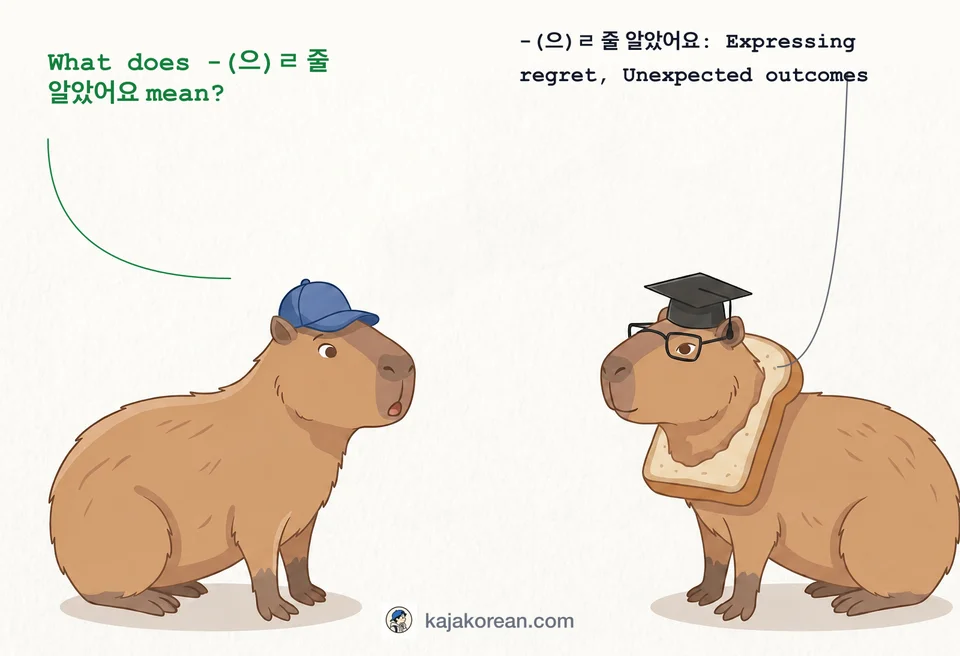
How to use 을/ㄹ 줄 알았어요 in Korean

Pattern: -(으)ㄹ 줄 알았어요

-(으)ㄹ 줄 알았어요 (-(eu)ㄹjulal-ass-eo-yo, (eu)ㄹjulalasseoyo)

-(으)ㄹ 줄 알았어요 expresses a situation different from what was expected or assumed.

Korean grammar pattern -(으)ㄹ 줄 알았어요 usage

Usage guide

When and how native speakers actually use it.

-(으)ㄹ 줄 알았어요(-(eu)ㄹjulal-ass-eo-yo, (eu)ㄹjulalasseoyo)

Means you thought something would happen, but it didn't.

When to use

Clearing misunderstandings, Unexpected outcomes, Expressing regret

The nuance

Attach '-(으)ㄹ 줄 알았어요' to verb stem to express past expectation that didn't happen. Use '-을 줄 알았어요' if stem ends with consonant, '-ㄹ 줄 알았어요' if vowel.

Real-world examples

  • 비가 올 줄 알았어요, 그래서 우산을 챙겼어요.

    bi-ga ol jul al-ass-eo-yo, geu-rae-seo u-san-eul chaeng-gyeoss-eo-yo., bi ga ol jul al ass eo yo, geu rae seo u san eul chaeng gyeoss eo yo.

    Shows expectation of rain, which may or may not have happened.

  • 그 사람이 올 줄 알았어요.

    geu sa-ram-i ol jul al-ass-eo-yo., geu sa ram i ol jul al ass eo yo.

    Expresses expectation about arrival, not guaranteed.

  • 시험이 쉬울 줄 알았어요.

    si-heom-i swi-ul jul al-ass-eo-yo., si heom i swi ul jul al ass eo yo.

    Expresses expectation about exam difficulty.

  • 나는 그 말을 들을 줄 알았어요.

    na-neun geu mal-eul deul-eul jul al-ass-eo-yo., na neun geu mal eul deul eul jul al ass eo yo.

    Shows expectation of hearing something.

  • 그가 내일 올 줄 알았어요.

    geu-ga nae-il ol jul al-ass-eo-yo., geu ga nae il ol jul al ass eo yo.

    Expresses expectation about future event.

  • 나는 그가 올 줄 알았어요.

    na-neun geu-ga ol jul al-ass-eo-yo., na neun geu ga ol jul al ass eo yo.

    Expresses past expectation.

  • 나는 그가 올 줄 알았어.

    na-neun geu-ga ol jul al-ass-eo., na neun geu ga ol jul al ass eo.

    Mixing polite past '-았/었어요' form with casual '-았/었어' is incorrect.

  • 나는 그가 올 줄 알아요.

    na-neun geu-ga ol jul al-a-yo., na neun geu ga ol jul al a yo.

    Present tense expressing current or future expectation.

Quick quiz

  1. When do you use -(으)ㄹ 줄 알았어요?

    -(으)ㄹ 줄 알았어요는 어떤 상황에 쓰이나요?(-(eu)ㄹjulal-ass-eo-yo-neuneo-tteonsang-hwang-esseu-i-na-yo?, (eu)ㄹjulalasseoyoneuneotteonsanghwangesseuinayo?)
  2. Which sentence is correct?

    다음 중 올바른 문장은?(da-eumjungol-ba-reunmun-jang-eun?, daeumjungolbareunmunjangeun?)
  3. The sentence "나는 그가 올 줄 알았어." is?

    "나는 그가 올 줄 알았어." 문장은?("na-neungeu-gaoljulal-ass-eo."mun-jang-eun?, "naneungeugaoljulalasseo."munjangeun?)

More usage guides

View all usage guides →