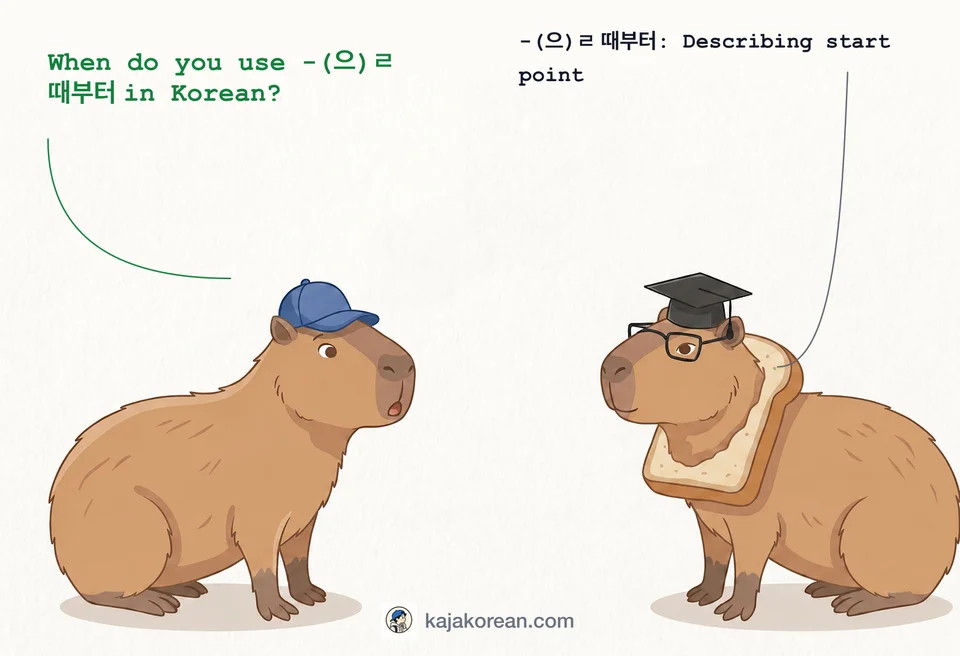
How to use 을/ㄹ 때부터 in Korean

Pattern: -(으)ㄹ 때부터

-(으)ㄹ 때부터 (-(eu)ㄹttae-bu-teo, (eu)ㄹttaebuteo)

-(으)ㄹ 때부터 indicates the starting point of an action or state. It’s used to express situations continuing from past to present.

Korean grammar -(으)ㄹ 때부터 usage guide

Usage guide

When and how native speakers actually use it.

-(으)ㄹ 때부터(-(eu)ㄹttae-bu-teo, (eu)ㄹttaebuteo)

Indicates the point in time when something started or the state continuing from that time.

When to use

Describing start point, Expressing state from past to present, Mentioning start of experience

The nuance

Attach -(으)ㄹ 때부터 to the verb or adjective stem. - Use '-을 때부터' if the stem ends with a consonant, '-ㄹ 때부터' if it ends with a vowel. - Used to express an action or state starting in the past and continuing to the present.

Real-world examples

  • 나는 한국에 살기 시작할 때부터 한국 음식을 좋아했어.

    na-neun han-guk-e sal-gi si-jak-hal ttae-bu-teo han-guk eum-sik-eul joh-a-haess-eo., na neun han guk e sal gi si jak hal ttae bu teo han guk eum sik eul joh a haess eo.

    ‘-기 시작할 때부터’ clearly indicates the start point, so it’s correct.

  • 그는 어렸을 때부터 피아노를 배웠다.

    geu-neun eo-ryeoss-eul ttae-bu-teo pi-a-no-reul bae-woss-da., geu neun eo ryeoss eul ttae bu teo pi a no reul bae woss da.

    Natural expression indicating the starting point in the past.

  • 비가 올 때부터 우산을 챙겨요.

    bi-ga ol ttae-bu-teo u-san-eul chaeng-gyeo-yo., bi ga ol ttae bu teo u san eul chaeng gyeo yo.

    -(으)ㄹ 때부터 is for past starting points, not future or present; '-기 시작할 때부터' is correct.

  • 나는 대학에 입학할 때부터 독립적으로 살았다.

    na-neun dae-hak-e ip-hak-hal ttae-bu-teo dok-rip-jeok-eu-ro sal-ass-da., na neun dae hak e ip hak hal ttae bu teo dok rip jeok eu ro sal ass da.

    Correctly shows independence starting from the past event of entering university.

  • 친구를 만날 때부터 기분이 좋아졌다.

    chin-gu-reul man-nal ttae-bu-teo gi-bun-i joh-a-jyeoss-da., chin gu reul man nal ttae bu teo gi bun i joh a jyeoss da.

    -(으)ㄹ 때부터 implies continuous state from start point; for momentary change, '-자' or '-고 나서' is better.

  • 그는 10년 전부터 영어를 공부해 왔다.

    geu-neun 10nyeon jeon-bu-teo yeong-eo-reul gong-bu-hae wass-da., geu neun 10nyeon jeon bu teo yeong eo reul gong bu hae wass da.

    Correctly expresses ongoing action from the start point to present.

Quick quiz

  1. Which sentence correctly uses -(으)ㄹ 때부터?

    다음 중 -(으)ㄹ 때부터를 올바르게 사용한 문장은?(da-eumjung-(eu)ㄹttae-bu-teo-reulol-ba-reu-gesa-yong-hanmun-jang-eun?, daeumjung(eu)ㄹttaebuteoreulolbareugesayonghanmunjangeun?)
  2. What is the correct meaning of -(으)ㄹ 때부터?

    -(으)ㄹ 때부터의 의미로 적절한 것은?(-(eu)ㄹttae-bu-teo-uiui-mi-rojeok-jeol-hangeos-eun?, (eu)ㄹttaebuteouiuimirojeokjeolhangeoseun?)
  3. What is the role of ‘-을 때부터’ in ‘대학에 입학할 때부터’?

    ‘대학에 입학할 때부터’에서 ‘-을 때부터’의 역할은?(‘dae-hak-eip-hak-halttae-bu-teo’e-seo‘-eulttae-bu-teo’uiyeok-hal-eun?, ‘daehakeiphakhalttaebuteo’eseo‘eulttaebuteo’uiyeokhaleun?)

More usage guides

View all usage guides →