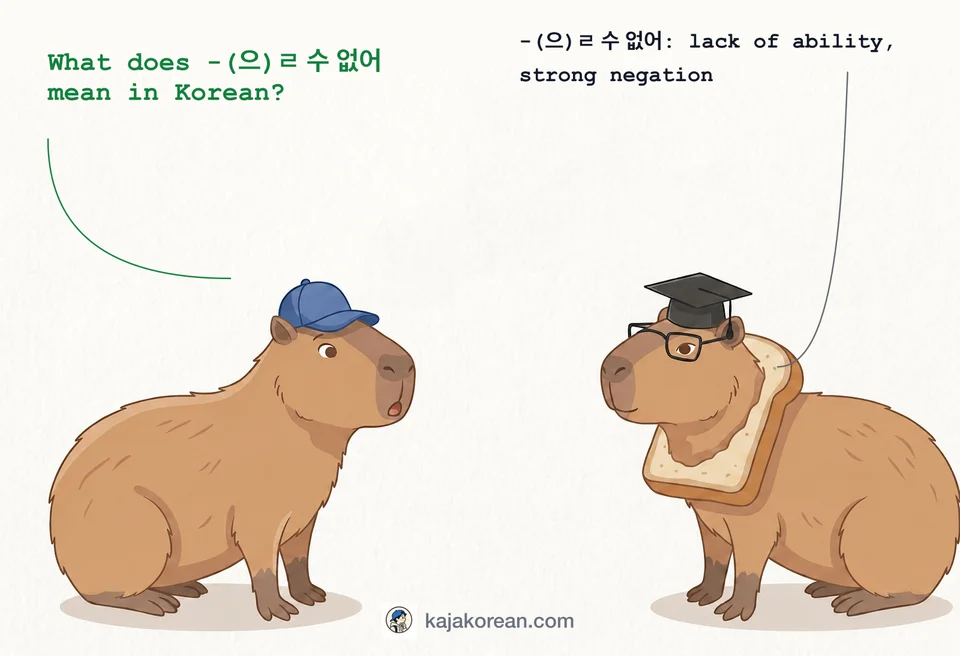
How to use 을/ㄹ 수 없어 in Korean

Pattern: -(으)ㄹ 수 없어

-(으)ㄹ 수 없어 (-(eu)ㄹsueop-eo, (eu)ㄹsueopeo)

-(으)ㄹ 수 없어 means ‘cannot do something’ due to inability or impossibility. Common in daily Korean.

Korean grammar -(으)ㄹ 수 없어 meaning and usage

Usage guide

When and how native speakers actually use it.

-(으)ㄹ 수 없어(-(eu)ㄹsueop-eo, (eu)ㄹsueopeo)

Indicates inability or impossibility to perform an action

When to use

lack of ability, situational impossibility, strong negation, expressing feelings

The nuance

Attach -(으)ㄹ 수 없어 to verb stems to express inability or impossibility. Use -을 수 없어 if stem ends with a consonant, -ㄹ 수 없어 if vowel. Past: -(으)ㄹ 수 없었다, Future: -(으)ㄹ 수 없을 것이다.

Real-world examples

  • 나는 그 무거운 상자를 혼자 들 수 없어.

    na-neun geu mu-geo-un sang-ja-reul hon-ja deul su eop-eo., na neun geu mu geo un sang ja reul hon ja deul su eop eo.

    Verb stem '들' ends with a vowel, so use '-ㄹ 수 없어'.

  • 비가 와서 운동할 수 없어.

    bi-ga wa-seo un-dong-hal su eop-eo., bi ga wa seo un dong hal su eop eo.

    Verb stem ends with vowel, so '-ㄹ 수 없어' is correct.

  • 나는 수영할 수 없어.

    na-neun su-yeong-hal su eop-eo., na neun su yeong hal su eop eo.

    Verb stem ends with vowel, so '-ㄹ 수 없어' is correct.

  • 너는 그 일을 할 수 없어.

    neo-neun geu il-eul hal su eop-eo., neo neun geu il eul hal su eop eo.

    Verb stem ends with vowel, so '-ㄹ 수 없어' is correct.

  • 나는 그 문제를 풀을 수 없어.

    na-neun geu mun-je-reul pul-eul su eop-eo., na neun geu mun je reul pul eul su eop eo.

    Verb stem ends with vowel, so '-ㄹ 수 없어' is correct, not '-을 수 없어'.

  • 그는 오늘 올 수 없어.

    geu-neun o-neul ol su eop-eo., geu neun o neul ol su eop eo.

    Verb stem ends with vowel, so '-ㄹ 수 없어' is correct.

  • 나는 밤에 운전할 수 없어.

    na-neun bam-e un-jeon-hal su eop-eo., na neun bam e un jeon hal su eop eo.

    Verb stem ends with vowel, so '-ㄹ 수 없어' is correct.

Quick quiz

  1. Which sentence uses -(으)ㄹ 수 없어 correctly?

    다음 중 -(으)ㄹ 수 없어가 올바르게 쓰인 문장은?(da-eumjung-(eu)ㄹsueop-eo-gaol-ba-reu-gesseu-inmun-jang-eun?, daeumjung(eu)ㄹsueopeogaolbareugesseuinmunjangeun?)
  2. How do you attach -(으)ㄹ 수 없어 to the verb ‘먹다’?

    ‘먹다’ 동사에 -(으)ㄹ 수 없어를 붙이면?(‘meok-da’dong-sa-e-(eu)ㄹsueop-eo-reulbut-i-myeon?, ‘meokda’dongsae(eu)ㄹsueopeoreulbutimyeon?)
  3. What is the correct -(으)ㄹ 수 없어 form for ‘달리다’?

    ‘달리다’에 맞는 -(으)ㄹ 수 없어 형태는?(‘dal-ri-da’emaj-neun-(eu)ㄹsueop-eohyeong-tae-neun?, ‘dalrida’emajneun(eu)ㄹsueopeohyeongtaeneun?)

More usage guides

View all usage guides →