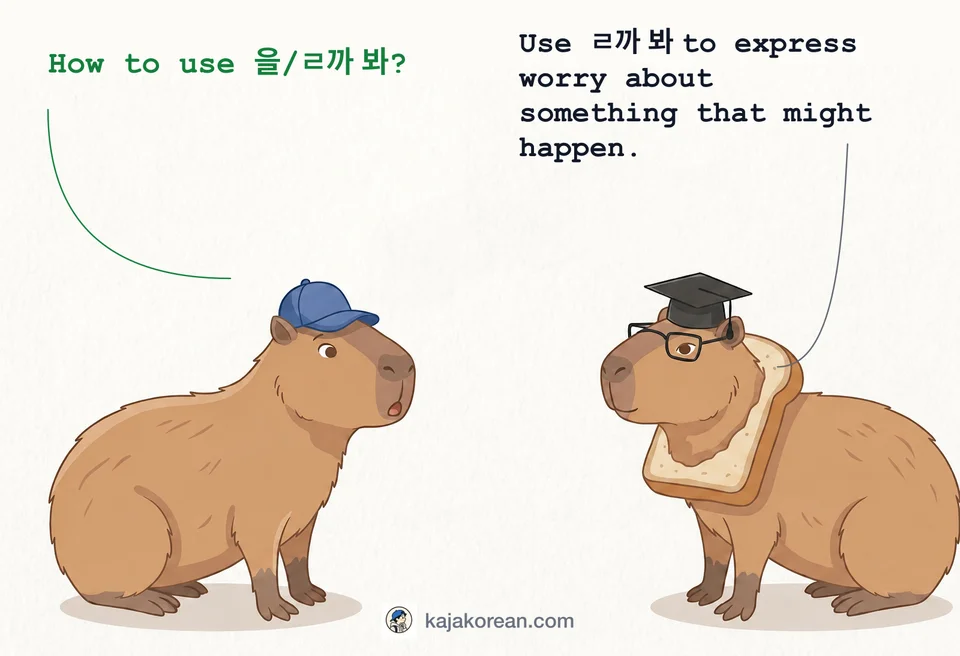
How to use 을/ㄹ까 봐 in Korean

Pattern: -(으)ㄹ까 봐

-(으)ㄹ까 봐 (-(eu)ㄹkkabwa, (eu)ㄹkkabwa)

-(으)ㄹ까 봐 expresses worry or concern about something. It naturally conveys your anxiety to others.

Illustration showing worry about future events

Usage guide

When and how native speakers actually use it.

-(으)ㄹ까 봐(-(eu)ㄹkkabwa, (eu)ㄹkkabwa)

Expresses worry or fear that something might happen.

When to use

expressing worry, future uncertainty, preventive action

The nuance

Attach -(으)ㄹ까 봐 to the verb or adjective stem. It expresses worry about a possible future event, often followed by an action taken to prevent or prepare for that event. For example, 'I took an umbrella because I was worried it might rain.'

Real-world examples

  • 비가 올까 봐 우산을 챙겼어요.

    bi-ga ol-kka bwa u-san-eul chaeng-gyeoss-eo-yo., bi ga ol kka bwa u san eul chaeng gyeoss eo yo.

    -(으)ㄹ까 봐 expresses worry about rain, and the action (taking an umbrella) follows logically.

  • 늦을까 봐 일찍 출발했어요.

    neuj-eul-kka bwa il-jjik chul-bal-haess-eo-yo., neuj eul kka bwa il jjik chul bal haess eo yo.

    Expresses worry about being late and the preventive action of leaving early.

  • 그 사람이 올까 봐 기다렸어요.

    geu sa-ram-i ol-kka bwa gi-da-ryeoss-eo-yo., geu sa ram i ol kka bwa gi da ryeoss eo yo.

    Worry about someone coming leads to the action of waiting.

  • 시험에 떨어질까 봐 공부를 많이 했어요.

    si-heom-e tteol-eo-jil-kka bwa gong-bu-reul man-i haess-eo-yo., si heom e tteol eo jil kka bwa gong bu reul man i haess eo yo.

    Expresses worry about failing and the action taken to prevent it.

  • 너무 늦을까 봐 걱정했어요.

    neo-mu neuj-eul-kka bwa geok-jeong-haess-eo-yo., neo mu neuj eul kka bwa geok jeong haess eo yo.

    Can be used just to express worry without a following preventive action.

  • 그 사람이 올까 봐 기다리지 않았어요.

    geu sa-ram-i ol-kka bwa gi-da-ri-ji an-ass-eo-yo., geu sa ram i ol kka bwa gi da ri ji an ass eo yo.

    Negative action with -(으)ㄹ까 봐 is possible but usually the reason and action must clearly connect; here it sounds unnatural.

  • 비가 올까 봐 걱정했어요, 하지만 우산을 안 가져왔어요.

    bi-ga ol-kka bwa geok-jeong-haess-eo-yo, ha-ji-man u-san-eul an ga-jyeo-wass-eo-yo., bi ga ol kka bwa geok jeong haess eo yo, ha ji man u san eul an ga jyeo wass eo yo.

    Expresses worry and then contrasts it with the actual action.

  • 내일 날씨가 좋을까 봐 걱정돼요.

    nae-il nal-ssi-ga joh-eul-kka bwa geok-jeong-dwae-yo., nae il nal ssi ga joh eul kka bwa geok jeong dwae yo.

    Naturally expresses worry about future weather.

Quick quiz

  1. What does -(으)ㄹ까 봐 mean?

    -(으)ㄹ까 봐의 의미는 무엇인가요?(-(eu)ㄹkkabwa-uiui-mi-neunmu-eos-in-ga-yo?, (eu)ㄹkkabwauiuimineunmueosingayo?)
  2. Which sentence correctly uses -(으)ㄹ까 봐?

    다음 문장 중 올바른 사용은?(da-eummun-jangjungol-ba-reunsa-yong-eun?, daeummunjangjungolbareunsayongeun?)
  3. Which cannot follow -(으)ㄹ까 봐?

    -(으)ㄹ까 봐 뒤에 올 수 없는 것은?(-(eu)ㄹkkabwadwi-eolsueop-neungeos-eun?, (eu)ㄹkkabwadwieolsueopneungeoseun?)

More usage guides

View all usage guides →