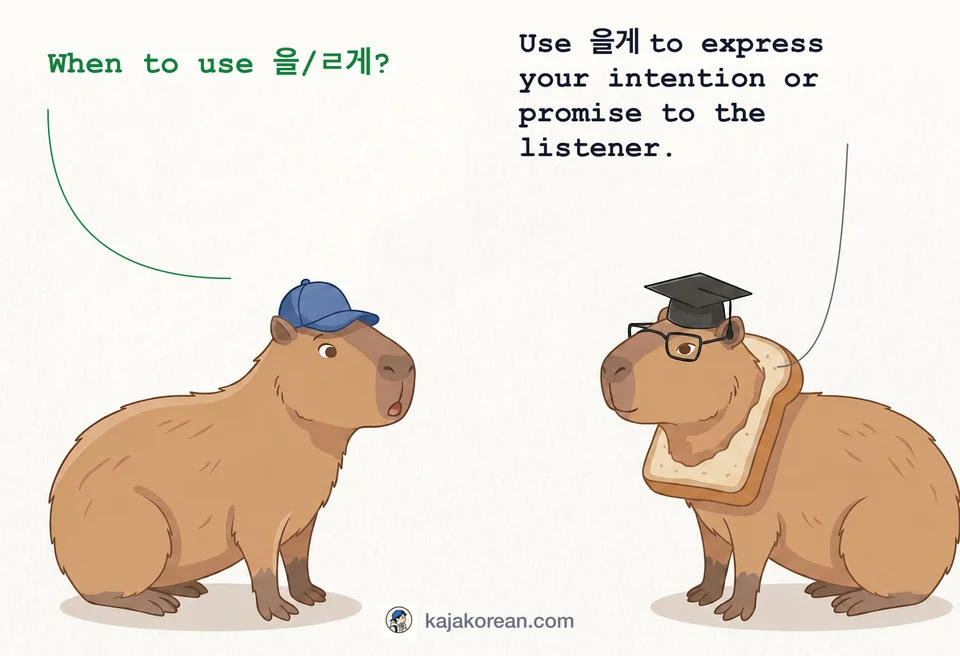
How to use 을/ㄹ게 in Korean

Pattern: -(으)ㄹ게

-(으)ㄹ게 (-(eu)ㄹge, (eu)ㄹge)

-(으)ㄹ게 is a sentence ending used by the speaker to express intention or promise to the listener.

Illustration showing speaker expressing intention with 을게

Usage guide

When and how native speakers actually use it.

-(으)ㄹ게(-(eu)ㄹge, (eu)ㄹge)

A sentence ending that expresses the speaker's intention or promise to the listener

When to use

Making promises, Expressing intention, Informing the listener of an action

The nuance

Attach -(으)ㄹ게 to verb or adjective stems to express the speaker's intention, decision, or promise. Use '-을게' if the stem ends with a consonant, '-ㄹ게' if it ends with a vowel. It is used mainly with first-person subjects and in contexts where the speaker's action affects the listener. Example: 가다 → 갈게, 먹다 → 먹을게. Commonly used in casual conversation to promise or express intention to the listener.

Real-world examples

  • 내일 일찍 올게.

    nae-il il-jjik ol-ge., nae il il jjik ol ge.

    Correct use showing speaker's intention to the listener.

  • 이거 내가 할게.

    i-geo nae-ga hal-ge., i geo nae ga hal ge.

    Shows the speaker's intention to perform the action.

  • 너한테 전화할게.

    neo-han-te jeon-hwa-hal-ge., neo han te jeon hwa hal ge.

    Appropriate sentence expressing promise or intention to the listener.

  • 나는 갈게 너는 기다려.

    na-neun gal-ge neo-neun gi-da-ryeo., na neun gal ge neo neun gi da ryeo.

    Expresses speaker's intention and instructs the listener.

  • 내가 먹을게.

    nae-ga meok-eul-ge., nae ga meok eul ge.

    Correct use showing speaker's intention to the listener.

  • 내가 갈게 너도 갈게.

    nae-ga gal-ge neo-do gal-ge., nae ga gal ge neo do gal ge.

    -(으)ㄹ게 is only for the speaker's intention, not the listener's.

  • 너는 먹을게?

    neo-neun meok-eul-ge?, neo neun meok eul ge?

    -(으)ㄹ게 is not used for questions or listener's intention.

Quick quiz

  1. Which sentence correctly uses -(으)ㄹ게?

    다음 중 -(으)ㄹ게를 올바르게 사용한 문장은?(da-eumjung-(eu)ㄹge-reulol-ba-reu-gesa-yong-hanmun-jang-eun?, daeumjung(eu)ㄹgereulolbareugesayonghanmunjangeun?)
  2. What is the correct meaning of -(으)ㄹ게?

    -(으)ㄹ게의 올바른 의미는?(-(eu)ㄹge-uiol-ba-reunui-mi-neun?, (eu)ㄹgeuiolbareunuimineun?)
  3. Which sentence is incorrect?

    다음 중 틀린 문장은?(da-eumjungteul-rinmun-jang-eun?, daeumjungteulrinmunjangeun?)

More usage guides

View all usage guides →