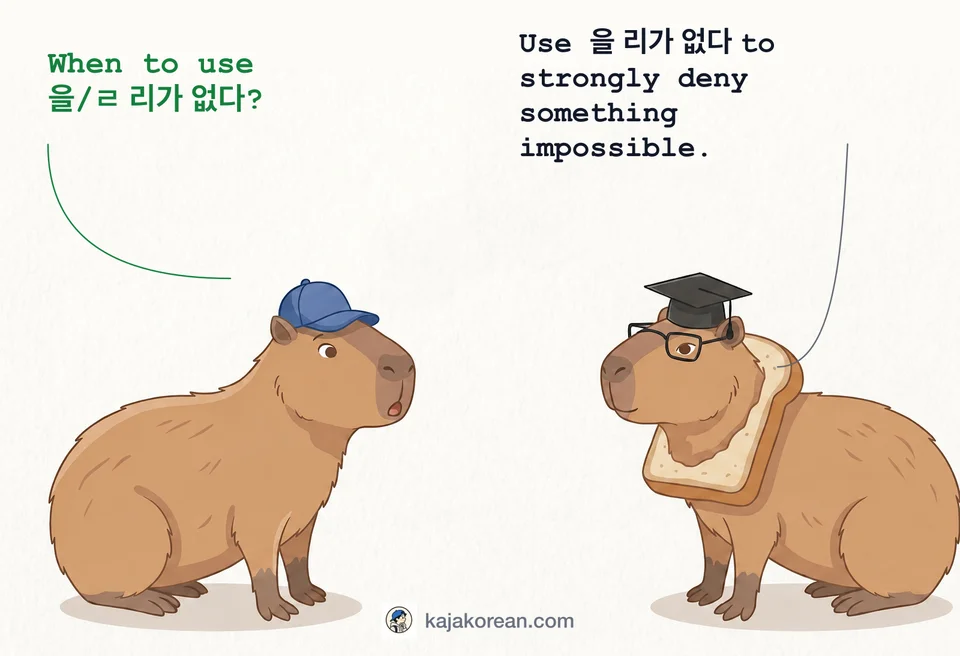
How to use 을/ㄹ 리가 없다 in Korean

Pattern: -(으)ㄹ 리가 없다

-(으)ㄹ 리가 없다 (-(eu)ㄹri-gaeop-da, (eu)ㄹrigaeopda)

-(으)ㄹ 리가 없다 expresses strong certainty that something cannot happen.

Example of Korean grammar -(으)ㄹ 리가 없다 usage

Usage guide

When and how native speakers actually use it.

-(으)ㄹ 리가 없다(-(eu)ㄹri-gaeop-da, (eu)ㄹrigaeopda)

Expresses certainty that something is impossible or will never happen

When to use

Describing impossible situations, Strong denial, Refuting doubtful claims

The nuance

Attach -(으)ㄹ 리가 없다 to verb or adjective stems to emphasize impossibility or strong denial about present or future events. Use '-을 리가 없다' if the stem ends with a consonant, '-ㄹ 리가 없다' if it ends with a vowel.

Real-world examples

  • 그 사람이 거짓말을 할 리가 없어요.

    geu sa-ram-i geo-jis-mal-eul hal ri-ga eop-eo-yo., geu sa ram i geo jis mal eul hal ri ga eop eo yo.

    It completely denies the possibility that the person would lie.

  • 내일 비가 올 리가 없는데 왜 우산을 가져왔어?

    nae-il bi-ga ol ri-ga eop-neun-de wae u-san-eul ga-jyeo-wass-eo?, nae il bi ga ol ri ga eop neun de wae u san eul ga jyeo wass eo?

    Used when you are certain rain will not come in the future.

  • 너가 거기 있을 리가 없어.

    neo-ga geo-gi iss-eul ri-ga eop-eo., neo ga geo gi iss eul ri ga eop eo.

    Strongly denies the possibility the person is there.

  • 그가 시험을 잘 볼 리가 없어요.

    geu-ga si-heom-eul jal bol ri-ga eop-eo-yo., geu ga si heom eul jal bol ri ga eop eo yo.

    Used when judging the person will definitely not do well on the exam.

  • 그 사람이 늦을 리가 없는데 왜 안 왔지?

    geu sa-ram-i neuj-eul ri-ga eop-neun-de wae an wass-ji?, geu sa ram i neuj eul ri ga eop neun de wae an wass ji?

    Emphasizes the person usually isn't late, denying possibility of being late.

  • 내가 그걸 모를 리가 없지.

    nae-ga geu-geol mo-reul ri-ga eop-ji., nae ga geu geol mo reul ri ga eop ji.

    Expresses strong confidence that the speaker definitely knows.

  • 그 사람이 우리를 도울 리가 없다.

    geu sa-ram-i u-ri-reul do-ul ri-ga eop-da., geu sa ram i u ri reul do ul ri ga eop da.

    Completely denies the possibility of receiving help from that person.

  • 그가 거짓말을 할 리가 있나요?

    geu-ga geo-jis-mal-eul hal ri-ga iss-na-yo?, geu ga geo jis mal eul hal ri ga iss na yo?

    -(으)ㄹ 리가 없다 must be used in a negative form; positive form is unnatural.

Quick quiz

  1. Which sentence correctly uses -(으)ㄹ 리가 없다?

    다음 중 '-(으)ㄹ 리가 없다'를 올바르게 사용한 문장은?(da-eumjung'-(eu)ㄹri-gaeop-da'reulol-ba-reu-gesa-yong-hanmun-jang-eun?, daeumjung'(eu)ㄹrigaeopda'reulolbareugesayonghanmunjangeun?)
  2. Choose the correct form to complete: '그가 시험에 합격할 ___ 없다'

    ‘그가 시험에 합격할 ___ 없다’에 들어갈 알맞은 표현은?(‘geu-gasi-heom-ehap-gyeok-hal___eop-da’edeul-eo-galal-maj-eunpyo-hyeon-eun?, ‘geugasiheomehapgyeokhal___eopda’edeuleogalalmajeunpyohyeoneun?)
  3. What does '내일 비가 올 리가 없는데 왜 우산을 가져왔어?' mean?

    ‘내일 비가 올 리가 없는데 왜 우산을 가져왔어?’ 문장의 의미는?(‘nae-ilbi-gaolri-gaeop-neun-dewaeu-san-eulga-jyeo-wass-eo?’mun-jang-uiui-mi-neun?, ‘naeilbigaolrigaeopneundewaeusaneulgajyeowasseo?’munjanguiuimineun?)

More usage guides

View all usage guides →