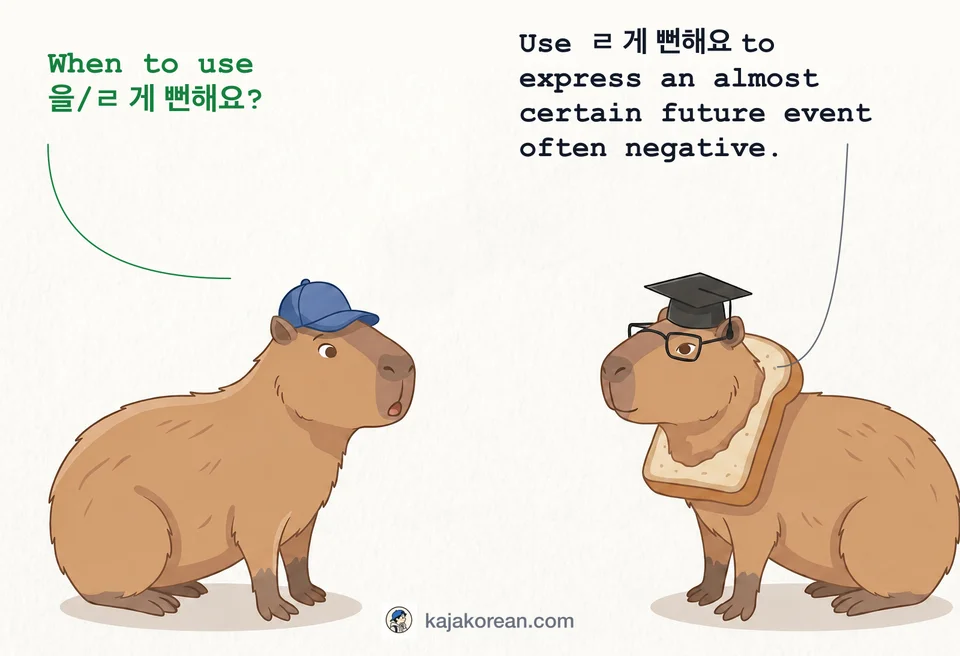
How to use 을/ㄹ 게 뻔해요 in Korean

Pattern: -(으)ㄹ 게 뻔해요

-(으)ㄹ 게 뻔해요 (-(eu)ㄹgeppeon-hae-yo, (eu)ㄹgeppeonhaeyo)

-(으)ㄹ 게 뻔해요 expresses that something is almost certain to happen.

Example sentences using ㄹ 게 뻔해요 in Korean

Usage guide

When and how native speakers actually use it.

-(으)ㄹ 게 뻔해요(-(eu)ㄹgeppeon-hae-yo, (eu)ㄹgeppeonhaeyo)

An expression indicating that something is almost certain to happen

When to use

Worrisome future situations, Negative predictions, Mentioning certain outcomes

The nuance

Attach '-(으)ㄹ 게 뻔해요' to the verb stem to express a future event that is very likely or certain. Use '-ㄹ 게 뻔해요' if the stem ends without a final consonant, and '-을 게 뻔해요' if it ends with a consonant. It often describes negative or worrisome outcomes.

Real-world examples

  • 그렇게 늦게 출발하면 지각할 게 뻔해요.

    geu-reoh-ge neuj-ge chul-bal-ha-myeon ji-gak-hal ge ppeon-hae-yo., geu reoh ge neuj ge chul bal ha myeon ji gak hal ge ppeon hae yo.

    '지각하다' stem has no final consonant, so '-ㄹ 게 뻔해요' is correct; the sentence describes a certain future result.

  • 비가 올 게 뻔해요.

    bi-ga ol ge ppeon-hae-yo., bi ga ol ge ppeon hae yo.

    '오다' stem has no final consonant, so '-ㄹ 게 뻔해요' is correct.

  • 그렇게 많이 먹으면 배탈 날 게 뻔해요.

    geu-reoh-ge man-i meok-eu-myeon bae-tal nal ge ppeon-hae-yo., geu reoh ge man i meok eu myeon bae tal nal ge ppeon hae yo.

    '나-' stem has no final consonant, so '-ㄹ 게 뻔해요' is appropriate; expresses a certain negative outcome.

  • 내일 비가 올을 게 뻔해요.

    nae-il bi-ga ol-eul ge ppeon-hae-yo., nae il bi ga ol eul ge ppeon hae yo.

    '오다' stem has no final consonant, so '-을 게 뻔해요' is incorrect.

  • 그 사람은 또 늦을 게 뻔해요.

    geu sa-ram-eun tto neuj-eul ge ppeon-hae-yo., geu sa ram eun tto neuj eul ge ppeon hae yo.

    '늦다' stem has a final consonant, so '-을 게 뻔해요' is correct.

  • 너무 피곤해서 일찍 잘 거에요.

    neo-mu pi-gon-hae-seo il-jjik jal geo-e-yo., neo mu pi gon hae seo il jjik jal geo e yo.

    '-거에요' is a different expression and not the same as '-ㄹ 게 뻔해요'.

  • 이렇게 계속 일하면 몸이 아플 게 뻔해요.

    i-reoh-ge gye-sok il-ha-myeon mom-i a-peul ge ppeon-hae-yo., i reoh ge gye sok il ha myeon mom i a peul ge ppeon hae yo.

    '아프다' stem has no final consonant, so '-ㄹ 게 뻔해요' is correct.

Quick quiz

  1. Which sentence correctly uses '-(으)ㄹ 게 뻔해요'?

    다음 중 '-(으)ㄹ 게 뻔해요' 사용법으로 맞는 문장은?(da-eumjung'-(eu)ㄹgeppeon-hae-yo'sa-yong-beop-eu-romaj-neunmun-jang-eun?, daeumjung'(eu)ㄹgeppeonhaeyo'sayongbeopeuromajneunmunjangeun?)
  2. In what situations is '-(으)ㄹ 게 뻔해요' mainly used?

    '-(으)ㄹ 게 뻔해요'는 주로 어떤 상황에 쓰이나요?('-(eu)ㄹgeppeon-hae-yo'neunju-roeo-tteonsang-hwang-esseu-i-na-yo?, '(eu)ㄹgeppeonhaeyo'neunjuroeotteonsanghwangesseuinayo?)

More usage guides

View all usage guides →