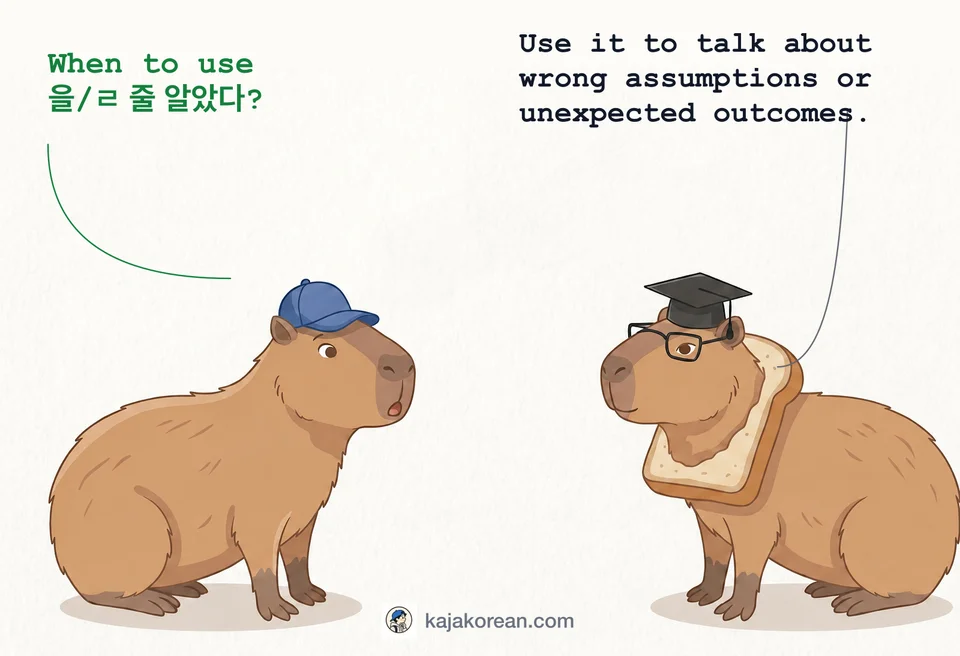
How to use 을/ㄹ 줄 알았다 in Korean

Pattern: -(으)ㄹ 줄 알았다

-(으)ㄹ 줄 알았다 (-(eu)ㄹjulal-ass-da, (eu)ㄹjulalassda)

-(으)ㄹ 줄 알았다 expresses expectations or assumptions that turned out to be wrong.

Explanation of how to use -(으)ㄹ 줄 알았다 in Korean

Usage guide

When and how native speakers actually use it.

-(으)ㄹ 줄 알았다(-(eu)ㄹjulal-ass-da, (eu)ㄹjulalassda)

Indicates that one thought something would happen but it didn't.

When to use

Expressing misunderstandings or misconceptions, Describing unexpected outcomes, Showing regret or surprise

The nuance

Attach -(으)ㄹ 줄 알았다 to the verb stem to express that a past expectation was different from reality. It works in both positive and negative sentences and emphasizes unexpected outcomes.

Real-world examples

  • 그 사람이 올 줄 알았는데 안 왔어요.

    geu sa-ram-i ol jul al-ass-neun-de an wass-eo-yo., geu sa ram i ol jul al ass neun de an wass eo yo.

    It correctly expresses an expectation that was not met.

  • 비가 올 줄 알았어요, 그래서 우산을 가져왔어요.

    bi-ga ol jul al-ass-eo-yo, geu-rae-seo u-san-eul ga-jyeo-wass-eo-yo., bi ga ol jul al ass eo yo, geu rae seo u san eul ga jyeo wass eo yo.

    Appropriate for talking about future expectations.

  • 시험이 쉬울 줄 알았는데 너무 어려웠어요.

    si-heom-i swi-ul jul al-ass-neun-de neo-mu eo-ryeo-woss-eo-yo., si heom i swi ul jul al ass neun de neo mu eo ryeo woss eo yo.

    Clearly shows the difference between expectation and reality.

  • 그 사람이 올 줄 몰랐어요.

    geu sa-ram-i ol jul mol-rass-eo-yo., geu sa ram i ol jul mol rass eo yo.

    Works in negative form to express unexpected situations.

  • 친구가 올 줄 알았는데, 친구가 안 왔어요.

    chin-gu-ga ol jul al-ass-neun-de, chin-gu-ga an wass-eo-yo., chin gu ga ol jul al ass neun de, chin gu ga an wass eo yo.

    Correctly expresses expectation and contrasting reality.

  • 내가 할 줄 알았어.

    nae-ga hal jul al-ass-eo., nae ga hal jul al ass eo.

    Can express expectations about oneself.

  • 그가 말할 줄 알았어요.

    geu-ga mal-hal jul al-ass-eo-yo., geu ga mal hal jul al ass eo yo.

    Suitable for expressing expectations about others' actions.

Quick quiz

  1. Which sentence correctly uses '-(으)ㄹ 줄 알았다'?

    다음 중 '-(으)ㄹ 줄 알았다'를 올바르게 사용한 문장은?(da-eumjung'-(eu)ㄹjulal-ass-da'reulol-ba-reu-gesa-yong-hanmun-jang-eun?, daeumjung'(eu)ㄹjulalassda'reulolbareugesayonghanmunjangeun?)
  2. Find the mistake in this sentence: '시험이 쉬울 줄 알았는데 너무 쉬웠어요.'

    다음 문장에서 틀린 부분을 고르세요: '시험이 쉬울 줄 알았는데 너무 쉬웠어요.'(da-eummun-jang-e-seoteul-rinbu-bun-eulgo-reu-se-yo:'si-heom-iswi-uljulal-ass-neun-deneo-muswi-woss-eo-yo.', daeummunjangeseoteulrinbubuneulgoreuseyo:'siheomiswiuljulalassneundeneomuswiwosseoyo.')
  3. What is the best meaning of '-(으)ㄹ 줄 알았다'?

    '- (으)ㄹ 줄 알았다'의 의미로 가장 적절한 것은?('-(eu)ㄹjulal-ass-da'uiui-mi-roga-jangjeok-jeol-hangeos-eun?, '(eu)ㄹjulalassda'uiuimirogajangjeokjeolhangeoseun?)

More usage guides

View all usage guides →