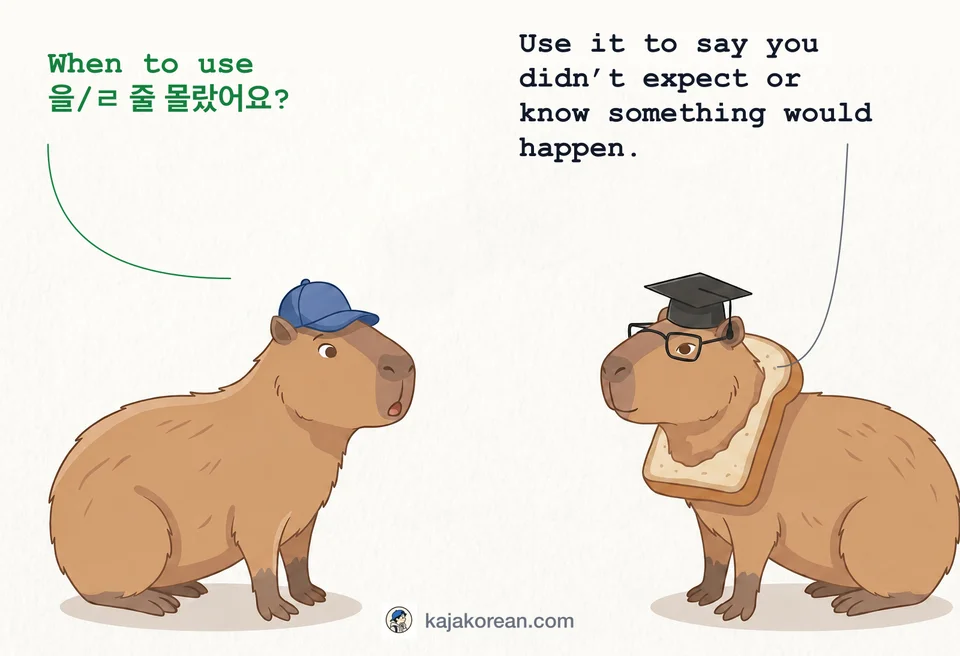
How to use 을/ㄹ 줄 몰랐어요 in Korean

Pattern: -(으)ㄹ 줄 몰랐어요

-(으)ㄹ 줄 몰랐어요 (-(eu)ㄹjulmol-rass-eo-yo, (eu)ㄹjulmolrasseoyo)

-(으)ㄹ 줄 몰랐어요 expresses that you didn’t know or expect something to happen.

Korean expression -(으)ㄹ 줄 몰랐어요 meaning unexpected event

Usage guide

When and how native speakers actually use it.

-(으)ㄹ 줄 몰랐어요(-(eu)ㄹjulmol-rass-eo-yo, (eu)ㄹjulmolrasseoyo)

Indicates that you did not expect or know that something would happen.

When to use

explaining unexpected situations, expressing surprise, sharing new information

The nuance

Attach -(으)ㄹ 줄 몰랐어요 to the verb or adjective stem in future tense form. '줄' implies ability or expectation, and '몰랐어요' is past tense negative (didn't know). Example: 가다 → 갈 줄 몰랐어요, 예쁘다 → 예쁠 줄 몰랐어요.

Real-world examples

  • 그 사람이 그렇게 빨리 올 줄 몰랐어요.

    geu sa-ram-i geu-reoh-ge ppal-ri ol jul mol-rass-eo-yo., geu sa ram i geu reoh ge ppal ri ol jul mol rass eo yo.

    Correctly expresses lack of expectation about a future event.

  • 이 음식이 이렇게 맛있을 줄 몰랐어요.

    i eum-sik-i i-reoh-ge mas-iss-eul jul mol-rass-eo-yo., i eum sik i i reoh ge mas iss eul jul mol rass eo yo.

    Naturally expresses no prior expectation about taste.

  • 그 영화가 재미있을 줄 몰랐어요.

    geu yeong-hwa-ga jae-mi-iss-eul jul mol-rass-eo-yo., geu yeong hwa ga jae mi iss eul jul mol rass eo yo.

    Properly indicates lack of expectation about opinion or feeling.

  • 나는 그가 거기에 갈 줄 몰랐어요.

    na-neun geu-ga geo-gi-e gal jul mol-rass-eo-yo., na neun geu ga geo gi e gal jul mol rass eo yo.

    Clearly expresses no expectation about an action.

  • 그 사람이 그렇게 빨리 올 줄 알았어요.

    geu sa-ram-i geu-reoh-ge ppal-ri ol jul al-ass-eo-yo., geu sa ram i geu reoh ge ppal ri ol jul al ass eo yo.

    Using '알았어요' means the opposite, so it’s a correct sentence but not with '-(으)ㄹ 줄 몰랐어요'.

  • 나는 그가 거기에 가는 줄 몰랐어요.

    na-neun geu-ga geo-gi-e ga-neun jul mol-rass-eo-yo., na neun geu ga geo gi e ga neun jul mol rass eo yo.

    For present or ongoing actions, use '-는 줄 몰랐어요', not '-(으)ㄹ 줄 몰랐어요'.

  • 그 사람이 그렇게 빨리 왔을 줄 몰랐어요.

    geu sa-ram-i geu-reoh-ge ppal-ri wass-eul jul mol-rass-eo-yo., geu sa ram i geu reoh ge ppal ri wass eul jul mol rass eo yo.

    Can be used to express unexpected past event as well.

Quick quiz

  1. Which sentence uses '-(으)ㄹ 줄 몰랐어요' correctly?

    다음 중 '-(으)ㄹ 줄 몰랐어요'를 올바르게 사용한 문장은?(da-eumjung'-(eu)ㄹjulmol-rass-eo-yo'reulol-ba-reu-gesa-yong-hanmun-jang-eun?, daeumjung'(eu)ㄹjulmolrasseoyo'reulolbareugesayonghanmunjangeun?)
  2. When can you NOT use '-(으)ㄹ 줄 몰랐어요'?

    '- (으)ㄹ 줄 몰랐어요'를 사용할 수 없는 경우는?('-(eu)ㄹjulmol-rass-eo-yo'reulsa-yong-halsueop-neungyeong-u-neun?, '(eu)ㄹjulmolrasseoyo'reulsayonghalsueopneungyeonguneun?)
  3. What does "그 영화가 재미있을 줄 몰랐어요." mean?

    "그 영화가 재미있을 줄 몰랐어요."의 뜻은?("geuyeong-hwa-gajae-mi-iss-euljulmol-rass-eo-yo."uitteus-eun?, "geuyeonghwagajaemiisseuljulmolrasseoyo."uitteuseun?)

More usage guides

View all usage guides →