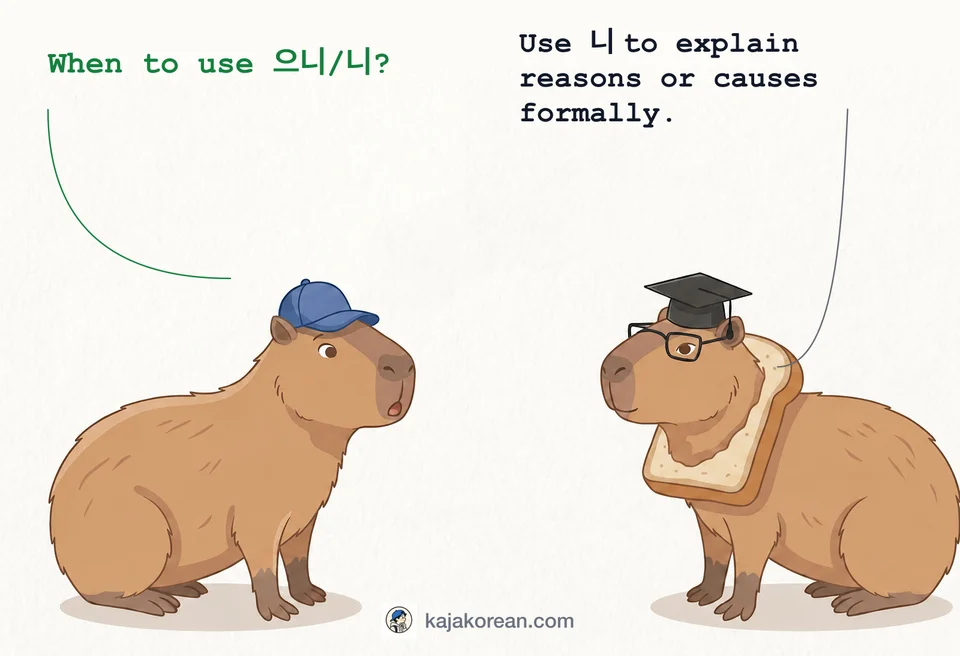
How to use 으니/니 in Korean

Pattern: -(으)니

-(으)니 (-(eu)ni, (eu)ni)

-(으)니 is a connective ending used to express reason or cause, common in daily speech and writing.

Explanation of 니 usage in Korean

Usage guide

When and how native speakers actually use it.

-(으)니(-(eu)ni, (eu)ni)

Expresses the reason or cause of an action or state.

When to use

explaining reasons, stating causes, formal speech

The nuance

Attach '-으니' after consonant stems or '-니' after vowel stems of verbs/adjectives to express cause or reason. It usually appears at the beginning of a sentence, followed by a result or judgment. Commonly used in formal contexts.

Real-world examples

  • 비가 오니 우산을 챙기세요.

    bi-ga o-ni u-san-eul chaeng-gi-se-yo., bi ga o ni u san eul chaeng gi se yo.

    '-으니' correctly attaches to verb stem '오-' to express cause.

  • 날씨가 추우니 옷을 따뜻하게 입으세요.

    nal-ssi-ga chu-u-ni os-eul tta-tteus-ha-ge ip-eu-se-yo., nal ssi ga chu u ni os eul tta tteus ha ge ip eu se yo.

    '-으니' attaches to adjective stem '춥-' to indicate reason.

  • 시간이 없으니 빨리 가자.

    si-gan-i eop-eu-ni ppal-ri ga-ja., si gan i eop eu ni ppal ri ga ja.

    Natural expression for stating reason in polite context.

  • 배가 고프니 밥을 먹자.

    bae-ga go-peu-ni bap-eul meok-ja., bae ga go peu ni bap eul meok ja.

    Natural cause-effect connection in everyday speech.

  • 좋으니 가자.

    joh-eu-ni ga-ja., joh eu ni ga ja.

    Must attach '-으니' after consonant stem; '좋으니' is correct form.

  • 먹으니 배고파요.

    meok-eu-ni bae-go-pa-yo., meok eu ni bae go pa yo.

    The cause and effect relationship is illogical here.

Quick quiz

  1. Choose the sentence that uses -(으)니 to express a reason.

    -(으)니를 사용해 이유를 나타내는 문장을 고르세요.(-(eu)ni-reulsa-yong-haei-yu-reulna-ta-nae-neunmun-jang-eulgo-reu-se-yo., (eu)nireulsayonghaeiyureulnatanaeneunmunjangeulgoreuseyo.)
  2. Which sentence incorrectly uses -(으)니?

    다음 중 -(으)니를 잘못 사용한 문장은?(da-eumjung-(eu)ni-reuljal-mossa-yong-hanmun-jang-eun?, daeumjung(eu)nireuljalmossayonghanmunjangeun?)
  3. What is the correct way to attach -(으)니?

    -(으)니를 붙일 때 올바른 형태는?(-(eu)ni-reulbut-ilttaeol-ba-reunhyeong-tae-neun?, (eu)nireulbutilttaeolbareunhyeongtaeneun?)

More usage guides

View all usage guides →