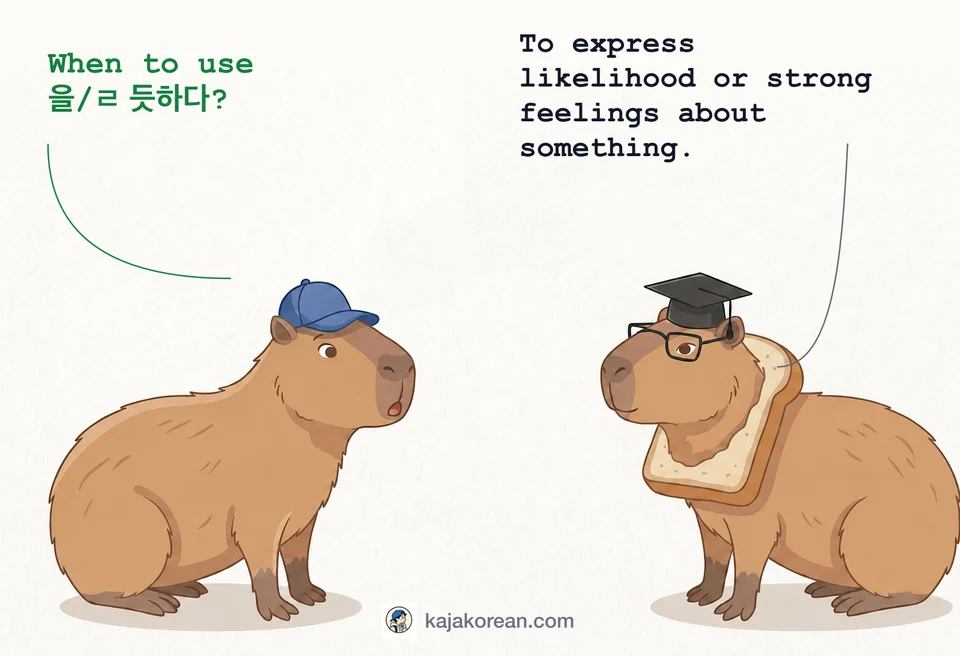
How to use 을/ㄹ 듯하다 in Korean

Pattern: -(으)ㄹ 듯하다

-(으)ㄹ 듯하다 (-(eu)ㄹdeus-ha-da, (eu)ㄹdeushada)

-(으)ㄹ 듯하다 expresses something likely to happen or a strong feeling.

Korean grammar pattern -(으)ㄹ 듯하다 usage

Usage guide

When and how native speakers actually use it.

-(으)ㄹ 듯하다(-(eu)ㄹdeus-ha-da, (eu)ㄹdeushada)

It means something seems about to happen or a strong feeling is felt.

When to use

future speculation, strong emotion expression, situation description

The nuance

Attach -(으)ㄹ 듯하다 to verb or adjective stems to express likelihood or strong feelings. Use -을 듯하다 if stem ends with a consonant, -ㄹ 듯하다 if vowel.

Real-world examples

  • 비가 올 듯해 우산을 챙겼어.

    bi-ga ol deus-hae u-san-eul chaeng-gyeoss-eo., bi ga ol deus hae u san eul chaeng gyeoss eo.

    The verb stem ends with a vowel, so '-ㄹ 듯하다' is correct.

  • 기분이 좋을 듯하다.

    gi-bun-i joh-eul deus-ha-da., gi bun i joh eul deus ha da.

    Correct form attaching '-을 듯하다' to adjective stem ending with consonant.

  • 그가 올 듯해 보인다.

    geu-ga ol deus-hae bo-in-da., geu ga ol deus hae bo in da.

    Natural sentence expressing future speculation.

  • 너무 피곤할 듯해요.

    neo-mu pi-gon-hal deus-hae-yo., neo mu pi gon hal deus hae yo.

    Expresses strong feeling using '-을 듯하다' with adjective.

  • 지금 비가 올 듯할 거예요.

    ji-geum bi-ga ol deus-hal geo-ye-yo., ji geum bi ga ol deus hal geo ye yo.

    Using '-을 듯하다' with future tense '-을 거예요' is redundant.

  • 그가 올 듯이 보여요.

    geu-ga ol deus-i bo-yeo-yo., geu ga ol deus i bo yeo yo.

    '-을 듯이' is different; '-을 듯하다' is the correct expression.

Quick quiz

  1. Which sentence correctly uses '-(으)ㄹ 듯하다'?

    다음 중 '-(으)ㄹ 듯하다'를 올바르게 사용한 문장은?(da-eumjung'-(eu)ㄹdeus-ha-da'reulol-ba-reu-gesa-yong-hanmun-jang-eun?, daeumjung'(eu)ㄹdeushada'reulolbareugesayonghanmunjangeun?)
  2. When is '-(으)ㄹ 듯하다' mainly used?

    '-(으)ㄹ 듯하다'는 어떤 상황에서 주로 쓰이나요?('-(eu)ㄹdeus-ha-da'neuneo-tteonsang-hwang-e-seoju-rosseu-i-na-yo?, '(eu)ㄹdeushada'neuneotteonsanghwangeseojurosseuinayo?)

More usage guides

View all usage guides →