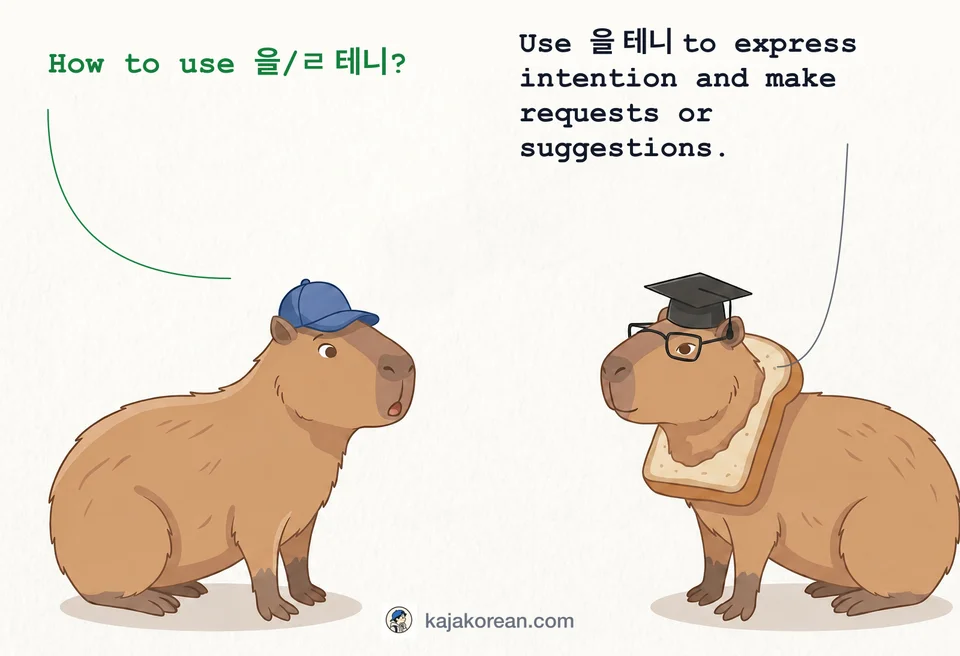
How to use 을/ㄹ 테니 in Korean

Pattern: -(으)ㄹ 테니

-(으)ㄹ 테니 (-(eu)ㄹte-ni, (eu)ㄹteni)

-(으)ㄹ 테니 expresses the speaker's intention or assumption to make a request or suggestion.

Explanation of how to use -(으)ㄹ 테니 in Korean

Usage guide

When and how native speakers actually use it.

-(으)ㄹ 테니(-(eu)ㄹte-ni, (eu)ㄹteni)

A connective ending expressing the speaker's intention or assumption, used to make requests or suggestions.

When to use

Making requests, Making suggestions, Persuading others

The nuance

Attach -(으)ㄹ 테니 to verb or adjective stems to express the speaker's intention or assumption. It is usually followed by a request, suggestion, or command. For example, '내가 도울 테니' (I will help, so...), '너는 준비해' (you prepare).

Real-world examples

  • 내가 먼저 갈 테니, 너는 천천히 와.

    nae-ga meon-jeo gal te-ni, neo-neun cheon-cheon-hi wa., nae ga meon jeo gal te ni, neo neun cheon cheon hi wa.

    Expresses speaker's intention followed naturally by a request.

  • 비가 올 테니 우산을 가져가.

    bi-ga ol te-ni u-san-eul ga-jyeo-ga., bi ga ol te ni u san eul ga jyeo ga.

    Shows assumption followed correctly by a suggestion.

  • 내가 할 테니 너는 그냥 있어.

    nae-ga hal te-ni neo-neun geu-nyang iss-eo., nae ga hal te ni neo neun geu nyang iss eo.

    Speaker's intention followed naturally by a command.

  • 내가 갈 테니 너는 가.

    nae-ga gal te-ni neo-neun ga., nae ga gal te ni neo neun ga.

    The following clause should be a request or command, not a simple statement.

  • 그가 올 테니 기다려야 해.

    geu-ga ol te-ni gi-da-ryeo-ya hae., geu ga ol te ni gi da ryeo ya hae.

    -(으)ㄹ 테니 is for intention or assumption with request/suggestion, not plain facts.

Quick quiz

  1. Which sentence uses -(으)ㄹ 테니 correctly?

    다음 중 -(으)ㄹ 테니를 올바르게 사용한 문장은?(da-eumjung-(eu)ㄹte-ni-reulol-ba-reu-gesa-yong-hanmun-jang-eun?, daeumjung(eu)ㄹtenireulolbareugesayonghanmunjangeun?)
  2. Which is NOT a correct use of -(으)ㄹ 테니?

    -(으)ㄹ 테니의 용법으로 옳지 않은 것은?(-(eu)ㄹte-ni-uiyong-beop-eu-rool-jian-eungeos-eun?, (eu)ㄹteniuiyongbeopeurooljianeungeoseun?)

More usage guides

View all usage guides →