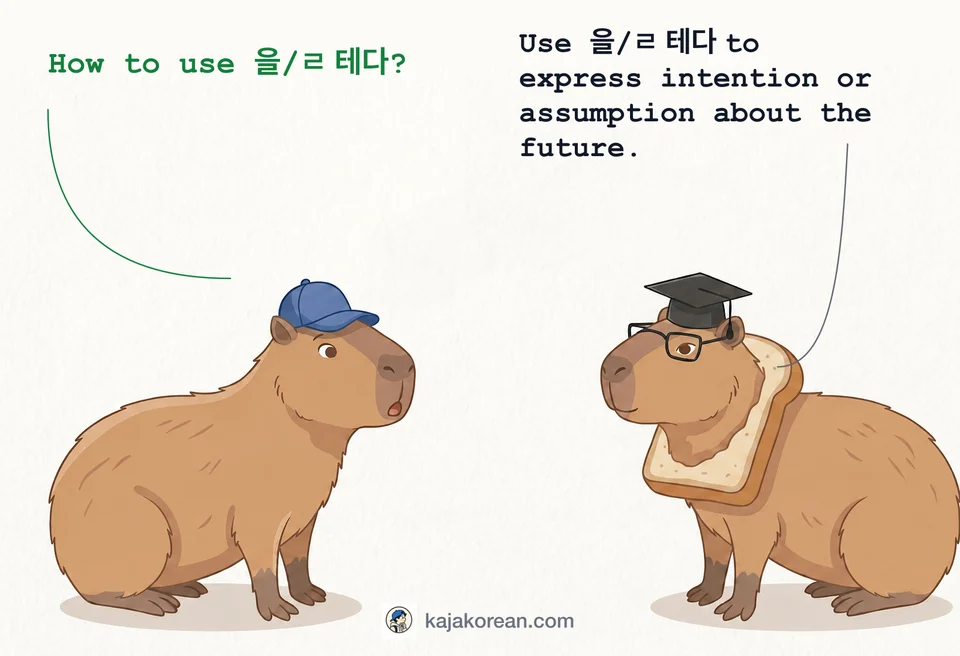
How to use 을/ㄹ 테다 in Korean

Pattern: -(으)ㄹ 테다

-(으)ㄹ 테다 (-(eu)ㄹte-da, (eu)ㄹteda)

-(으)ㄹ 테다 expresses the speaker's intention or assumption about the future. It is used to talk about future situations.

Korean grammar 을/ㄹ 테다 explanation

Usage guide

When and how native speakers actually use it.

-(으)ㄹ 테다(-(eu)ㄹte-da, (eu)ㄹteda)

Expresses the speaker's intention, assumption, or certainty

When to use

Expressing one's intention, Guessing someone else's action, Predicting future situations

The nuance

Attach -(으)ㄹ 테다 to the verb stem: use -을 테다 if the stem ends with a consonant, -ㄹ 테다 if it ends with a vowel. It expresses the speaker's intention or assumption about a future action or situation. It can also be used to guess or assume about someone else's actions or situations.

Real-world examples

  • 내일은 비가 올 테다.

    nae-il-eun bi-ga ol te-da., nae il eun bi ga ol te da.

    Correct sentence expressing a future assumption.

  • 나는 지금 집에 갈 테다.

    na-neun ji-geum jip-e gal te-da., na neun ji geum jip e gal te da.

    Natural sentence expressing the speaker's intention.

  • 그 사람이 늦을 테다.

    geu sa-ram-i neuj-eul te-da., geu sa ram i neuj eul te da.

    Correctly expresses a guess about someone else's action.

  • 나는 밥을 먹을 테야.

    na-neun bap-eul meok-eul te-ya., na neun bap eul meok eul te ya.

    Incorrect form; '-테야' is not a valid ending.

  • 우리가 이길 테다.

    u-ri-ga i-gil te-da., u ri ga i gil te da.

    Natural sentence expressing future certainty.

  • 너는 공부할 테다?

    neo-neun gong-bu-hal te-da?, neo neun gong bu hal te da?

    -(으)ㄹ 테다 is not used in questions.

Quick quiz

  1. Which sentence correctly uses -(으)ㄹ 테다?

    다음 중 -(으)ㄹ 테다를 올바르게 사용한 문장은?(da-eumjung-(eu)ㄹte-da-reulol-ba-reu-gesa-yong-hanmun-jang-eun?, daeumjung(eu)ㄹtedareulolbareugesayonghanmunjangeun?)
  2. What does -(으)ㄹ 테다 mainly express?

    -(으)ㄹ 테다는 주로 어떤 의미로 사용되나요?(-(eu)ㄹte-da-neunju-roeo-tteonui-mi-rosa-yong-doe-na-yo?, (eu)ㄹtedaneunjuroeotteonuimirosayongdoenayo?)
  3. Which sentence is incorrect?

    다음 중 틀린 문장은?(da-eumjungteul-rinmun-jang-eun?, daeumjungteulrinmunjangeun?)

More usage guides

View all usage guides →