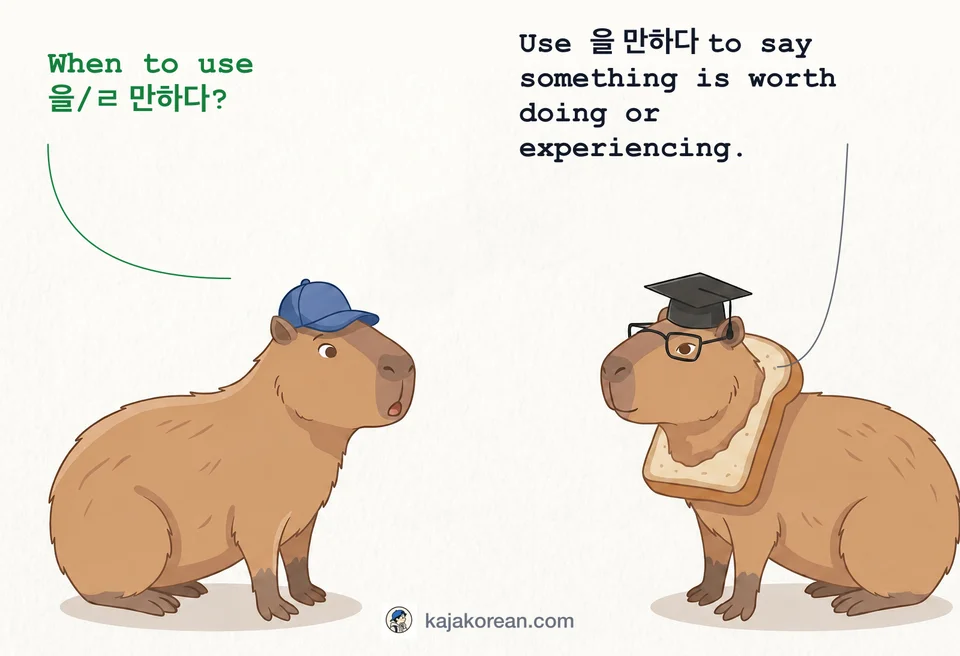
How to use 을/ㄹ 만하다 in Korean

Pattern: -(으)ㄹ 만하다

-(으)ㄹ 만하다 (-(eu)ㄹman-ha-da, (eu)ㄹmanhada)

-(으)ㄹ 만하다 expresses that an action or situation is worth doing or experiencing.

Explanation of 을 만하다 usage

Usage guide

When and how native speakers actually use it.

-(으)ㄹ 만하다(-(eu)ㄹman-ha-da, (eu)ㄹmanhada)

Indicates that something is worth doing or experiencing

When to use

Making recommendations, Expressing experience, Judging value

The nuance

Attach -(으)ㄹ 만하다 to the verb stem to express that an action is worth doing or experiencing. Use -을 만하다 if the stem ends with a consonant, and -ㄹ 만하다 if it ends with a vowel.

Real-world examples

  • 이 영화는 정말 볼 만해요.

    i yeong-hwa-neun jeong-mal bol man-hae-yo., i yeong hwa neun jeong mal bol man hae yo.

    The verb '보다' has no final consonant, so '볼 만하다' is correct.

  • 그 식당은 가을 만해요.

    geu sik-dang-eun ga-eul man-hae-yo., geu sik dang eun ga eul man hae yo.

    The correct form of '가다' is '갈 만하다'. Since no consonant, use '갈 만하다'.

  • 이 책은 읽을 만한 가치가 있어요.

    i chaek-eun ik-eul man-han ga-chi-ga iss-eo-yo., i chaek eun ik eul man han ga chi ga iss eo yo.

    The verb '읽다' ends with a consonant, so '읽을 만하다' is correct.

  • 그 노래는 들을 만하지 않아요.

    geu no-rae-neun deul-eul man-ha-ji an-a-yo., geu no rae neun deul eul man ha ji an a yo.

    Negation uses the same rule; '듣다' ends with consonant, so '들을 만하다' is correct.

  • 여기서 사진을 찍을 만해요.

    yeo-gi-seo sa-jin-eul jjik-eul man-hae-yo., yeo gi seo sa jin eul jjik eul man hae yo.

    The verb '찍다' ends with a consonant, so '찍을 만하다' is correct.

  • 그 영화는 보을 만해요.

    geu yeong-hwa-neun bo-eul man-hae-yo., geu yeong hwa neun bo eul man hae yo.

    '보을 만하다' is incorrect. '보다' has no consonant, so '볼 만하다' is correct.

Quick quiz

  1. Which is the correct expression?

    다음 중 올바른 표현은?(da-eumjungol-ba-reunpyo-hyeon-eun?, daeumjungolbareunpyohyeoneun?)
  2. Fill in the blank: "This food is really ( )"

    "이 음식은 정말 ( )"에 들어갈 말은?("ieum-sik-eunjeong-mal()"edeul-eo-galmal-eun?, "ieumsikeunjeongmal()"edeuleogalmaleun?)
  3. Fill in the blank: "That book is worth reading."

    "그 책은 읽( ) 만해요."("geuchaek-eunik()man-hae-yo.", "geuchaekeunik()manhaeyo.")

More usage guides

View all usage guides →