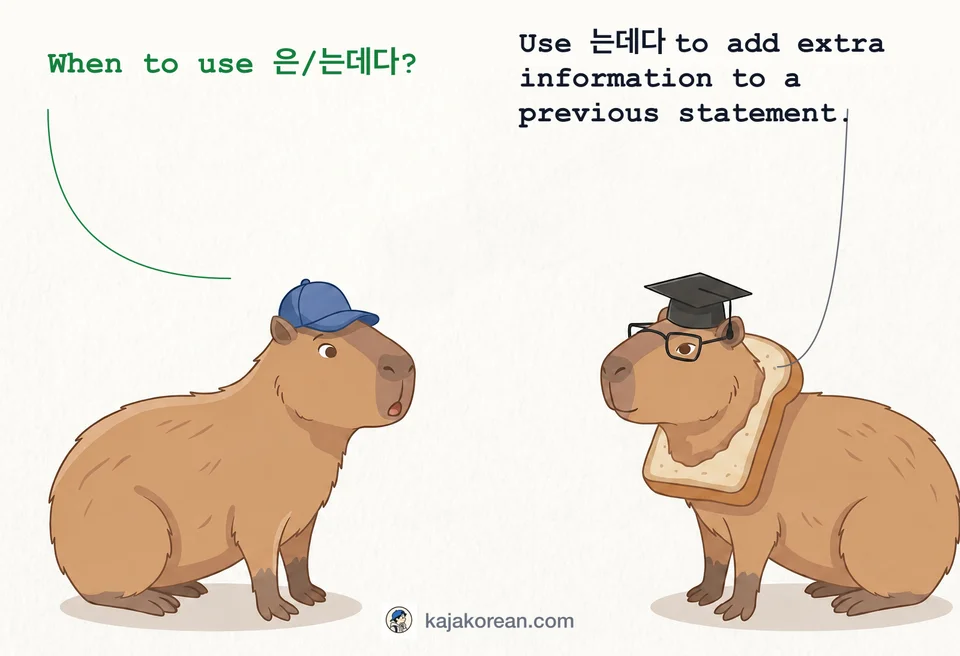
How to use 은/는데다 in Korean

Pattern: -(으)ㄴ/는데다

-(으)ㄴ/는데다 (-(eu)ㄴ, (eu)ㄴ, neun-de-da, neundeda)

-(으)ㄴ/는데다 is used to add new information on top of the previous clause.

Explanation of Korean grammar -(으)ㄴ/는데다 usage

Usage guide

When and how native speakers actually use it.

-(으)ㄴ/는데다(-(eu)ㄴ, (eu)ㄴ, neun-de-da, neundeda)

A connective ending that adds additional information to the previous statement.

When to use

adding information, explaining situations, linking cause and effect

The nuance

Attach -(으)ㄴ/는데다 after past tense verbs or adjectives to add extra information. For nouns, use '-인데다'. It connects additional positive or negative circumstances to the previous clause.

Real-world examples

  • 이 식당은 맛있는 데다 가격도 저렴해요.

    i sik-dang-eun mas-iss-neun de-da ga-gyeok-do jeo-ryeom-hae-yo., i sik dang eun mas iss neun de da ga gyeok do jeo ryeom hae yo.

    Correct use of adjective past form + '-는데다' to add information.

  • 그 사람은 친절한 데다 일도 잘해요.

    geu sa-ram-eun chin-jeol-han de-da il-do jal-hae-yo., geu sa ram eun chin jeol han de da il do jal hae yo.

    Proper use of adjective + '-데다' to add more info.

  • 비가 오는 데다 바람도 많이 불어요.

    bi-ga o-neun de-da ba-ram-do man-i bul-eo-yo., bi ga o neun de da ba ram do man i bul eo yo.

    Correct connection after verb stem + '-는데다'.

  • 그는 학생인데다 아르바이트도 해요.

    geu-neun hak-saeng-in-de-da a-reu-ba-i-teu-do hae-yo., geu neun hak saeng in de da a reu ba i teu do hae yo.

    Correct use of noun + '-인데다'.

  • 이 문제는 어려운데다가 시간이 부족해요.

    i mun-je-neun eo-ryeo-un-de-da-ga si-gan-i bu-jok-hae-yo., i mun je neun eo ryeo un de da ga si gan i bu jok hae yo.

    Correctly connects two negative facts with adjective + '-는데다'.

  • 음식이 맛있는데다가 서비스도 좋아요.

    eum-sik-i mas-iss-neun-de-da-ga seo-bi-seu-do joh-a-yo., eum sik i mas iss neun de da ga seo bi seu do joh a yo.

    Proper use of adjective + '-는데다' for positive addition.

  • 그는 부자인데다가 게으르다.

    geu-neun bu-ja-in-de-da-ga ge-eu-reu-da., geu neun bu ja in de da ga ge eu reu da.

    Incorrect because second clause uses dictionary form verb, not past/adjective form.

  • 날씨가 좋고 데다가 바람도 불어요.

    nal-ssi-ga joh-go de-da-ga ba-ram-do bul-eo-yo., nal ssi ga joh go de da ga ba ram do bul eo yo.

    Incorrect use; '-는데다' must follow past/adjective form, not '고'.

Quick quiz

  1. Which sentence correctly uses -(으)ㄴ/는데다?

    다음 중 -(으)ㄴ/는데다를 올바르게 사용한 문장은?(da-eumjung-(eu)ㄴ, daeumjung(eu)ㄴ, neun-de-da-reulol-ba-reu-gesa-yong-hanmun-jang-eun?, neundedareulolbareugesayonghanmunjangeun?)
  2. What is the correct -(으)ㄴ/는데다 form after a noun?

    명사 뒤에 붙는 -(으)ㄴ/는데다 형태는?(myeong-sadwi-ebut-neun-(eu)ㄴ, myeongsadwiebutneun(eu)ㄴ, neun-de-dahyeong-tae-neun?, neundedahyeongtaeneun?)
  3. Which sentence is incorrect?

    다음 중 틀린 문장은?(da-eumjungteul-rinmun-jang-eun?, daeumjungteulrinmunjangeun?)

More usage guides

View all usage guides →